No-Code vs AI-Generated Software: Who You Hire Next
Orkosi Team · · 11 min read

No-code vs AI-generated software: the decision nobody models
Almost every no-code vs AI-generated software comparison benchmarks the wrong week. They measure time to first screen, time to first login, time to a working form. Those are real numbers and no-code usually wins them. But the decision that actually costs money arrives around month 12, when you need help and you have to find a human being who can touch your product without a six-week ramp.
My position: choose your build substrate based on who you will be able to hire from it, not how fast you can get a landing page live. Speed to first screen is a week-one problem. Hiring is a forever problem.

Why speed comparisons mislead
A no-code platform gives you primitives: a database, a page builder, a workflow engine. Inside those primitives you are extremely fast. Outside them you are stuck, and "outside them" arrives on a schedule you cannot predict, usually the first time a customer asks for something boring like per-seat billing with proration, a webhook retry queue, or a CSV import that does not time out at 40,000 rows.
AI-generated code starts slower because you are producing a real repository, a deployment pipeline, environment variables and all the plumbing a platform hides. The payoff is that the ceiling is wherever your stack's ceiling is, and the people who know that stack are everywhere.
The question that actually separates the two
Ask this instead of "which is faster": if I posted a job tomorrow, how many people on earth could do it, and what would they charge? Everything else in this article is downstream of that question.
Two talent pools, two orders of magnitude
The asymmetry is not subtle. One pool has millions of people in it. The other has thousands.
The general developer market
The U.S. Bureau of Labor Statistics counts software developers, QA analysts and testers in the millions of jobs in the United States alone, with projected growth well above the average for all occupations. That is one country. And within that pool the skills are concentrated: the Stack Overflow Developer Survey 2024 puts JavaScript at roughly 62% of respondents, SQL and Python each above half, and TypeScript around a third.
So if your product is a TypeScript/React front end with a Postgres database, you are hiring from the thickest part of the market. You can find someone in a week, in your timezone, at a rate set by competition rather than scarcity — and you can replace them without the product becoming unmaintainable.
The platform-specialist market
Platform specialists are real and often excellent. Good Bubble developers understand its data model, its workflow engine, and how to keep workload units under control better than a generalist ever would in a month. The problem is not quality, it is depth and liquidity.
No-code platforms do not register in the Stack Overflow survey's most-used technologies at all. There is no equivalent of the 62% number. When you are hiring a Bubble developer, you are fishing in a pool measured in thousands of practitioners worldwide, concentrated in agencies and freelance marketplaces, and the good ones are booked. The no-code developer talent pool is not a bad pool. It is a thin one, and thin pools price accordingly.
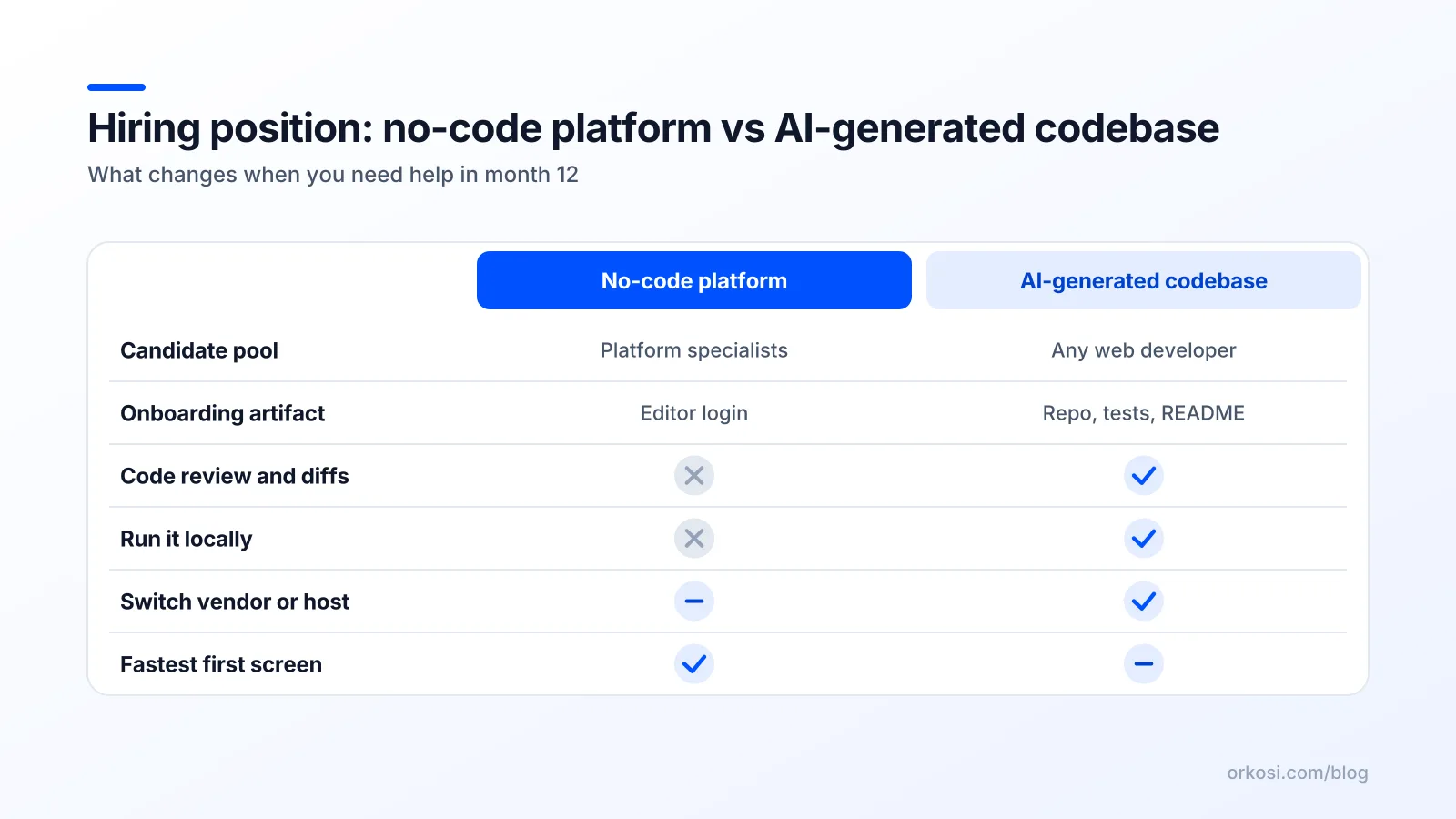
| Hiring criterion | No-code platform | AI-generated codebase |
|---|---|---|
| Candidate pool | Thousands of platform specialists | Millions of general developers |
| Onboarding artifact | A login and a screen-share | A repo, README, tests, CI |
| Ramp to first useful change | Days to weeks (platform idioms) | Hours to days (familiar stack) |
| Replaceability of a contractor | Low: knowledge lives in their head | High: knowledge lives in git history |
| Pricing power | Theirs | Yours |
| Ceiling on features | Platform primitives | Your stack's ceiling |
| Time to first screen | Hours | Days |
What you hand a new hire on day one
Onboarding is where the difference becomes physical. You are handing over an artifact, and its shape determines how fast a stranger becomes useful.
A repository vs a login
With code, you hand over a git URL. The new hire clones it, runs npm install, reads the README, runs the tests, and starts poking. Everything is local, searchable with grep, and legible in an editor they already configured to their taste.
With a no-code app you hand over a login. The logic lives in nested workflow panels that only render inside the vendor's UI. There is no grep. There is no "show me every place we charge a customer". There is clicking, and a screen-share, and you narrating what you built nine months ago.
Reading time before first useful change
Code history is hiring infrastructure, not developer vanity. git blame and git log let a new person ask "who changed this line, when, and why" and get an answer in two seconds without interrupting anyone. Pull request diffs let them propose a change you can review before it touches production. Tests tell them whether they broke something.
None of that has a clean equivalent inside a visual editor. Most platforms offer version snapshots and a rollback button, which is backup, not history. You cannot diff a workflow panel against last month's and see one line changed.
This is also why any plan to hand off a no-code app to developers is really a plan to rebuild it. I have yet to see a hand-off where the receiving team said "great, we'll keep this". They quote a rewrite, because reading the old thing costs more than replacing it.
The lock-in that shows up in salary negotiations
No-code vendor lock-in is usually discussed as data lock-in: can I get my records out? That framing is too kind. The expensive version is people lock-in.
When one contractor knows your whole product
Here is the scenario, and I have watched versions of it three times. A founder builds the MVP themselves, hits the limits of their own patience, and brings in one specialist contractor. That contractor spends four months adding the hard parts: the billing logic, the permission rules, the integration with the warehouse API.
Now the contractor is the only person who knows how the product works, on a platform where the knowledge cannot be read out of the artifact. Launch week arrives. They go on holiday to a place with bad wifi. There is a bug in checkout. Your options are: wait, or pay an unfamiliar specialist a premium to spend three days learning your workflow panels before touching anything.
Pricing power and bus factor
Your bus factor is the number of people who can be hit by a bus before the product stops moving. A thin talent pool plus an unreadable artifact gives you a bus factor of one, and contractors know what that is worth. Rates go up at renewal, not because anyone is acting in bad faith, but because that is what scarcity does.
It also slows hiring in a way founders underestimate. Platform-specific concepts have no transfer value. Explaining Bubble's workload units and plan tiers to a competent generalist is not hard, but it is novel: nothing in their previous ten years tells them how to reason about workload consumption. Meanwhile a generalist joining a Next.js app has already debugged that exact class of problem somewhere else.
For a first technical hire for a startup, this matters more than anything on their CV. You want a hire whose existing skills apply on day one and whose replacement, if it comes to that, is findable.
The honest case for no-code
Now the steelman, because the above is not a universal rule.
Where the platform wins outright
If your product's specification will never exceed the platform's primitives, no-code is faster, cheaper and requires no hire at all. That is a genuinely enormous category. Ignore this article's advice if you are building:
- An internal tool used by your own team, where downtime costs a Slack message
- Forms, intake flows, applications and approval workflows
- A directory, a job board, a members' area, a simple two-sided marketplace
- A prototype whose only job is to be shown to twelve people and then deleted
- Anything with fewer than a few dozen users where the real work happens in a spreadsheet anyway
In those cases the hiring question is moot. The founder maintains it in two hours a month and the platform handles hosting, auth, backups and upgrades. Paying for a repository you have to deploy and monitor would be strictly worse.
Internal tools, forms and the 20-user app
The honest dividing line is whether the product is the business. A no-code ops dashboard inside a code-based company is excellent engineering. A no-code app that is the company, charging customers, handling money, and needing a team in 18 months, is a bet that your roadmap stays inside somebody else's primitives.
The honest case against AI-generated code
AI-generated code is not automatically hireable either. "Any developer can read it" is a claim about your codebase, not about code in general, and plenty of generated codebases fail it.
Inherited code you didn't write
Generated code can be verbose, inconsistent across files, duplicated in three places, and subtly wrong in ways that pass a smoke test. If nobody reviewed it, you have a 40,000-line repository that nobody understands, which is worse than a 200-element workflow panel that one contractor understands.
DORA's research is worth reading honestly here: its 2024 findings associated rising AI adoption with improvements in things like documentation and code review speed, but also with measurable declines in delivery throughput and stability. More code, faster, is not the same as better software. The practices that predict delivery performance are the unglamorous ones: version control, automated testing, small batch sizes, fast feedback.
Review discipline, tests and conventions
Here are the rules that keep a generated codebase hireable. They are cheap to adopt at the start and expensive to retrofit.
- One stack, no exceptions. Pick TypeScript or Python. Do not let a codebase accumulate three ORMs and two state management libraries because different sessions preferred different things.
- Linting and formatting enforced in CI. A new hire should not be able to tell which files were generated in which month.
- Tests on money paths. Signup, checkout, permissions, refunds. You do not need 90% coverage; you need the four flows whose failure costs you customers.
- Plain-English task history. Every change should have a sentence explaining why, so
git logreads as a product narrative, not a wall of "update files". - A README a stranger can follow. Clone, install, seed, run, test. Five commands.
Fail those and you have traded platform lock-in for comprehension debt. Hold them and you have an artifact that the whole BLS-sized talent pool can pick up.
A hiring-readiness test you can run this week
Stop theorising about your build and measure it. Three tests, each with a pass/fail line.

The 90-minute stranger test
Hire a competent developer for two hours. Give them access and one small, real task: change a label on the dashboard and add a field to the signup form. Do not help. Watch.
Pass: the change ships within 90 minutes with no more than one clarifying question. Fail: you spent 45 minutes screen-sharing where things live, or the answer was "I'd need to learn this platform first".
The export test
Export everything. Data, logic, assets, configuration. Then try to run the product, or any meaningful part of it, somewhere that is not the vendor.
Pass: the export is code or structured data that runs elsewhere with work measured in days. Fail: you get a CSV of your database and nothing that represents your logic. That is the moment to price the rewrite you will eventually commission.
The job-post test
Write the job ad for the hire you will need in a year. Post it, or at least search the same keywords on a general job board and a freelance marketplace, and count candidates with relevant experience in your city or timezone.
Pass: 25+ plausible candidates and rates inside your budget. Fail: fewer than 10, or every quote arrives from an agency with a four-week start date.
How Orkosi fits this decision
Orkosi sits deliberately on the code side of this split. Its agents write and deploy a real codebase on AWS that you own, so the hiring pool stays "any competent developer" rather than "specialists in one vendor's editor", while the agents handle iteration, hosting, billing, SEO and the plumbing you would otherwise do yourself.
The templates cover SaaS and web apps, online stores, websites, mobile and desktop apps, image studios and video channels, and you can see what that produces in practice in the showcase. The trade-off is the one described above: a real repository means real responsibilities, so hold the discipline rules rather than assuming generated code is self-documenting. The docs cover how tasks, deployments and environments work, there is an honest comparison with other builders, and plans with credit allowances are on the pricing page.
If your product is a 20-user internal form, a no-code platform is still the better answer. Orkosi is for the case where the product is the business.
FAQ
Is no-code or AI-generated code better for a non-technical founder?
No-code is better if the product will stay inside the platform's primitives and you never plan to hire. AI-generated code is better if the product is the business, because it leaves you with a repository that millions of developers can read, review and extend. The deciding question is not which is easier this month, it is who you can hire in month 12.
Can you hand off a no-code app to developers later?
Rarely without a rewrite. The logic lives in the vendor's visual editor rather than in files, so a receiving team cannot diff it, grep it or run it locally, and most will quote a rebuild instead of a hand-off. Budget for the rewrite from the start rather than assuming a clean migration path.
Is AI-generated code maintainable enough to hire against?
It is, if you enforce the basics: one stack, automated linting, tests on the paths that touch money, and a commit history written in plain English. DORA's research consistently links delivery performance to version control, automated testing and small changes, not to how the code was authored. Without those practices, maintainability degrades fast and you have swapped vendor lock-in for comprehension debt.
What should my first technical hire actually look like?
Hire for your stack, not for your platform: someone who has shipped production software in the language your codebase is written in and can read a repository without a tour guide. Run the 90-minute stranger test before you sign anything longer than a week. If your honest job ad returns fewer than ten plausible candidates, the problem is your build substrate, not your recruiting.
Run the three tests on whatever you are building now, and if the export test fails, start a free build and see what owning the repository changes. Credits, plans and what each one includes are on the pricing page.