Build a SaaS Product Without Code: Skills You Still Need
Orkosi Team · · 12 min read

Plenty of people now ship real software without touching a text editor. You can describe a product in English, watch agents write and deploy it, and have paying customers inside a fortnight. What almost nobody tells you is that the decision to build a SaaS product without code removes the typing, not the thinking. The syntax is gone. The responsibility is not.

"Without code" is not "without engineering"
What actually gets removed
Three things genuinely disappear when AI agents build SaaS products for you: syntax, boilerplate, and the hiring problem. You no longer need to know that a React hook can't be called conditionally, or spend three weeks wiring authentication that 40,000 other products have already wired. You also skip the part where a non-technical founder spends four months and £15,000 finding a contractor who ghosts them in month five. That is a huge amount of removed friction, and it is why agent-built software has stopped being a toy category.
What stubbornly stays
The decisions stay. Which data belongs to which customer, what happens when a card declines, how long you keep deleted records, what you do at 2am when signups stop working. An agent will make every one of those decisions if you don't, and it will make them reasonably, and you will have no idea which way it went.
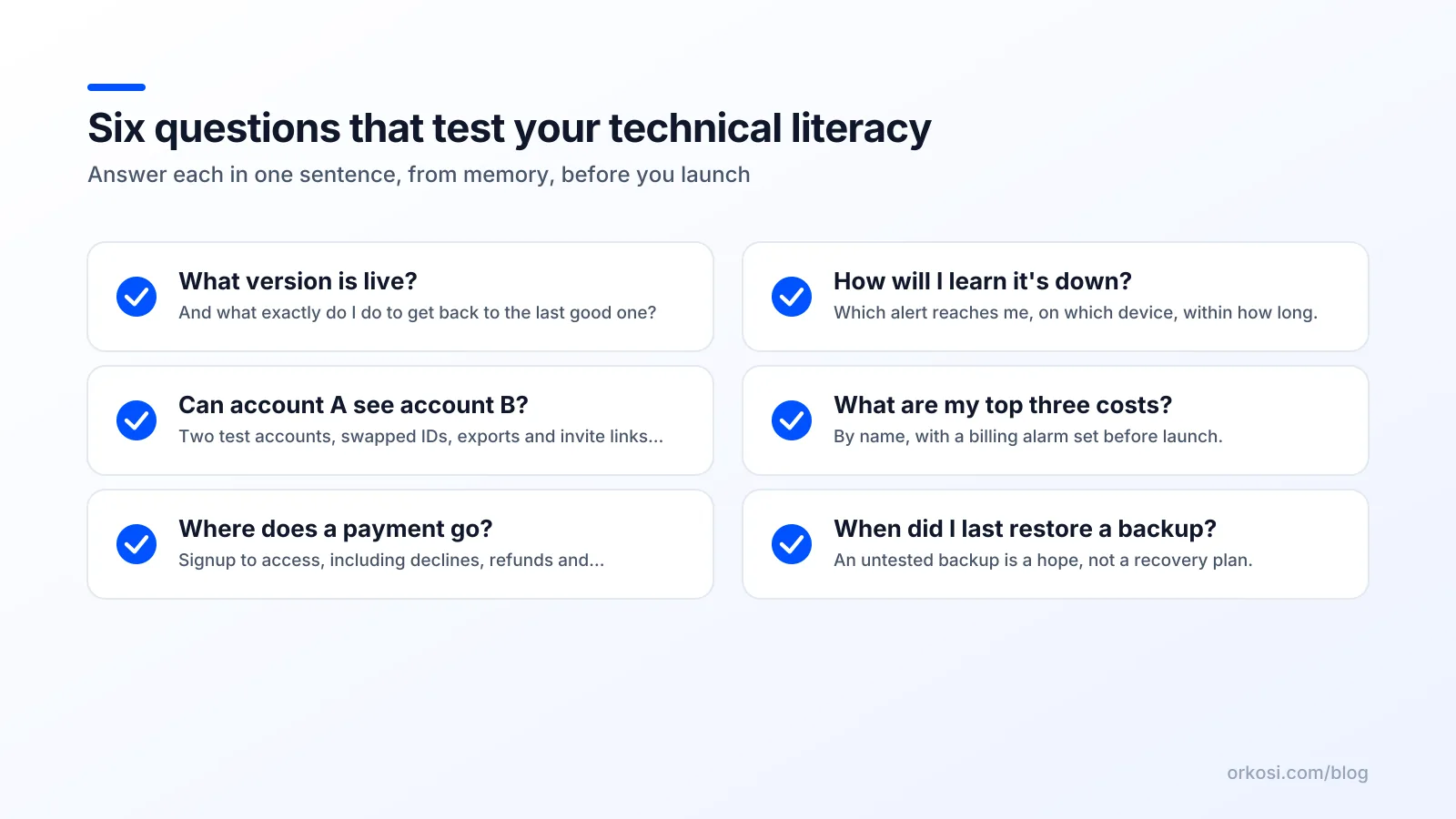
Here is the gap in one sentence: a founder who can describe a feature but can't tell whether it is safely live is not shipping, they're gambling. The difference between those two states is a set of six literacies, none of which require you to read code:
- Releases — what is live, and how to go back
- Permissions — who can see whose data
- Money — the path from signup to bank account
- Observability — finding out before customers tell you
- Cost — the bill as a product decision
- Data lifecycle — backups, restores, exports, deletion
Two prerequisites sit underneath all six: writing a spec an agent can act on, and modelling your data before you build on it. If your entities and relationships are still vague, fix that first; the six literacies below assume you know what a "customer", an "account" and a "subscription" mean in your product. Browsing what people actually build with agents is a fast way to calibrate scope.
Literacy 1: Releases — knowing what is live and how to undo it
Staging, production and the word 'deployed'
Production is the version your customers use. Staging is an identical copy nobody pays for, where changes get tried first. "Deployed" means code moved into one of those two places, and the word is useless until you say which.
This matters because agents move fast. A task that says "add team invites" can touch authentication, email and the database in one pass. If that pass goes straight to production, your customers are the test suite.
The rollback question
Two questions. Keep them permanently loaded:
- What version are my customers on right now?
- How do I get back to the last version that worked, and how long does it take?
"The agent deployed it" is not an answer to either. A founder who never asks for a rollback path will eventually learn their rollback path during an outage, with a support inbox filling up, which is the most expensive possible classroom. Ask for the procedure in writing before your first paying customer, and ask for it to be tested once, on purpose, on a quiet afternoon.
The honest trade-off: insisting on a staging environment and a documented rollback will slow your first week. You will ship your landing page two days later than you wanted. It saves your first bad month, which is a trade most founders would take if anyone offered it to them in advance.
Literacy 2: Permissions — who can see whose data
Multi-tenancy in one paragraph
Multi-tenancy means many customers share one application and one database, separated only by logic. Account 41's dashboard and account 42's dashboard are the same code reading the same tables; the only thing stopping 41 from seeing 42's invoices is a condition in a query. Every feature you add either inherits that condition or quietly breaks it.
This is not an edge case. OWASP ranks broken access control first in its Top 10, noting it appeared in more tested applications than any other category. The most common serious flaw in web software is "the wrong person could see the thing".
The two-account test
You can test this yourself in fifteen minutes, with no code reading, and you should do it after every meaningful feature:
- Create two accounts in production:
founder+a@andfounder+b@. Put distinguishable data in each. - Log in as A. Find a URL with an ID in it (
/invoices/1042,/projects/7). Change the number to one belonging to B. You should get a 404 or a denial, never B's data. - Try the export. CSV and PDF exports are frequently built as a separate code path and frequently forget the account filter.
- Try the invite link. Accept an invite from B's account while logged in as A and see what happens.
- Try a deleted or downgraded account. Cancel B's subscription and confirm B loses access to the right things and keeps access to their own export.
Write the results in a note. Re-run it before every release that touches data. This single habit catches more real damage than any other founder-level check.
Literacy 3: Money — the path from signup to bank account
Billing is the one subsystem you must be able to trace end to end on paper. Not because it is the hardest, but because when it is wrong, you lose money silently and you find out from an accountant months later.
Webhooks are where billing lives
Most founders think billing is the checkout page. The checkout page is 10% of it. The other 90% is webhooks: messages your payment provider sends your app after the fact, saying "this subscription renewed", "this card failed", "this customer cancelled".
Stripe's webhook documentation spells out two facts that matter to you as the owner. Events are retried if your endpoint fails, which means your app can receive the same event twice and must handle it idempotently (processing it twice has the same effect as once). And events can arrive out of order. If nobody thought about either, you get double-granted access, double-counted revenue, or customers who paid and can't log in.
Failure states you must name
Draw your signup-to-access flow on one sheet of paper. Then annotate it with these:
| Failure state | The question to ask the agents |
|---|---|
| Card declined at signup | Does the account exist in a half-created state? |
| Card declined at renewal | How many retries, how is the customer told, when is access revoked? |
| Cancelled mid-period | Do they keep access until period end, or lose it immediately? |
| Plan downgrade | What happens to data above the new limit? |
| Refund issued | Is access removed, and does your revenue number update? |
| Webhook endpoint down for an hour | Do retried events catch up correctly? |
If you cannot answer those six, you do not know whether your revenue is being recorded correctly, and no dashboard will tell you otherwise.
Literacy 4: Observability — finding out before your customers tell you
Logs, errors and uptime, distinguished
Three different things, routinely confused:
- Uptime checks ask "does the site respond?" from outside, every minute.
- Error tracking captures exceptions with a stack trace when code fails, whether or not the site is up.
- Logs are the running narrative of what the application did, useful after the fact and nearly useless as an alert.
A site can be 100% "up" while every signup fails. Uptime alone is comfort, not information.
What to put on one screen
Google's SRE guidance on monitoring distributed systems argues for symptom-based alerting: alert on what users experience, not on internal metrics you can't interpret. For a solo founder that collapses to four signals:
- Can a new user sign up?
- Can an existing user log in?
- Can a payment complete?
- Do the main pages load, and how slowly?
Minimum viable setup before launch: one external uptime check on the login page, error alerts routed to email or Slack, and a standing fifteen minutes each week to actually read the error list. CPU graphs can wait until you have someone who knows what to do about them.
The trade-off goes the other way too. The SRE material is blunt about alert fatigue: a pager that cries wolf stops being read. Three alerts a week that each mean something beats forty that mean nothing. If you find yourself swiping notifications away without looking, you have too many, and you should delete some rather than promise yourself you'll pay more attention.
Literacy 5: Cost — the bill is a product decision
Where spend actually hides
Architecture decisions you delegate are still cost decisions you own. The AWS Well-Architected Framework treats reliability and cost as deliberate trade-offs made by the workload owner, which is you, whoever typed the code.
Spend hides in predictable places: database instances sized for traffic you don't have, data transfer out, object storage that never gets cleaned, log retention set to forever, and AI/LLM calls inside your own product's features. That last one is the new classic. A single "summarise this for me" button with no rate limit is an open invoice to anyone who finds it.
Usage caps as a design choice
Two habits cover most of the risk. First, set a billing alarm before launch, at a number that would make you wince, not a number you expect. Second, be able to name your three biggest line items without looking. If you can't, you are not managing cost, you are receiving it.
Usage caps belong in the product, not the spreadsheet. Decide per plan how many exports, API calls or AI generations are included, and have the agents enforce it in code. Platform-level spend is its own line: with Orkosi, agent work is metered in credits against a monthly plan, and the current figures live on the pricing page rather than in this article, because quoting them from memory is how founders end up with wrong expectations.
Literacy 6: Data lifecycle — backups, restores, exports and deletion
This is the literacy founders skip and regret hardest, because the failure mode is unrecoverable rather than embarrassing. A permissions bug is a bad week. A missing backup is the end of the company.
A backup you haven't restored isn't a backup
Automated snapshots existing in a console is not evidence of anything. The only evidence is a restore. Open a task: restore last night's snapshot into a scratch environment and give me a link to look at it. Then look at it. Is the data there? How old is it? How long did the restore take, start to finish?
Write those three answers down. "We lose at most 24 hours of data and need about 40 minutes to recover" is a sentence a founder can act on. "We have backups" is not.

Deletion is a legal obligation, not a feature
If you have a single user in the EU or UK, GDPR Article 17 gives them a right to erasure, and you have to be able to honour it. "Deleted" in most applications means a flag was set and the row is still there, still in backups, still in your analytics tool, still in the transactional email provider. Decide what you actually mean, before someone emails to ask.
Exports serve two masters. They are customer trust (people pay more readily for software they can leave) and they are your own exit hatch. If Orkosi, or any platform, stops suiting you, a full data export plus owning your code is the difference between migrating and starting over. That portability question is worth weighing when comparing builders.
How to build a SaaS product without code and still own the result
Ask for the explanation, not the code
You will never usefully audit a diff. You can absolutely audit an explanation. After every substantial change, ask: in plain language, what did you change, what could break because of it, and how do I undo it? A good answer names the affected areas and the rollback. A vague answer is itself the finding.
A standing set of questions for every change
Keep a one-page runbook with your environments, your rollback steps, your alert destinations, your restore time and your three biggest cost lines. Before every release, run five questions:
- Is this on staging, and have I clicked it?
- Does the two-account test still pass?
- Does anything here touch billing or access?
- Will I be told if it breaks, and how?
- What's the rollback, and how long does it take?
Twenty minutes. It is the entire difference between a founder with SaaS technical literacy and a founder hoping.
Where Orkosi fits
Orkosi's model suits this way of working because iteration happens as discrete tasks, hosting runs on AWS, and you own the code. Every item above is a request you can make and verify: ask for the staging environment, the rollback procedure, the restore into a scratch environment, the uptime check and error alerts, the customer data export. The platform does the work; the asking is still your job.
The honest trade-off: agents are fast and tireless, and they are also happy to ship a reasonable-looking feature that quietly widens a permission. Speed raises the value of your checks rather than lowering it. The docs are the right starting point for how tasks and environments behave in practice.
FAQ
Can you really build a SaaS product without code in 2026?
Yes, for a very wide range of products: subscription web apps, marketplaces, internal tools, stores and content sites are all routinely built by agents now. The constraint is no longer whether the code can be written, it's whether the owner can judge what has been built. Novel infrastructure, heavy real-time systems and regulated-industry work still benefit from a specialist in the room.
What should a non-technical founder learn before launching?
Releases, permissions, billing flow, basic monitoring, cost and data lifecycle, in that order of urgency. None of these require programming; they require being able to ask a precise question and recognise a vague answer. Budget a weekend to learn the vocabulary and you will be ahead of most first-time technical founders on operational discipline.
Do I need a technical co-founder if AI agents write the code?
Not to ship, and increasingly not to run a small product either. You do need someone, somewhere, who can be called when something looks wrong and you can't tell how wrong: an advisor on retainer, a fractional CTO, a friend who'll answer on a Sunday. The non-technical founder technical skills in this article are what let you use that person for an hour instead of a month.
What happens when the product breaks and I can't read the error?
You copy the error, the time it happened and what the user was doing, and you open it as a task. Agents are genuinely good at diagnosing from a stack trace plus context, which is why error tracking matters more than log reading for a solo operator. The thing that makes this survivable is the rollback path you set up earlier, because reverting to a working version buys you the calm to investigate properly.
Pick one of the six literacies and close the gap this week, starting with the restore drill if you have paying customers. Start free if you want something to practise on, and check pricing when you're ready to run it in production.