AI App Builder for Startups: Build the Boring 80%
Orkosi Team · · 11 min read

A startup app is mostly not a startup. Strip out the parts that thousands of other products already ship, and what remains, the thing a customer would actually miss, is usually a handful of screens and a few hundred lines of logic. That ratio is the single most useful fact for deciding what an AI app builder for startups should do: hand it the repeated 80%, keep your own hands on the 20% that only you can specify.

The uncomfortable truth: 80% of your app is not your idea
Open any B2B SaaS product and count the screens. Sign-up, email verification, password reset, invite teammates, org switcher, roles, billing page, invoice history, settings, notification preferences, search, empty states, 404s, admin impersonation. None of it is your idea. All of it has to exist before anyone can use your idea.
Two terms for the rest of this article:
- Commodity layer (the 80%): features where the correct behaviour is published, standardised, and identical across products. Success is measured against an external spec.
- Differentiated layer (the 20%): features where correct behaviour lives in your head, your customers' workflows, or your market's rules. Success is measured against judgement you have not written down yet.
What the commodity layer actually contains
| Commodity (delegate) | Differentiated (own it) |
|---|---|
| Email/password and OAuth sign-in, sessions, password reset | The core workflow someone pays to use |
| Subscription billing, trials, proration, dunning | Your pricing model and what counts as usage |
| Role-based access, team invites, org switching | Which roles exist and what each may approve |
| Admin tables, search, filters, CSV export | Domain rules, validation, exception handling |
| Transactional email, error logging, backups, deploys | Onboarding sequence that creates the "aha" |
| Marketing site, docs, legal pages | Positioning and what you refuse to build |
The left column is where AI app builder commodity features pay for themselves. The right column is where they quietly cost you.
Why founders overestimate their uniqueness
Founders overweight the part of the product they think about most. You have spent six months on your matching algorithm, so it feels like the product, while auth feels like a detail. In the codebase, the ratio is inverted: auth, billing, and admin typically account for the bulk of files, migrations and tests.
This matters because attention follows perceived importance, and perceived importance is miscalibrated. The practical consequence is founders reviewing login button copy in week three while the pricing rules for their actual product remain three bullet points in a Notion doc.
Why the boring 80% is where AI agents are strongest
Agents are strongest where the problem is conventional, documented and testable. That is not a limitation dressed up as a virtue, it is a straightforward consequence of how these systems learn and how you verify their work.
Well-trodden patterns, abundant training data
Subscription billing is the clearest case. Stripe's subscriptions documentation specifies the object model, webhook events, trial handling and proration behaviour in detail. An agent implementing it is not inventing anything, it is transcribing a published standard into your schema, and you can check the result against the same document.
Identity is similar. Amazon Cognito's pricing page lists per monthly-active-user rates for user pools, which tells you something important: identity is a thing you buy or configure with a published unit cost, not a thing you differentiate on. Nobody has ever churned because a competitor's password reset email was more elegant.
The honest trade-off: conventional also means generic. An agent will give you the standard Stripe checkout flow and the standard settings page. If your wedge is a radically novel onboarding experience, the commodity layer is suddenly part of your 20% and you should treat it that way.
Deterministic acceptance criteria
The second reason agents do well here is that you can write down what "done" means before work starts. "A user who cancels mid-cycle retains access until period end and receives one email" is testable. "The dashboard should feel reassuring" is not.
Developer sentiment tracks this split. In the Stack Overflow Developer Survey 2024, roughly three quarters of respondents were using or planning to use AI tools, yet only around 43% expressed trust in the accuracy of their output, and complex tasks were the most commonly cited weakness. Developers are not confused. They have learned where the tools are reliable.
Temper the optimism with delivery data. The 2024 DORA report found that increases in AI adoption were associated with small decreases in delivery throughput and stability, not increases. Speed of code generation is not the same as speed of shipping working software. Both things can be true: agents can build the commodity layer faster than you can, and your overall delivery can still get worse if you skip review.
Where agents are weakest: stay hands-on here
Some work resists delegation for reasons that have nothing to do with model quality. It resists because the specification does not exist in writing, and an agent cannot read your mind or your customers' habits.
Domain rules nobody wrote down
Every real business has rules that live in someone's head. A freight startup knows that a shipment flagged "hold" on a Friday behaves differently from one flagged on a Tuesday. A clinic knows which fields are legally required and which are merely expected. These rules were never documented because everyone who mattered already knew them.
Agents fill undefined behaviour with the most common pattern from the training distribution. That pattern will be plausible, consistent and wrong in exactly the way that produces a support ticket three months later. This is a limit of specification, not of capability: the same agent will implement the rule correctly the moment you state it precisely.
Edge cases from real customers belong in the same bucket. You discover them by watching usage, not by prompting. No startup MVP scope survives first contact with ten real accounts, and the revisions that follow are judgement calls.
Pricing, permissions and anything with money or law attached
Three boundaries deserve human sign-off regardless of how good the generated code looks:
- Money. Not the billing integration, which is standard, but what you charge for, when usage is counted, and what happens on overage. Those are strategy decisions encoded as code.
- Permissions. Broken access control sits at the top of the OWASP Top 10, with identification and authentication failures close behind. An agent can implement role checks competently, but only you know that a "manager" must not see another region's margin data.
- Legal and compliance surfaces. Data retention, consent, audit trails, jurisdiction. The cost of getting these wrong is not a bug, it is a liability.
And above all, the core workflow, the actual reason someone pays. If an agent could specify that from a one-paragraph prompt, your competitors would already have it.
The 80/20 brief: how to write tasks that exploit the split
The split changes how you write tasks, not just which tasks you write. Commodity briefs name a standard. Core briefs enumerate rules with examples and counter-examples.

Commodity tasks: name the standard, not the behaviour
Bad: "Add billing so users can pay us monthly and it should handle upgrades nicely."
Better:
Implement subscription billing with Stripe Billing. Two prices: Starter monthly, Pro monthly. 14-day trial, no card required. Handle
customer.subscription.updated,invoice.payment_failed,customer.subscription.deleted. Proration on upgrade, downgrade at period end. On three failed payments, downgrade to read-only and send one email. Invoice history on the billing page. Test mode first, with webhook signature verification.
Reusable template: [Standard or provider] + [exact configuration] + [events or states to handle] + [failure behaviour] + [where it appears in the UI]. You are describing which well-known thing to build, not inventing behaviour.
Core tasks: write the rules as examples and counter-examples
Bad: "Build the shipment approval flow."
Better:
Shipment approval. A shipment enters
pending_approvalwhen declared value exceeds £10,000 or the destination is outside the EU. Examples: £12,000 to Manchester → pending. £400 to Lagos → pending. £9,000 to Dublin → auto-approved. Counter-examples: a £12,000 shipment already approved this week by the same manager for the same client does not re-enter approval, it inherits the prior decision. Onlyops_managermay approve. Approvals are immutable and logged with actor, timestamp and reason.
Reusable template: [State and trigger] + [three positive examples] + [two counter-examples] + [who may act] + [what gets recorded]. Counter-examples carry the most information, because they rule out the plausible default the agent would otherwise pick.
How to judge an AI app builder for startups on the commodity layer
Evaluate any builder on whether it ships the full commodity layer to production standard, not on whether the demo looks slick. A tool that generates a pretty dashboard but no backups, no error logs and no rollback has handed you a prototype and called it a product.
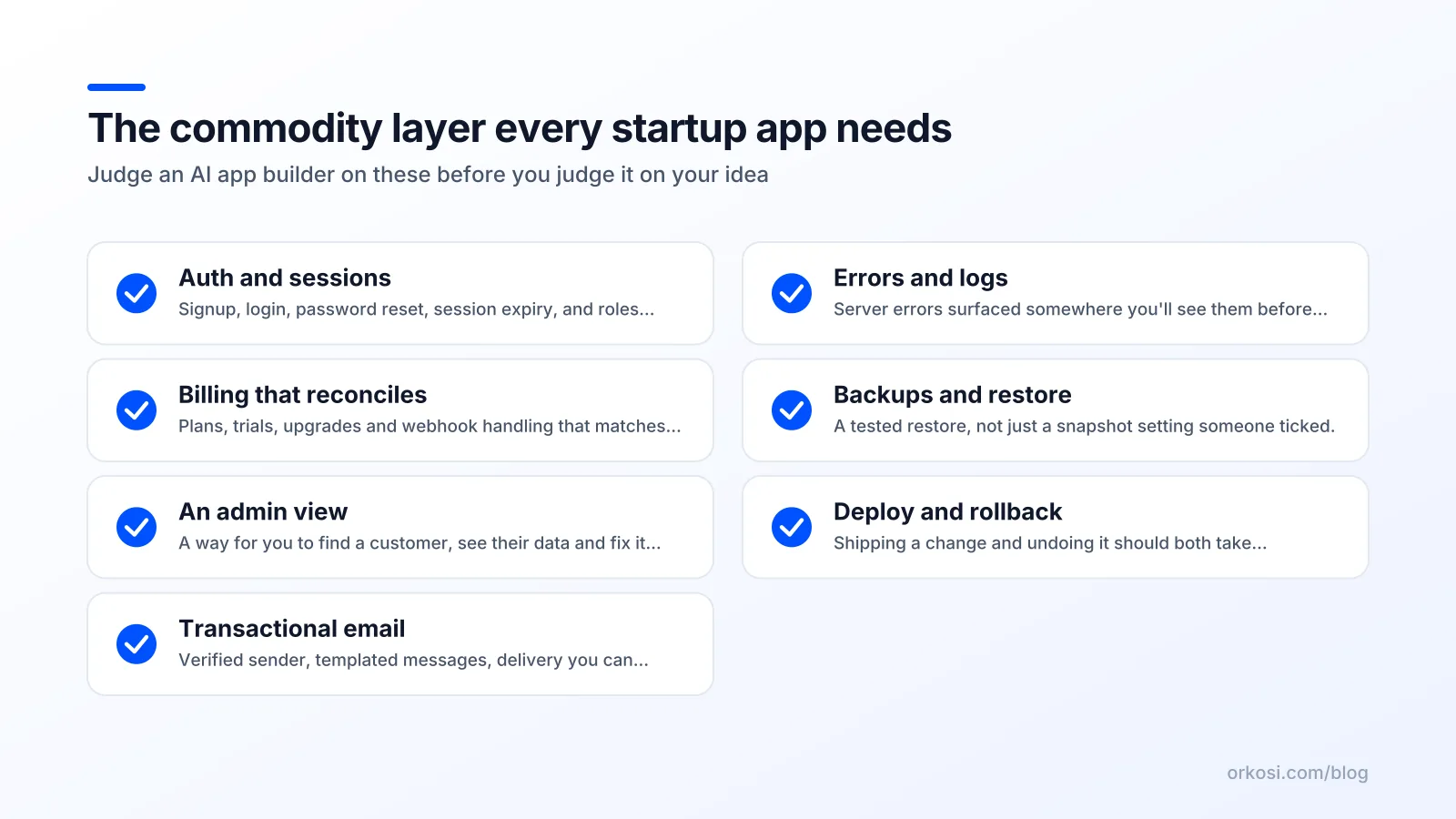
Seven things to check before you commit
| Check | What "done" looks like |
|---|---|
| Authentication | Sign-up, verified email, password reset, session expiry and revocation, OAuth optional |
| Billing | Live subscriptions with trials, proration, failed-payment handling, invoice history |
| Roles and admin | At least two roles enforced server-side, plus an internal view to inspect and fix accounts |
| Transactional email | Deliverable from a verified domain, with templates you can edit, not console logs |
| Error visibility | Server errors captured with stack traces and a timestamp you can search |
| Backups | Automated database backups with a documented restore you have actually tested once |
| Deploy and rollback | One-command deploy, and a way back to the previous version in minutes |
The rollback test is the one most tools fail. Ask directly: what happens at 11pm when the latest change breaks sign-up?
Orkosi is one option here: agents write the code, deploy to AWS, and keep iterating through tasks, with hosting, brand kit, billing and SEO tooling bundled. The trade-off is the usual one for managed platforms, you get the commodity layer and infrastructure handled in exchange for working inside the platform's conventions. If you want to compare that against other approaches, the comparison page and the docs are more useful than any vendor summary, including this one.
The failure mode: spending your 20% budget on the 80%
The common way to waste a build is not picking the wrong tool. It is spending finite founder attention on the commodity layer while the differentiated workflow stays half-specified.
Symptoms in week three
- Your last five tasks were about spacing, copy, or the admin table's column order.
- You can describe your login flow in precise detail and your core workflow in vague adjectives.
- You have no written rules for your own pricing edge cases.
- Nobody outside the team has used the product end to end.
- You are proud of the settings page.
Any two of those together mean you are spending 20% budget on 80% work.
Reallocating attention mid-build
Freeze cosmetic work on commodity screens for two weeks. Accept the ugly-but-working version: a plain table with a search box is fine, an unstyled settings page is fine, generic empty states are fine. None of these will lose you a customer in month one.
Then spend the reclaimed cycles writing the examples and counter-examples for your core logic, and put them in front of five real users. The build vs buy startup features decision is easier once you have accepted that polish on bought features is the most expensive vanity in early-stage software.
What this means for how you staff and spend
Credits, attention and the real scarce resource
Agent iteration is cheap relative to engineering salary. A SaaS boilerplate with AI agents generating and maintaining the commodity layer removes weeks of work that nobody would describe as fun or defensible.
Orkosi's model reflects that: work happens as tasks, paid in credits, where 1 credit equals $0.01. Starter is $25/month with 2,000 credits, Pro is $100/month with 6,000, and there is a free trial; see pricing for current plan detail. The point is not the arithmetic, it is that you can afford to iterate on the boring parts without a hiring decision.
Founder attention does not refill monthly. Treat credits as abundant and your review bandwidth as the constraint, and the allocation becomes obvious: spend credits generously on the commodity layer, spend attention almost entirely on differentiated product features.
When to bring in a human specialist
Bring in a specialist for three things: a security review before you handle real customer data, a data-model review before you have enough rows to make migrations painful, and performance work once you have a query that genuinely hurts. Each is a bounded engagement, days not months, and each covers a risk class where being wrong is expensive and quiet.
Do not hire a specialist to build your auth screens. In 2026 that is like hiring a carpenter to assemble flat-pack furniture: possible, slow, and a misuse of someone good.
FAQ
Is an AI app builder good enough for a startup's core product logic?
It can implement core logic well, but only if you specify it precisely. Agents fill ambiguity with the most common pattern from their training data, which is usually plausible and occasionally wrong in your specific domain. Write core features as explicit rules with positive examples and counter-examples, then review the output yourself. The constraint is your specification, not the model.
Should I use a boilerplate template or let an agent generate the commodity layer?
Start from a template where one exists, then let agents extend it. Templates give you a known-good structure for auth, billing and deploys, which means the agent is editing a working system rather than inventing one. Orkosi works this way, with templates for SaaS apps, stores, websites, mobile and desktop apps. Generating the commodity layer from scratch each time wastes credits and produces more variance.
How do I stop the agent from rewriting my custom logic?
Three practices. Keep core domain logic in clearly named, separate modules so it is obvious what not to touch. State the boundary in the task itself: "do not modify pricing rules in /billing/rules". And review diffs on every task that touches the core, with backups and a tested rollback behind you. Scoped tasks beat broad ones precisely because they limit blast radius.
What should I build by hand in 2026?
Your core workflow's rules, your pricing and usage definitions, your permission model, and anything with legal exposure. Build by hand means specify by hand, since an agent can still write the code once the rules are unambiguous. Everything else, auth, billing integration, admin views, email, logging, deploys, should be delegated or bought. If a competitor could copy a feature from your docs in a week, it is not worth your week.
Pick one differentiated workflow, write it as rules with counter-examples, and let agents handle the rest: start free and see how far the commodity layer gets you in a weekend. Plan and credit details are on the pricing page.