No-Code vs AI-Generated Software: Change Request #50
Orkosi Team · · 10 min read

Every builder looks good on change #1. The honest question in no-code vs AI-generated software is not which route ships a login page faster, it is which route still bends on change #50, eight months in, when a paying customer asks for per-team permissions and your data model was designed for a single user. A change request here means any post-launch edit: a new field, a new rule, a new role, a new integration, a bug fix, a copy tweak. This article is a test of rework cost, not build speed.

Change #1 is a sales demo. Change #50 is the product.
Build-speed demos are rigged, on purpose. They show a greenfield app with no users, no data, no integrations and no decisions you regret. The cost curve that matters starts in month three, once there are rows in the database you cannot delete and customers whose workflow breaks when you rename a column.
By change #50 the work is mostly archaeology. Someone has to find where a rule lives, understand why it was written, change it without breaking three adjacent things, and prove the change is safe. Whichever route makes archaeology cheap wins, regardless of how the first week felt.
No-code vs AI-generated software: what each route actually is
The common framing, visual builder versus text editor, is wrong. The real difference is who owns the runtime and whether a change is expressed as configuration or as diffable source code.
No-code: a hosted runtime you configure
A no-code platform gives you a runtime it operates, plus a visual editor for configuring behaviour inside it. Your app is a set of records in the vendor's system: pages, workflows, formulas, database tables, automations. You rent execution. Pricing is typically metered against app activity, as with Bubble's workload-unit model, where heavier logic and more traffic increase cost. No-code maintenance cost therefore has two components that founders often conflate: the time to make a change and the platform bill that change creates forever after.
AI-generated software: a codebase an agent writes and edits
In the AI-generated route, an agent produces real source code in ordinary languages and frameworks, which is then deployed to infrastructure you control, usually a cloud account. A change is a diff: a set of line-level edits, reviewable, revertable, attributable. The agent is a very fast contractor, not the runtime. If the agent disappears, the repository and the deployment still exist, which is the entire point.
The hybrid everyone forgets: no-code frontend, code backend
A large share of real products are not either/or. An internal ops tool on a no-code canvas can sit on top of a coded API, or a coded product can use no-code for an admin panel and a marketing site. This is often the correct answer, and it is underrated because neither category of vendor markets it.
| No-code | AI-generated code | |
|---|---|---|
| Runtime owner | Vendor | You |
| Change unit | Configuration | Diff in version control |
| Who can change it | Anyone trained on that tool | Any engineer or agent |
| Exit cost | Rebuild | Clone the repo |
The anatomy of change #50: four kinds of edit
Not all change requests are the same shape, and the two routes fail in different places.
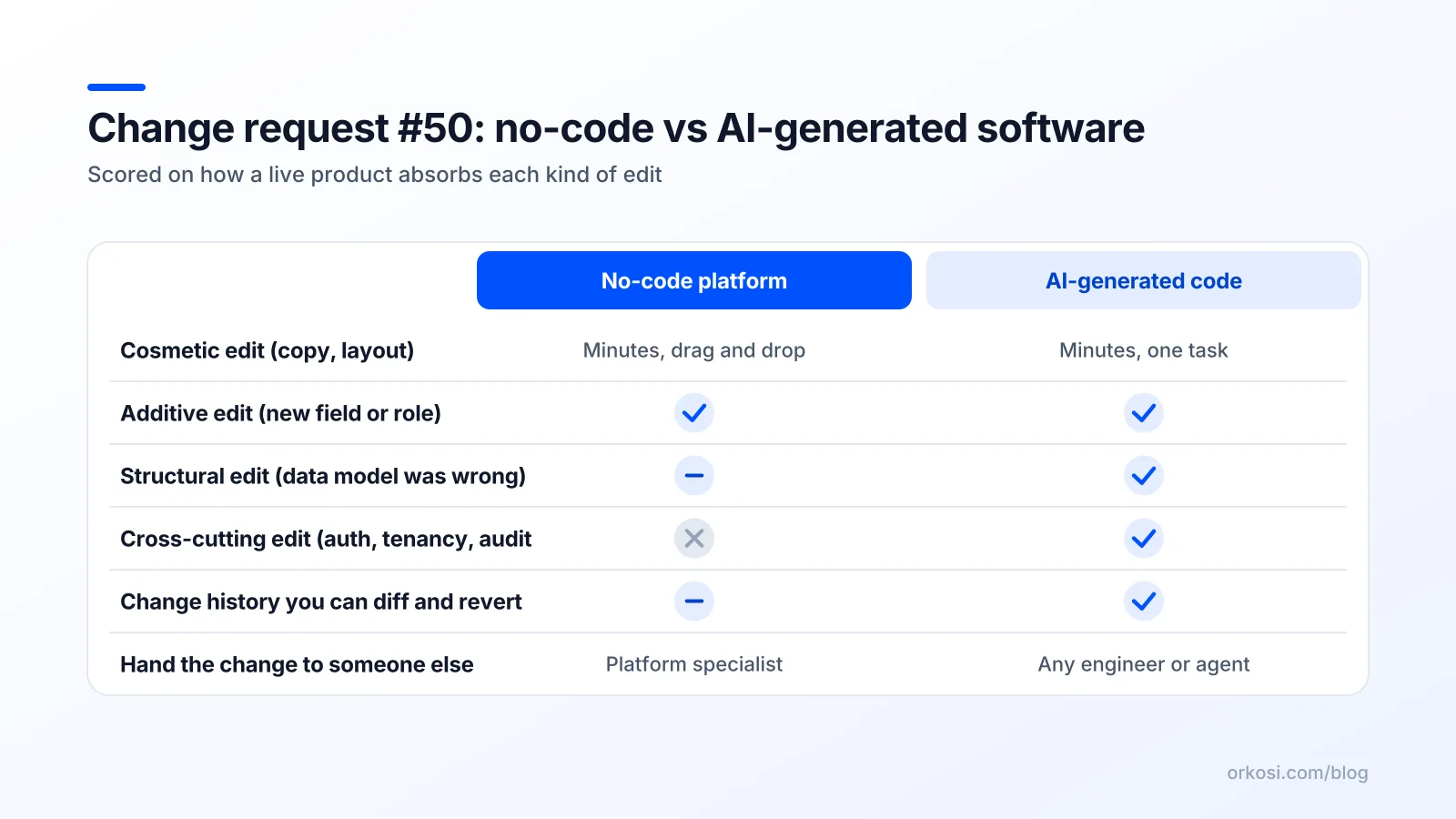
Cosmetic edits (copy, layout, colours)
No-code wins outright. Dragging a field, changing a heading, swapping a colour: minutes, no deploy, no review, no technical literacy required. Asking an agent to change button copy and waiting for a build is slower and sillier. Any honest comparison of no-code vs AI-generated software should concede this lane entirely.
Additive edits (a field, a page, a role)
Still no-code's territory, with an asterisk. Adding a "priority" field to a task is trivial on a canvas. Adding it in a way that updates the list view, the filters, the export, the email digest and the API is where the asterisk bites, because each of those is a separate manual edit with no way to verify you found them all.
In code, the same change is one migration plus a type error in every place that needs updating. The compiler is a to-do list.
Structural edits (the data model was wrong)
This is where the curve bends. "Projects now belong to teams, not users" is a sentence that takes thirty seconds to say and rewires every query, permission check and screen in the app. Changing a no-code app at this level usually means hand-editing dozens of workflows while live data sits in the old shape, because there is no rename-across-project, no staging branch, and often no scripted migration.
An agent on a real codebase can grep, rename, write a migration, update tests and show you the diff. It may do it imperfectly. It will not miss a workflow nobody remembered existed.
Cross-cutting edits (auth, audit logs, multi-tenancy, rate limits)
Cross-cutting means the change touches almost every request path: authentication, authorisation, tenancy isolation, logging, rate limiting. On no-code platforms these are enforced per screen and per workflow, which is exactly why OWASP maintains a Top 10 Low-Code/No-Code Security Risks listing account impersonation, authorisation misuse and data leakage as characteristic failure modes. The risk is not that the platform is insecure, it is that correctness depends on a human applying the same rule in forty places.
Middleware exists for this. It is one of the genuine no-code platform limitations that a canvas cannot express "every request, always, without exception".
Opinion: no-code debt is invisible debt
Here is the position: both routes accumulate debt, but code debt is legible and no-code debt is not. Legible debt can be priced, delegated and paid down. Invisible debt can only be discovered by the next person, usually at the worst moment.
No diff, no review, no blame log
When a coded change breaks production, you read the diff, find the commit, see who or what made it and why, and revert. When a no-code app breaks, you ask in Slack who touched the workflow on Tuesday. Versioning and branching on no-code platforms have improved genuinely in the last few years, but the unit of comparison is usually a snapshot of the whole app, not a readable list of what actually changed.
Logic hidden in 40 workflow steps
Business rules in no-code tools live in three or four places at once: a conditional on a workflow step, a formula in a field, an automation, and a visibility rule on an element. None of them show up in a search for the rule's name because the rule does not have a name. On change #50, the cost is not editing the rule, it is finding all four copies of it.
Undo is a person's memory
AI generated code maintainability has a real failure mode: an agent can produce sprawling, duplicated, badly named code that a human dreads opening. That is debt too, and pretending otherwise is marketing. The difference is that bad code can be handed to any engineer, any linter, any test suite or any other agent and improved incrementally. Bad no-code configuration can only be untangled by someone fluent in that specific vendor's canvas, which is a much smaller labour market.
Where AI-generated code loses, honestly
Drift: the agent re-solves a problem it already solved
Give an unguided agent twenty change requests and it will write three different date formatters, two notification helpers and a second, slightly incompatible permission check. Drift is the signature failure of AI agents making software changes without a spec, a shared module layout, or tests that fail when logic is duplicated.
Confident wrongness on edge cases
Developers in the Stack Overflow 2024 survey's AI section reported heavy adoption alongside limited trust: the single biggest frustration was output that is almost right but not quite, with a large share saying debugging AI-written code can take longer than writing it. Agents are confident about edge cases they have not considered: timezone boundaries, partial refunds, concurrent edits, the second tenant.
The 2024 DORA State of DevOps report found that increased AI adoption was associated with improvements in individual productivity but a measured decrease in delivery stability. The lesson is not "avoid agents", it is that review gates, automated tests and small reversible deploys matter more than model quality.
You now own a runtime, a build and a deploy
Owning the code means owning the pipeline. Someone has to keep the build green, rotate secrets, patch dependencies and handle a failed deploy at 2am. A managed platform that keeps the infrastructure boring is doing real work here, and if you choose the code route without one you have traded vendor lock-in for an operations job.
The test: run your next five change requests through both routes
Stop reading comparison tables, including mine. Run the experiment with your own backlog.
Write the changes down before you choose a tool
Pick five real items from your backlog, not hypotheticals. At least one must be structural (the data model moves) and one cross-cutting (auth, tenancy, billing or audit logging). Write each as a sentence a customer would say. Tool choice made before the list exists is a choice made by a demo video.
Measure time-to-live, not time-to-mockup
Time-to-mockup flatters no-code and time-to-live flatters nobody. Measure from "change described" to "change running for real users with their real data", including the migration, the regression check and the moment you tell a customer it is done.
Score reversibility and blast radius
Reversibility is a legitimate engineering criterion, not a preference: the AWS Well-Architected operational excellence pillar treats small, frequent, reversible changes as a defining property of well-run systems. Score each change on this grid and total it.
| Criterion | Question | Score 1 to 5 |
|---|---|---|
| Time to live | Described to running on real data | |
| Reversibility | Can you undo it in under 10 minutes? | |
| Who can do it | Founder, ops teammate, engineer, agent? | |
| Blast radius | If wrong, who notices and how badly? | |
| Recurring cost | Does this change raise the monthly bill forever? |
If no-code wins your five, use no-code and ignore the discourse. Most founders find it wins the first three items and loses the last two by a wide margin.
What a change request looks like on Orkosi
On Orkosi, a change is a task you write in plain language. Agents edit the codebase, deploy to AWS, and hand you the result to review, so the output is a running app plus source code rather than a configuration you rent. Hosting, the brand kit, billing, SEO and marketing tooling sit alongside the code instead of in four separate vendors.
Templates for SaaS and web apps, online stores, websites, image studio, mobile and desktop apps are starting points rather than ceilings, because change #50 is usually outside whatever the template anticipated. Usage runs on credits (1 credit = $0.01), so a quiet month of small edits and a heavy month of structural work cost differently; current plans and allowances are on the pricing page, and the docs describe how tasks and deploys work in practice.
The honest trade-off: this route is slower than a canvas for pure cosmetics, and you still need to read what the agents did. It is not magic, it is a reviewable diff produced quickly. If you want a side-by-side against other builders, see how Orkosi compares.
The verdict: pick the route that matches your change profile
The decision rule is about your change profile, not your technical ability.
Choose no-code if your product is a stable internal workflow, your users number in the dozens, your changes are cosmetic and additive, and the data model is already correct. You will ship faster and the no-code maintenance cost will stay low because nothing structural ever happens.
Choose an AI-maintained codebase if you expect the data model to move, you sell to other businesses, or your changes touch authentication, billing, permissions and third-party integrations. And take the hybrid seriously: coded product, no-code admin panel is a defensible architecture, not a compromise.
FAQ
Is AI-generated code harder to maintain than no-code?
It is harder to read and easier to fix. Unguided agents produce duplicated logic and inconsistent patterns, which is real debt. But that debt lives in files with version history, so any engineer or agent can find it, test it and refactor it. No-code debt is spread across workflows and formulas with limited diffing, so the only people who can untangle it are specialists in that specific platform.
Can I migrate from a no-code app to AI-generated code later?
Yes, but it is a rebuild, not a migration. You can usually export your data; you cannot export your workflows, formulas or page logic as code. Budget for reimplementing the behaviour from scratch, using the existing app as a live specification. The upside is that the spec is already proven by users, which makes it a good brief for an agent.
How many changes before no-code starts hurting?
There is no magic number, because it depends on change type rather than change count. Two hundred cosmetic edits cost nothing; the first structural edit, such as introducing teams or tenants, can cost more than the original build. Pain usually arrives with the first paying business customer who needs roles, audit trails or an integration.
Do I need a developer to review the agent's changes?
For cosmetic and additive changes, no: check the running app against what you asked for. For anything touching money, authentication, permissions or customer data, get technical review, whether that is a contractor, a fractional CTO or an engineer on your team. DORA's 2024 evidence on delivery stability points the same way: review gates and tests, not model confidence, are what keep AI-assisted delivery safe.
Take five real items from your backlog, score them on the grid above, and then start free to see what change #50 actually costs on a codebase agents maintain. Plans and credit allowances are on the pricing page when you are ready to compare the recurring bill.