Build a SaaS Product Without Code: Budget for Month Six
Orkosi Team · · 11 min read

Most founders who set out to build a SaaS product without code budget for the wrong thing. They ask what the first version costs, get an answer, and plan around it. Six months later the build line item has been paid off and forgotten, while hosting, payment fees, change requests and support hours are quietly compounding. The first version is now the cheapest part of the project, and that single fact breaks the way non-technical founders plan.

What "without code" actually buys you in 2025
The honest definition
Building without code means delegating implementation to AI agents or visual tools. You describe the product, something else writes the database schema, the API, the UI and the deploy pipeline. That is a real and large saving: the work that used to need a contract developer at an hourly rate now happens in minutes.
"Implementation" is the narrow slice. It is typing the code, wiring the services, configuring the server. It is not the project.
What it does not remove
Four jobs stay with you no matter which tool you pick:
- Specification. Deciding what the product does, for whom, and what happens in the weird cases. An agent will faithfully build the wrong thing if you describe the wrong thing.
- Data modelling. What entities exist, what belongs to whom, what happens on deletion. Get this wrong in month one and you pay for it in month five.
- QA and verification. The Stack Overflow Developer Survey 2024 found that while AI tool use among developers is now mainstream, trust in the accuracy of their output is markedly lower than adoption. Professionals check the work. So should you.
- Support. Someone answers the email when a customer's invoice looks wrong. That someone is you.
So the honest version of the pitch is: no-code and AI-agent builds remove roughly the construction cost and leave the ownership cost. Ownership is where the money goes.
The project budget is the wrong mental model
Why "we'll build it for $X" fails
Treating software as a one-off capital project is the most common budgeting mistake non-technical founders make. It comes from the agency world, where a quote is a fixed deliverable: $18,000, twelve weeks, here are the files.
The problem is that the quote describes a snapshot of a product that nobody has used yet. The day real customers arrive, the snapshot is wrong. They ask for annual billing. They want CSV export. Your payment provider deprecates an API. Your data model assumed one workspace per user and your best prospect has four.
A build quote is an answer to a question customers have not asked yet.
Software is a subscription to change
Google's SRE book has a chapter on eliminating toil that makes the point sharply: the repetitive, manual, scaling-with-usage work of keeping a system alive will eat your capacity unless you actively manage it. The construction phase ends. The toil does not.
DORA's State of DevOps research comes at it from the other side: the teams that get good outcomes are the ones with short change lead times and frequent deploys, not the ones that built fast once. Throughput of changes is the metric that correlates with success.
Translate that into founder language: budget a monthly run-rate, not a build price. Your no-code SaaS budget should be expressed as "$X per month for six months, with a decision point at the end," and your SaaS iteration budget should be a standing line, not a contingency.
Where the money goes after launch
Change requests and iteration
This is the biggest and least predictable bucket. A change that sounds tiny in a sentence can be large in a system. "Add a 20% discount for annual plans" touches the pricing page, the checkout flow, the subscription records, the invoice template, the proration logic and the cancellation path.
Expect 8 to 20 meaningful change requests in the first ninety days after launch. Most will come from customers, a few from you noticing something embarrassing. On a platform like Orkosi, each of those is a task that consumes credits, which is the practical shape of AI software maintenance cost: not a retainer, but a per-change meter you can see.
Infrastructure and third-party fees
Hosting is often bundled, which is helpful, but anything metered by usage is not free forever. Model your own numbers with the AWS Pricing Calculator rather than guessing: put in realistic storage, data transfer and database sizes for 100 users, then for 1,000. The shape of the curve matters more than the exact figure.
Payment processing is the fee most founders forget because it does not arrive as an invoice. Stripe's published pricing is per successful transaction plus a fixed amount, which means it scales with revenue, not with build effort. At $2,000 MRR that is a real line item, and it is the one cost that grows exactly when you are feeling good about yourself.
Then the small subscriptions: transactional email, a domain, maybe an error tracker, maybe a help desk. Individually trivial, collectively $30 to $120 a month.
Support, refunds and edge cases
One confused customer can cost two hours. They cannot log in, you cannot reproduce it, you eventually discover they signed up with a Google account and later tried an email password. That is a product bug, a support conversation and a change request in one.
Budget support in hours, not dollars, and assume 1 to 3 hours per week per 50 active users early on. It falls as you fix the top three confusions. It never reaches zero.
Compliance and admin
Unglamorous and non-optional: terms of service, a privacy policy, sales tax or VAT handling for cross-border sales, a business bank account, bookkeeping. If you take EU customers you have data-protection obligations regardless of how the software got built.
Most of this is a few hundred dollars once plus a modest monthly accounting cost. The failure mode is not expense, it is discovering it in month five during a sales call.
A six-month budget you can actually defend
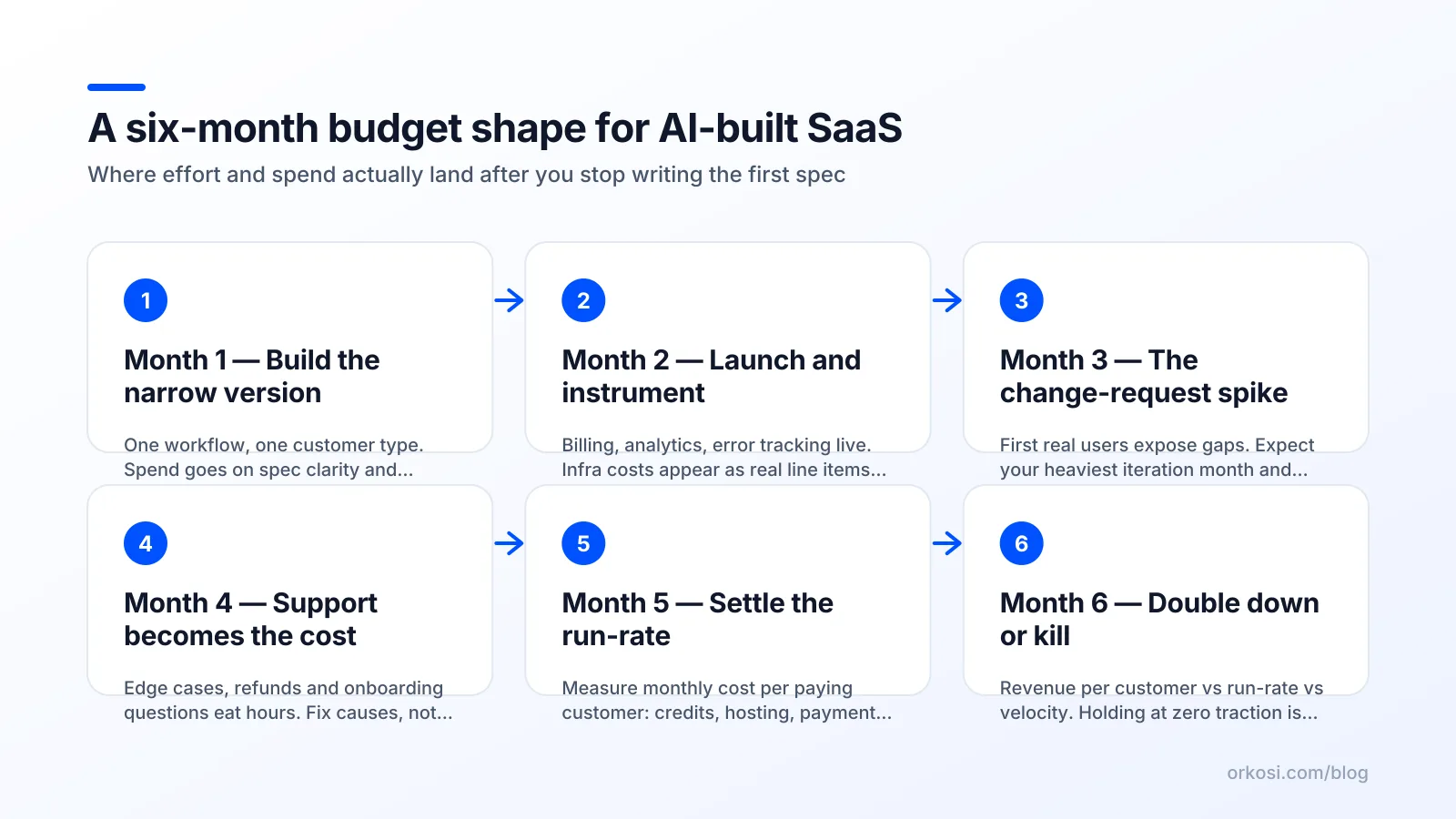
Here is a planning framework that survives contact with reality. The dollar figures below are illustrative of the non-Orkosi costs; for current plan and credit details, check Orkosi pricing rather than trusting a number in an article.
| Phase | Work shape | Typical non-platform costs |
|---|---|---|
| Month 1-2 | Build, test, launch. 20-40 tasks. Heavy specification effort. | Domain, email sending, legal docs: $150-400 one-off |
| Month 3-4 | Change-request spike. 15-30 tasks. First real support load. | Payment fees begin, metered infra appears: $40-150/mo |
| Month 5-6 | Steady state or stall. 5-15 tasks. Decision prep. | Flat run-rate plus fees that track revenue |
Month 1-2: build and launch
Your effort goes into specification, not construction. Write down the data model in plain English before you ask for anything to be built: who owns what, what a "project" or "order" or "client" actually is, and what happens when someone deletes one.
Task volume is high here because you are iterating on a thing nobody has used. That is fine. It is the cheapest time to change your mind.
Month 3-4: the change-request spike
Almost every founder is surprised by this. Costs go up after launch, not down, because real usage generates requirements you could not have invented. This is the month where a project-budget mindset falls apart and a run-rate mindset holds.
On Orkosi, credits are consumed per task, at 1 credit = $0.01, so a month of heavy iteration draws down faster than a quiet month. The Starter plan includes 2,000 credits a month and Pro includes 6,000; the honest read is that a launch-and-iterate period looks like Pro and a maintenance period looks like Starter. Hosting is included in the plan either way, which removes one variable from the forecast.
Month 5-6: steady state or dead weight
By month five the change curve flattens for one of two reasons: you have fixed the things customers complained about, or nobody is using it. Those look identical on a credit statement and completely different on a revenue statement. Track both.
Steady state for a small B2B SaaS with a handful of paying customers is realistically a platform plan plus $50 to $200 of fees and subscriptions. That is your how much does it cost to run a SaaS answer at small scale, and it is an order of magnitude below what the same product cost to run in 2015.
Two things worth overspending on, three that aren't
Worth it: instrumentation and billing correctness
Spend here. Analytics and error tracking shorten every future iteration loop, because the alternative to data is argument. If you can see that 70% of signups never create a first record, you know what next month's tasks are. If you cannot, you will spend those tasks on guesses.
Billing correctness is the second. A product that charges the wrong amount generates refunds, chargebacks, support hours and lost trust, and each of those is more expensive than the task that would have prevented it. Test the upgrade path, the downgrade path, the failed-card path and the cancellation path with real card numbers before you tell anyone the product exists.
Skip: custom design systems, mobile on day one, your own admin panel
A bespoke design system before product-market fit is pure burn. Use the brand kit, pick a consistent component style, ship. Nobody has ever churned from a B2B tool because the spacing scale was ordinary.
Mobile on day one doubles your surface area and your bug count for an audience you have not validated. Build the web app, find out whether anyone opens it on a phone, then decide. Platforms that support mobile templates will still be there in month four; see what you can build when you are ready.
Your own admin panel is the sneakiest one. Founders build internal tooling because it feels productive and no customer ever sees it. Query the database directly, run a task when you need something changed, and revisit at 200 customers.
The month-six decision: double down, hold, or kill
Three numbers that decide it
Put these on one line and look at them without flinching:
- Revenue per active customer per month. Not total revenue. Per customer, so you know whether the model works at any scale.
- Monthly run-rate. Platform plan plus metered infra plus payment fees plus subscriptions. One number.
- Iteration velocity. Tasks shipped per month, and whether the requests coming in are from customers or from you.
Double down when revenue per customer times customers is trending toward run-rate and the requests are customer-driven. Kill or park when it is not.
Why holding is usually the worst option
A product costing $150 a month to run with two unpaid users is not a business, it is a hobby with an invoice. Holding costs you the run-rate and the attention, which is the scarcer resource.
Founders resist killing because they are thinking about the sunk build cost. With AI-built software that logic is inverted: the thing that was expensive to build in 2015 is cheap to rebuild in 2025. You can export the spec, park the product, and if the market changes, have a new version standing in days. Killing is reversible now. Drift is not.
When a different route is genuinely cheaper
Off-the-shelf SaaS plus a spreadsheet
Test: can you name three mature competitors doing roughly what you want, and would you be a happy customer of any of them? If yes, buy one. A $30/month tool plus a well-organised spreadsheet beats a custom build for most internal workflows, and you get someone else's support team.
Build when the workflow is your differentiator or when you are selling the software itself.
A fixed-scope agency build
Test: is the scope genuinely frozen? A regulatory filing tool with a published spec, a one-off migration, a conference site. If the requirements cannot change, a fixed-price build is a reasonable purchase and the ongoing cost really is near zero.
Almost no customer-facing product passes this test. If yours does, take the fixed quote.
Classic no-code tools
Test: does the whole thing fit forms, tables and views? Internal CRUD apps, approval workflows, simple directories. Form-and-table builders are fast and cheap for exactly that shape.
They get expensive at the edges: custom billing logic, unusual data relationships, per-seat pricing at scale, or anything needing real backend control. That is the boundary where agent-built code on your own infrastructure starts to win, and it is worth reading an honest comparison of Orkosi and other builders before committing either way.
FAQ
How much does it cost to build a SaaS product without code?
The cost to build a SaaS product with AI splits into a platform subscription, metered infrastructure and third-party fees, not a one-off build price. A realistic first six months for a small product is a monthly plan plus roughly $40 to $200 a month in payment processing, email, domains and metered usage. See Orkosi pricing for current plan and credit figures.
Why do costs rise after launch instead of falling?
Because real users generate requirements that specification cannot anticipate. Launch is when the change-request volume peaks, support begins, and usage-based infrastructure and payment fees start appearing. This matches the operational pattern described in Google's work on eliminating toil: running a system costs more over time than building it.
Can I pause a product and restart it later?
Yes, and it is often the right call at month six. Keep the specification, the data export and the domain, drop back to a lower plan or stop active iteration, and restart when you have a reason. The practical details of plan changes and task handling are in the Orkosi docs.
Do I own the code if an AI agent wrote it?
You own the product you commission, including the code deployed to your infrastructure. The important question to ask any platform is whether you can export the codebase and move it elsewhere, because that is what makes the ownership real. Check the terms before you commit, on Orkosi or anywhere else.
Pick a six-month run-rate you can defend, not a build quote you will forget. Start free and model the numbers yourself against current plans and credit allowances.