Launch a SaaS Product Checklist: The First 72 Hours
Orkosi Team · · 11 min read

The launch a SaaS product checklist that ends at 'press publish' is the wrong checklist
Launch is not a marketing moment, it is an operating shift. Most of what you find when you search for a launch a SaaS product checklist is a list of things to publish: landing page copy, Product Hunt assets, a waitlist email, a tweet thread. Those matter for about four hours. What determines whether launch week is a win or a quiet disaster is whether you can see your product failing, and whether you can undo the thing you just shipped.

What typical launch lists cover
The standard list covers acquisition: SEO basics, social posts, outreach emails, a demo video, pricing page copy. It usually includes a vague "test everything" line and a reminder to set up analytics. None of that is wrong. It is just the half of the job that happens before anyone can hurt you.
What actually goes wrong in the first three days
The failure modes are boringly consistent. Payment webhooks fail silently, so people are charged but never provisioned, and you find out from a tweet. The signup funnel has a dead end on one browser or one email provider, so your conversion rate looks like bad marketing rather than a broken form. Transactional email lands in spam, so password resets never arrive. And one angry customer has nowhere to reach you, because the "contact" link goes to a form you never wired to an inbox.
The plan below is a 72-hour operating schedule you can copy: one pre-flight window and four windows after the announcement, each with a single job.
My position: nothing ships until it has a signal, an owner and an undo
Every item on your launch list should pass a three-part test. If it cannot pass, either fix that or accept that this part of your product is unmonitored and you will learn about failures from customers.
Signal: you can see it fail
A signal means a failure produces a visible artifact without a human looking for it: an alert, an error in a tracker, a row in a dead-letter queue. Google's SRE book makes the case for alerting on symptoms users actually feel rather than on every internal metric, and for launch day that advice collapses to four things: is the site up, are requests erroring, is signup completing, is billing recording events.
Owner: a named human, even if it's you
Owner means one person is responsible for responding, with a stated window. Solo founders skip this because it feels absurd to assign yourself. Write it down anyway, because the useful part is the hours: "I respond to alerts between 07:00 and 23:00, outside that the site degrades until morning" is a real decision. An unwritten expectation that you are always awake is not.
Undo: rollback measured in minutes, not evenings
Undo means you can return to the last known-good state in under ten minutes without thinking hard. DORA's research consistently finds that change failure rate and time to restore service separate high performers from everyone else, not deploy frequency alone. A launch is a spike in change failure risk, so the undo path is the single highest-value thing you can rehearse.
The honest trade-off: applying this test adds roughly a day before launch. You will test a renewal, replay a webhook, deploy twice, and write a refund policy you hope not to use. That day is cheap compared with a weekend of refunds and apology emails, but it is a real delay and you should make it knowingly.
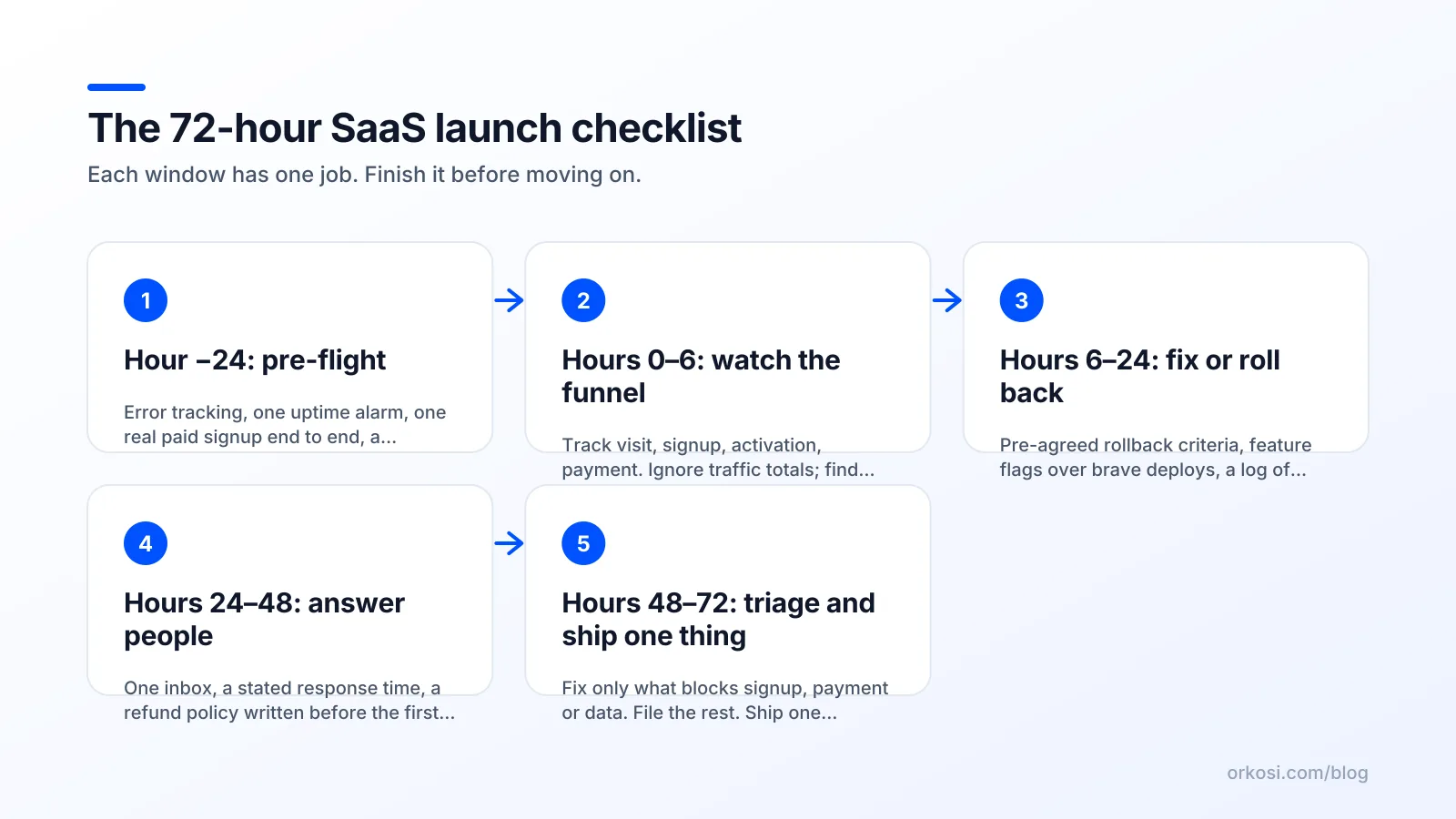
Hour minus 24: the pre-flight items that are not theatre
This is the only part of the launch a SaaS product checklist that must be complete before you announce. It is short on purpose.
| Item | Done when | Time |
|---|---|---|
| Error tracking | An unhandled exception in production appears in your tracker within 60 seconds, with a stack trace | 30 min |
| Uptime check | An external check hits a real endpoint every minute and emails or texts you after two failures | 20 min |
| 5xx alarm | A metric alarm fires on server errors above a threshold over a 5-minute window | 30 min |
| Paid signup end to end | A stranger-equivalent account signs up, pays and reaches first value | 45 min |
| Webhook replay tested | You can resend a billing event and the system handles it idempotently | 45 min |
| Email deliverability | Signup and reset emails reach a Gmail inbox and an Outlook inbox, not spam | 30 min |
| Deploy path used twice | Two successful staging-to-production deploys and one rollback, today | 60 min |
Error tracking and one uptime check
Install one error tracker and trigger a deliberate exception so you know the pipeline works. Then add one external uptime check and one server-error alarm. On AWS the mechanics are documented step by step for creating an alarm that sends an email through SNS. Two alarms is correct for launch. Twelve alarms means you will mute the channel by hour three.
Payment webhook replay and a test subscription that actually renews
Billing is where silent failure lives. Stripe retries failed webhook deliveries with backoff and expects your endpoint to be idempotent, because the same event can arrive twice; the webhooks documentation covers retries, signature verification and event replay. Three concrete checks: verify signatures and return 2xx fast, store the event ID and ignore duplicates, and use a test clock or a short trial to watch one renewal actually succeed. Then deliberately break your handler, let an event fail, fix it, and replay the event from the dashboard. If you cannot replay, webhook failures at launch become invisible revenue loss.
Transactional email deliverability
Send your signup confirmation, password reset and receipt to a Gmail address and an Outlook address from a fresh domain. Check SPF, DKIM and DMARC records are published and aligned. A password reset that lands in spam looks identical to a product nobody wants.
A staging-to-production path you've used at least twice
Deploy today. Twice. Then roll back once and time it. If the number is over ten minutes, your undo is a story, not a plan.
Hours 0–6: watch the funnel, not the traffic
Traffic dashboards are the wrong place to look in hour one. Concurrent visitors tell you the announcement worked, which you already know. The question is whether a stranger can sign up, pay and reach first value.
The four events worth instrumenting
Four events, named consistently: visit_landing, signup_completed, activation_reached, payment_succeeded. Activation is the specific moment your product becomes useful: first project created, first file processed, first store published. If you instrument nothing else, instrument these, because every launch-day diagnosis is a ratio between two of them.
Signup-to-first-value drop-off
Read the funnel with small numbers and tight loops. 120 visits and zero signups after 40 minutes is a broken form, not weak copy. 30 signups and zero activations is an onboarding dead end. Six signups and one payment is normal variance and tells you nothing yet. The pattern that justifies panic is a hard zero where a non-zero is expected.
What to do when the first error lands
Classify it in one question: does it block signup, payment or data integrity? If yes, it is an incident and you work it now. If no, it goes in the change log as a task and you keep watching the funnel. Most hour-one errors are browser-specific CSS, bot traffic hitting old routes, or a 404 from your own announcement typo.
Hours 6–24: fix forward or roll back, decide in advance

Your rollback plan for first release is a decision rule, written before launch, because at 2am with customers watching you will choose whichever option feels brave rather than whichever is reversible.
The two-strike rule for hotfixes
Two attempts, thirty minutes total. If the second hotfix does not resolve a funnel-blocking bug, roll back to the last known-good deploy and reopen the problem in daylight. Every additional hot patch under stress raises change failure rate, exactly the metric DORA ties to poor delivery outcomes. Rolling back is not defeat, it is the cheap path.
Feature flags beat brave deploys
Ship the risky parts behind flags so your undo is a config toggle rather than a deploy. Flags let you disable the new onboarding variant, the referral page or the AI feature that is burning tokens, without touching the code path that takes money. Keep a change log for the full 72 hours: timestamp, what changed, who triggered it, how to revert.
Writing the one-paragraph incident note
Borrow the SRE framing and shrink it. The incident response chapter of the SRE workbook argues for declaring incidents early and keeping a running record; for one person that is a single note per incident with five lines: time detected, symptom users saw, scope, action taken, current status. It takes four minutes and it is the only reason you will remember on Thursday what you did on Tuesday.
Hours 24–48: support is a product surface
By day two the traffic spike is over and the humans arrive. Support quality now does more for retention than any feature you could ship this week.
One inbox, one promise, one response time
One channel, reachable from inside the app and from the marketing site, going to an inbox you actually read. State the promise publicly: "we reply within 4 hours, 08:00 to 22:00 UTC". A slow, honest window beats an implied instant chat you cannot staff. That is also the practical answer to on-call for solo founders: publish your hours and let the rest wait.
Refunds and credits: decide the policy before the email arrives
Write the policy at hour minus 24, not when the email lands. Mine: full refund on request, no questions, within 30 days, processed the same day. A refund issued in ten minutes buys more goodwill than a perfect bug fix shipped in three days, because the customer's actual complaint is being out of pocket and ignored. Credits are for people who want to stay; refunds are for people who want out.
Logging every question as a task, not a thought
Every conversation ends with a tracked item: a bug, a doc gap, or a copy fix. Three people asking where the export button lives is not three support tickets, it is one navigation bug. Keeping support in your head is how week two becomes amnesia.
Hours 48–72: triage signal from noise and ship one thing
Scoring the feedback you got
Use one rule. Does it block payment, block signup, or risk data integrity? Fix now. Everything else is filed.
| Signal | Example | Action |
|---|---|---|
| Blocks payment | Card declines on renewal, webhook not provisioning | Fix now |
| Blocks signup | OAuth fails on Safari, reset email in spam | Fix now |
| Data integrity | Wrong tenant's data visible, lost uploads | Fix now, before anything else |
| Friction | Confusing empty state, unclear pricing copy | Ship one, file the rest |
| Preference | "I'd use this if it had Slack integration" | File, count mentions |
The one change that earns the week
Before day four, ship exactly one visible improvement that came from a real user, and tell the people who asked for it. One is the right number because it proves you listen without blowing the post-launch monitoring checklist you are still running.
What you deliberately leave broken
Name the things you are not fixing: the mobile layout on tablets, the admin export, the second payment method. Write them down as explicitly deferred. Most launch feedback should be filed rather than acted on, because launch-day users are disproportionately curious tourists, and building for tourists is how products drift.
Running the 72 hours when agents build the product
Why the checklist gets easier, not shorter
When agents write and deploy the product, the pre-flight work shrinks because hosting, deploys and billing come with the platform rather than being assembled by you. On Orkosi, the app is deployed on AWS and billing is wired in, so the items you would otherwise spend a day on arrive configured. The checklist does not get shorter, it gets faster: you still verify the paid signup, still replay a webhook, still time a rollback, because verification is the point.
Turning launch-day findings into tasks
The useful difference is cycle time. Each finding from your funnel or your inbox becomes a task in the agent loop, so a copy fix or a broken redirect can ship the same afternoon instead of waiting for your next free evening. The Orkosi docs cover how the task loop and deploys work, and the comparison with other builders is the honest place to check whether that trade-off suits you, because agent-built code means less of it is in your head.
What still needs a human decision
Three calls stay yours no matter who writes the code: whether to roll back, whether to refund, and what to prioritise on day three. Those are judgement about customers and risk, not engineering throughput. An agent platform makes a launch a SaaS product checklist cheaper to execute; it does not make the decisions.
FAQ
What should be on a launch day SaaS checklist if I only have four hours?
Spend it on signal and billing. In four hours you can install error tracking and trigger a test exception, add one external uptime check with notification, complete one real paid signup from a different browser and card, confirm signup email reaches a Gmail inbox, and time one rollback. Skip the social assets if you must. Marketing failures are recoverable next week; a billing failure you cannot see costs refunds and trust.
Do I need an on-call rotation as a solo founder?
No rotation, but yes to published hours. On-call for solo founders means two things: alerts that reach your phone for site-down and payment-failure only, and a stated support window customers can read. Everything else waits until morning. A rotation of one person who is always on call is just burnout with a schedule, and muted alerts are worse than no alerts because you stop trusting them.
How do I know if a launch-day bug is worth a rollback?
Roll back if the bug blocks signup, blocks payment, or threatens data integrity and two hotfix attempts within thirty minutes have not fixed it. Cosmetic and single-browser issues never justify a rollback. The deciding factor is reversibility: returning to a known-good deploy has predictable cost, while a third stress patch has unbounded cost. DORA's evidence on recovery time supports optimising for fast restore over heroic fixes.
Should I delay launch until monitoring is perfect?
No. Delay until monitoring is minimal and verified: one uptime check, one error tracker, one server-error alarm, and a billing webhook you have replayed successfully. That is a day of work, not a sprint. Perfect dashboards built before you have users measure guesses, while four real signals measure the things customers feel. Add depth in week two using what the first 72 hours actually taught you.
Ready to build the thing you are going to launch? Start free on Orkosi and describe the product you want agents to build, deploy and keep iterating on. Check pricing to see which plan matches the pace you intend to ship at.