Launch a SaaS Product Checklist: Half of It Is Theatre
Orkosi Team · · 13 min read

Most published guides to launching software are written to look thorough rather than to be finished. A 60-item launch a SaaS product checklist reads like diligence, but if you treat every row as equal weight you will spend three extra weeks on a status page and a design system while shipping a billing ledger that double-charges your first customer. SaaS here means software as a service: a product customers access over the web and pay for on a recurring basis. The useful question before go-live is not "have I done everything?" but "which of these can I still fix on Tuesday?"

The checklist problem: completeness is not readiness
Why 60-item launch checklists exist
Long lists are easy to write and impossible to argue with. Every item is defensible in isolation: yes, you should have a cookie banner; yes, a help centre is nice; yes, someone will eventually ask for a changelog. Nobody gets criticised for recommending more preparation, so lists grow by accretion and never get pruned. They also sell: a pre-launch checklist with 60 rows signals expertise more loudly than one with nine, even when the nine-row version better predicts whether your launch survives its first week.
The cost of a checklist you never finish
An unfinished list does not just delay you, it distorts your judgement. You work the items you can complete (copy tweaks, a nicer empty state) instead of the ones that are hard and consequential (the account model, the webhook handler). By the time you launch you feel prepared and are not.
The second cost is silent: the longest-tail items on these lists are almost always reversible, and the genuinely irreversible decisions rarely appear at all. I have never seen a published SaaS go-live checklist with "decide your primary key for users" on it. It should be near the top.
Sort your launch checklist by reversibility, not by category
The one-way door test
A one-way door is a choice that is expensive or impossible to reverse once customers are through it. A two-way door is a choice you can walk back in an afternoon. Sort your entire launch checklist by that axis and most of it collapses.
Two-way doors: landing page copy, pricing page layout, feature set, onboarding flow, button colours, plan names, which blog post you publish first. You can change all of these next week with no residue beyond mild embarrassment.
One-way doors: anything touching stored data, money, identity, URLs, email reputation or legal promises. These leave artefacts in other people's systems, including Google's index, Stripe's event log, your customers' inboxes and your own database.
Three questions that classify any launch task
- Does it touch stored data? If getting it wrong means writing a migration against live customer records, it is a one-way door.
- Does it touch money? Ledgers are append-only in practice. A wrong charge is a refund, an apology and a support thread, not an edit.
- Has an external system cached, indexed or delivered it? Search engines, mail providers, webhook logs and screenshot-taking customers all keep copies you do not control.
Three noes means ship it imperfect. One yes means finish it before the first real customer arrives.
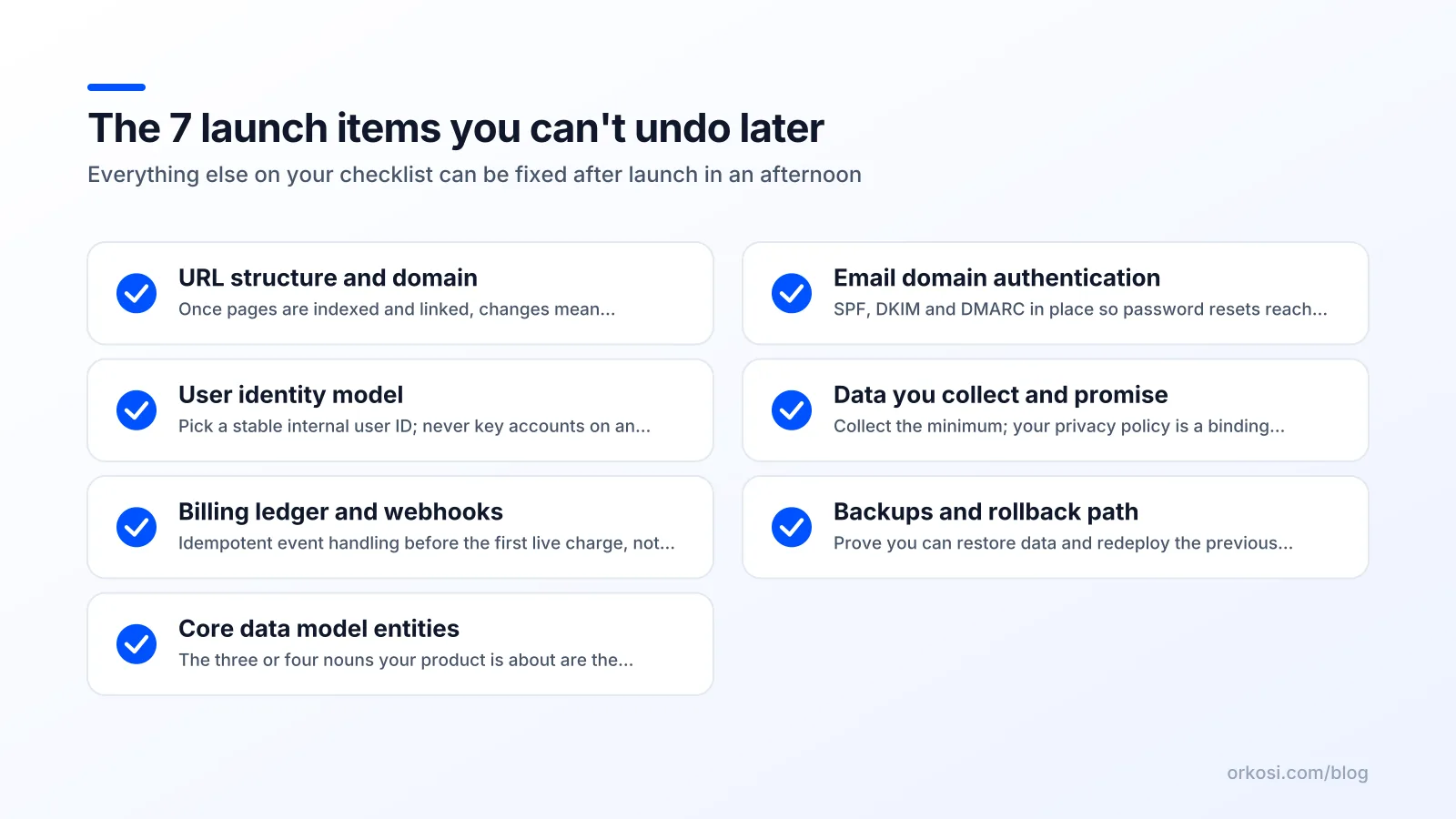
The seven items you genuinely can't undo later
URL structure and domain
Decide your domain and your URL pattern for app routes, marketing pages and blog posts before anything gets indexed or linked. Changing them later means mapping redirects for every old path, and Google's own guidance on site moves with URL changes describes it as a project with planning, redirect maintenance and a recovery period, not a settings change.
Done looks like this: one canonical hostname (with or without www, pick one and redirect the other), HTTPS enforced, and a written pattern for /pricing, /blog/<slug>, /app/... that you are willing to keep for two years.
User identity and account model
Do not use an email address as the primary key for a user. People change emails, companies merge, and one human will want two workspaces. Use an opaque internal ID, store email as a mutable attribute, and decide now whether the billable entity is a user or an organisation. This is the most expensive mistake on the list, because retrofitting teams onto a user-per-account schema touches every table, every permission check and every invoice you have already issued.
Done looks like this: users have UUID primary keys, accounts/organisations are a separate entity, and one user can belong to more than one account even if your UI does not expose that yet.
The billing ledger and Stripe events
Your payment provider is the source of truth for charges; your database needs a record that reconciles with it. The risk is duplicate processing: Stripe retries webhook events, and the Stripe webhooks documentation is explicit that endpoints may receive the same event more than once and should handle duplicates. Idempotency means processing the same event twice produces the same end state, not two charges or two granted subscriptions.
Done looks like this: every webhook event ID is stored before it is acted on, re-delivering the same event changes nothing, and you have completed one real live-mode payment and seen the matching row in your own ledger.
Your data model's primary entities
Names and relationships for your core objects are effectively permanent, because they propagate into API responses, CSV exports, support vocabulary and customer habits. Renaming "project" to "workspace" after 200 customers is a migration plus a documentation rewrite plus a week of confused tickets.
Done looks like this: three to five named entities, their relationships written down in one paragraph, and no entity whose meaning you are still arguing about.
Email sending domain and authentication
Transactional email is a trust path. Password resets, receipts and verification links that land in spam look identical to a broken product from the customer's side, and reputation accrues to a domain slowly, so a bad start is slow to recover from. Google's email sender guidelines require SPF and DKIM authentication and recommend DMARC, with stricter requirements for bulk senders.
SPF, DKIM and DMARC are DNS records that let receiving servers verify that mail claiming to come from your domain actually did. Done looks like this: SPF and DKIM pass, a DMARC record exists, you send from a subdomain you control, and a password reset arrives in a real Gmail inbox rather than the spam folder.
Privacy promises and data you collect
What you collect at launch is a commitment, not a default. GDPR Article 5 sets out data minimisation and purpose limitation: you collect what you need for a stated purpose and keep it no longer than necessary. Collecting more "just in case" creates retention and deletion obligations for records you never use.
Done looks like this: a list of every field you store about a person, a one-line purpose for each, a retention period, and a privacy policy that matches the list rather than a template that does not.
Backups and a rollback path
The last one-way door is the absence of an exit. If a launch-day deploy corrupts data and you have no restore, you do not have a bug, you have a closure. The AWS Well-Architected Framework treats deploying small reversible changes and recovering from failure as a baseline operational practice, not an advanced one.
Done looks like this: automated database backups on, one restore actually tested into a scratch environment, and a documented command or button that redeploys the previous version in under ten minutes.
What I'd skip until week two, and defend skipping
Product Hunt and press
Skip it. A Product Hunt launch is the one free attention spike you get, and spending it before you have ten paying users means you learn nothing from the traffic because you cannot yet tell which parts of your funnel are broken. Launch publicly when you can convert, not when you are ready to be looked at.
Trade-off: if your product is genuinely viral (consumer, visual, shareable), early distribution may matter more than conversion polish. That exception is narrower than most founders believe.
Onboarding tours and empty states
Onboarding tours written before launch are guesses about where users get stuck. Watch ten real signups, note the exact step where they stall, then build a tooltip for that one step. Empty states deserve a sentence and a button, not an illustration set.
Trade-off: a product with genuinely complex setup (data imports, integrations) needs a minimum guided path on day one or nobody reaches value.
The analytics stack
A day-one product has few enough events that you can read them. Skip the warehouse, the event taxonomy and the dashboard suite; log signups, activations and payments to a table and query it. The main harm of a premature analytics stack is that it makes you feel informed while you avoid talking to the eleven people who signed up.
Trade-off: instrument the activation event properly from day one, because you cannot backfill events you never recorded. That is instrumentation, not analytics.
SOC 2, status pages and a design system
All three are week-twelve problems disguised as week-one problems. SOC 2 is an audit of controls operating over time, so it cannot be bought in a week anyway; a status page with no incidents is a page with no information; a design system before you have five screens is furniture for a house with no walls.
Trade-off: if your first sales calls are with enterprise buyers who ask about SOC 2, or if you handle regulated data (health, payments, children's data), security work moves to the front of the queue and changes the shape of your whole launch.
The 20-minute pre-flight that catches most launch-day embarrassment

Six checks, in a clean browser
Open a fresh incognito window and do these in order, as a stranger would:
| # | Check | Pass condition |
|---|---|---|
| 1 | Sign up with a real email you can read | Account exists, verification email arrives within 60 seconds |
| 2 | Complete a live-mode payment with a real card | Charge succeeds and your own ledger row matches the Stripe charge ID |
| 3 | Trigger a password reset | Email lands in a Gmail inbox, not spam, and the link works once |
| 4 | Visit a nonsense URL and a broken state | A real 404 page, no stack trace, no blank white screen |
| 5 | Load the app at phone width | Primary action is reachable without horizontal scroll |
| 6 | Redeploy the previous version | Completes, and the site stays up |
This beats a 60-item audit because it walks the two paths that carry money and trust. Most launch-day disasters are a failure in one of these six, not an absent changelog.
What to do when one fails
Stop and fix only that one, then rerun the whole sequence. Failures cluster: a mail authentication problem that breaks check 3 usually breaks receipts too, and a rollback that fails in check 6 means every later fix is riskier than it looks. If a check fails and you cannot fix it today, delay the announcement rather than launching with a known broken trust path. Nobody is waiting.
The trade-off I'll argue for: fewer features, more instrumentation
Error tracking and structured logs before feature three
At launch, visibility is worth more than surface area. Launch-week bugs are reported terribly ("it didn't work", "the button did nothing"), and without logs you cannot reconstruct what happened, so you ship a guess and wait to see whether the complaint returns.
Before you build your third feature, get an error tracker capturing unhandled exceptions with user and request context, and structured logs you can grep by user ID. The operational excellence pillar of the Well-Architected Framework makes the same argument in formal terms: you cannot operate what you cannot observe.
One number that tells you launch worked
Pick exactly one activation metric, meaning the event that proves a new user reached value, and define it per product type:
| Product type | Activation event |
|---|---|
| SaaS / web app | User completed the core action once and returned the next day |
| Online store | First order placed by someone who is not you |
| Website | Visitor submitted the contact or booking form |
| Mobile app | Session two, on a different day |
Count that number by hand daily for the first month. A dashboard of 14 charts, none of which you act on, is slower and less honest.
How AI agents change the checklist, and the parts they can't take over
What gets automated: deploys, hosting, SEO plumbing, brand assets
Agent-run build platforms genuinely shrink the two-way-door half of the list. On Orkosi, you describe the product and agents write the code, deploy it on AWS and keep iterating through tasks, with hosting, a brand kit, billing, SEO and marketing tooling included. The practical effect is that copy, layout, onboarding and even feature scope stop being launch-blocking, because changing them is a task, not a sprint.
That changes the economics of deferral. Items are billed in credits rather than scheduled against a roadmap (see plan details on the pricing page), so "fix it in week two" is a realistic promise instead of a polite fiction. Competing builders make similar claims with different trade-offs around code ownership and hosting, which is worth comparing directly before you commit.
What stays yours: the one-way doors
An agent can implement your account model; it cannot decide whether you bill users or organisations, because that is a pricing and go-to-market choice. It can wire SPF and DKIM; it cannot choose your sending domain. It can write the webhook handler; your Stripe account, your tax registrations and your privacy policy remain your legal commitments.
So the division is clean: hand over the implementation, keep the seven decisions. If you are using an agent platform, write those seven answers down first and give them as constraints, which is also how the Orkosi docs suggest framing product requirements.
The launch a SaaS product checklist you can finish in one day
Morning: the seven one-way doors. Canonical domain and URL patterns. UUID user IDs with a separate account entity. Idempotent webhook handling and one reconciled live payment. Core entities named and written down. SPF, DKIM and DMARC configured on a sending subdomain. The list of personal data you collect, with purposes and retention. Backups on, one restore tested, rollback command documented.
Afternoon: the 20-minute pre-flight, twice. Once to find failures, once to confirm the fixes. Keep the clean-browser discipline; your logged-in browser lies to you.
Evening: announce small. Email the people who asked to know, post once where you already have an audience, and reply to everything personally. Ten engaged users beat a thousand bounces.
Deliberately not doing this yet: Product Hunt, press outreach, onboarding tour, analytics stack, SOC 2, status page, design system, help centre, affiliate programme, changelog, cookie preference centre beyond what the law requires, mobile app, dark mode. Write that list somewhere visible so you stop relitigating it at 11pm.
The decision rule, once: finish anything you cannot fix in an afternoon, and ship everything else broken enough to learn from.
FAQ
What should be on a minimum SaaS launch checklist?
Seven irreversible items: domain and URL structure, user identity and account model, a reconciled billing ledger with idempotent webhooks, named core data entities, authenticated email sending, a documented list of personal data you collect, and tested backups with a rollback path. Everything else on a typical go-live checklist can be fixed after launch. Finish those seven, run the six-check pre-flight, then announce.
How long before launch should I set up the legal and billing side?
Before you take the first payment, not before you write the first line of code. You need the entity, a payment account in its name, tax registration where it applies and a privacy policy matching the data you actually collect, because invoices and consent records are hard to restate retroactively. Plan for two to four weeks of waiting on third parties (bank, registry, payment verification) and treat that as the real constraint on your launch date.
Should I launch on Product Hunt on day one?
Usually no. A public launch spends your largest single burst of attention on a funnel you have not yet seen a stranger use, and you only get one credible first attempt. Get ten paying users and a working activation metric first, then launch publicly with copy informed by what those users actually said.
Can AI agents run my launch checklist for me?
They can run the implementation half: building and deploying the app, wiring hosting and DNS records, generating brand and SEO assets, and shipping post-launch fixes as tasks. They cannot make the one-way-door decisions for you, and they cannot own your payment account, tax registrations or privacy commitments. Platforms like Orkosi make the reversible items genuinely cheap to revisit, which is exactly why the seven irreversible ones deserve your whole morning.
Write your seven answers down tonight and have the first version deployed tomorrow: start free and give the agents those constraints as your build brief. Plan limits and credit allowances are on the pricing page if you want to know what iterating after launch actually costs.