Build a SaaS Product Without Code: The Spec Is the Job
Orkosi Team · · 11 min read

Yes, you can build a SaaS product without code in 2026, and thousands of people now do it every week. The surprise is what's left over once the typing disappears. What remains is not easier than coding, it is just different: deciding exactly what the software should do, in which order, for whom, and what counts as correct. That work has a name. It's the spec, and it is now the job.

Code was never the bottleneck, ambiguity was
Ask anyone who shipped software before 2023 where their projects died. Almost nobody says "we couldn't type the functions fast enough." They say the requirements changed, the edge case ate three weeks, the billing logic was wrong, nobody agreed what "archived" meant.
What changed in 2024–2026
Generation got cheap and good. Agents now scaffold a multi-tenant app, wire authentication, set up a database, deploy to AWS and come back with a URL. On well-scoped tasks the speedup is real and measured: in a controlled study of developers building an HTTP server, the group with GitHub Copilot finished about 56% faster than the control group.
Note the qualifier. Well-scoped. The task was defined, the output was testable, the goal was unambiguous.
What didn't change at all
When the task is messy, the gains evaporate. METR ran a randomized trial with 16 experienced open-source maintainers on 246 real issues in repositories they knew deeply. They predicted AI would make them 24% faster. They were 19% slower, while still believing they had sped up.
The difference between those two studies isn't model quality. It's how much of the problem was already decided before the work started. An agent writing code for an unspecified behavior does not stop and ask; it picks something reasonable and moves on. Every unspecified behavior is a coin flip you didn't watch.
So the honest framing for anyone trying to build SaaS without developers: you removed the typing, not the deciding. The deciding is now the whole job, and it was always the hard part.
The four things an agent cannot infer
An agent can infer conventions: that passwords get hashed, that a list probably needs pagination, that dates should be stored in UTC. It cannot infer your business. Here are the four categories where silence in the brief becomes a bug in month two.
Business rules
"Users can invite teammates" is not a rule. Can a teammate invite another teammate? Is there a seat limit? Does an invite expire? If someone is invited to two workspaces with the same email, is that one account or two?
Each unanswered question gets answered anyway, by the agent, quietly, in a way you'll discover when a customer complains.
States and edge cases
Objects have lifecycles, and founders usually name two states when there are six. A "draft" document sounds simple until you ask: can a draft be shared by link? Does deleting a draft notify collaborators? If the author leaves the workspace, who owns the draft?

Money
Billing is where unspecified states hurt most, because the failure mode is either angry customers or lost revenue. Stripe's own subscription model carries eight statuses: trialing, active, incomplete, incomplete_expired, past_due, canceled, unpaid and paused, each with its own lifecycle events and transitions.
Your spec needs a position on most of them. What happens to a user's data when a trial ends and no card is on file? Does past_due mean read-only access or no access? If a customer upgrades mid-cycle, do you prorate? If you refund, does access revoke immediately or at period end?
Answer those four questions and you've eliminated a large share of the support tickets a first SaaS version generates.
Permissions
Who can see what, and who can destroy what. This is not a detail to leave for later: broken access control sits at number one in the OWASP Top 10, the most widely used list of application security risks.
An agent given no permission model will build the friendly default, which is usually "any logged-in member of the workspace can do anything." That is fine for a two-person pilot and dangerous the moment you sell to a company with contractors.
To build a SaaS product without code, write a one-page spec, not a twenty-page document
The instinct when you can't code is to compensate with volume. Resist it. Twenty pages of prose buries the decisions that matter inside paragraphs nobody re-reads. One dense page, structured, beats it every time, and it's the single highest-leverage artifact in no-code SaaS requirements.
Nouns, verbs, states
Structure the page in three lists.
Nouns. The objects in your system and their fields. Project: name, owner, status, created_at. Invoice: amount, currency, status, due_date, customer. Five to eight nouns is normal for a first version. If you have twenty, you are building version three.
Verbs. Who does what to which noun. "An owner can archive a project." "A viewer can comment on a project but cannot archive it." One line per verb, with the actor named.
States. For each noun, the full list of states and the legal transitions. Invoice: draft → sent → paid | overdue → written_off. Drawing the arrows is where you discover the gaps.
The rule of one screen
A requirement is only useful if someone can check it. ISO/IEC/IEEE 29148, the international standard for requirements engineering, defines good requirements as necessary, unambiguous, singular, feasible and above all verifiable. You don't need to read the standard. You need one habit from it: for every line in your spec, ask "how would I prove this is working on a screen?" If you can't answer, rewrite the line.
"The app should be fast" fails. "A project list of 500 items loads in under two seconds" passes.
Where to leave the agent room to decide
A good product spec for AI agents also says what you don't care about. Write three lines under a heading called Agent's choice: the things you are explicitly delegating. Typography and spacing. Database schema details. Which specific email provider. Pagination style.
This is not laziness, it's scoping. Defaults are good now, and you want your attention on the decisions that are expensive to reverse.
The spec sections founders always skip
Four omissions cause most of the rework I see. None of them are features, which is exactly why they get skipped.
Who sees what
Write a permission grid, even a crude one. Roles down the left, actions across the top, yes/no in the cells.
| Action | Owner | Admin | Member | Viewer |
|---|---|---|---|---|
| Invite users | Yes | Yes | No | No |
| Edit billing | Yes | No | No | No |
| Delete project | Yes | Yes | No | No |
| Export data | Yes | Yes | Yes | No |
| View audit log | Yes | Yes | No | No |
Five minutes of table-filling prevents the single most common class of production security bug.
What happens on failure
Payment declines. Email bounces. The upload times out. The third-party API returns a 500. For each external dependency, write one line: what the user sees, whether the system retries, and whether you get notified.
Agents build the happy path beautifully. Unhappy paths are a specification problem.
What gets emailed to whom
Transactional email is product surface area that founders treat as plumbing. List the triggers: signup confirmation, invite, password reset, payment failed, trial ending in three days, weekly digest. For each, say who receives it and whether it can be turned off.
Data you'll regret collecting
Privacy-by-design means deciding not to collect things. Under GDPR-style data minimization, every field you store is a liability you chose. Do you need date of birth? Phone number? Full address for a product that never ships anything physical?
Also specify deletion: when a user deletes their account, what actually disappears, what is retained for accounting, and after how long. An agent will not invent a retention policy for you.
Write acceptance criteria before you look at the screen
"It looks right" is not a test. It is a vibe, and vibes do not survive the third iteration, when fixing one thing silently breaks another.
Acceptance criteria for AI-built apps are plain-English lines in a given/when/then shape that you can run by hand in four minutes. Here is a realistic set for a first feature, a team workspace with invites:
- Given I am signed out, when I visit a workspace URL, then I am redirected to login and returned to that URL after signing in.
- Given I am an owner, when I invite
a@example.com, then that address receives an invite email containing a link that expires in 7 days. - Given an invite has expired, when the recipient clicks the link, then they see "This invite has expired" and no account is created.
- Given I am a Member, when I open the billing page, then I see a 403 message and no card details are rendered anywhere in the response.
- Given a workspace has 3 of 3 seats used, when the owner sends a fourth invite, then the invite is blocked with an upgrade prompt.
- Given my trial ended 1 day ago with no card on file, when I log in, then I can read existing projects but cannot create new ones.
- Given my payment fails, when the subscription enters
past_due, then I receive one email immediately and access continues for 7 days. - Given I delete my account, when I try to log in again, then login fails and my projects are no longer reachable by direct URL.
Keep this list in a document next to your spec. Run every line after every build iteration. When a criterion changes, change the line first, then request the build. The list is your regression suite, and it costs you nothing but attention.
The honest trade-offs of specifying instead of coding
I've argued the spec is the job. Here is where that argument is weakest.
When over-specifying slows you down
If you spend two weeks writing requirements for a product nobody has used, you will spend most of that time being wrong with great precision. Early specs are hypotheses. A working build in front of five users teaches you more in a day than another page of detail.
When the agent's default is better than your opinion
You probably do not have a strong, correct view on form validation patterns, empty-state copy, or how a settings page should be laid out. Agents have absorbed a lot of competent convention. Specifying these wastes your budget and often produces a worse result than the default. Leave them in the Agent's choice block.
The cost of changing your mind on day 60
The asymmetry that resolves the debate: some decisions are cheap to change later and some are brutally expensive. Changing a button color on day 60 costs one task. Discovering on day 60 that your data model has no concept of organizations, only users, costs a migration, a billing rework, and every customer's trust.
So draw the line there. Specify up front what is expensive to reverse: the data model, money, permissions, deletion. Discover the rest in the build. Anyone claiming you should plan everything or plan nothing is selling a methodology, not describing software.
The iteration loop is part of the spec
A spec is not a handover document you throw over a wall. It's a running contract you edit. The loop looks like this: change the spec line, turn it into a task, let the agent build, run the acceptance criteria, update the spec with what you learned.
This is how the workflow runs on Orkosi: you describe the product, agents write the code and deploy it on AWS, and you keep iterating through tasks against the running app. Hosting, billing and the brand kit come with it, which removes the integration scramble that usually eats the first month. You can see the kinds of products this produces in the showcase, and there is an honest comparison with other builders if you want to see where it fits against the alternatives.
The trade-off is real and worth stating. Agent iterations cost credits, so vague tasks are not free: a badly specified change burns budget producing something you then have to undo. On the Starter plan at $25/month you get 2,000 credits, and 1 credit is $0.01, which means a sloppy brief has a visible price. Current plan details are on the pricing page. This is another argument for acceptance criteria: a task with a testable outcome is a task you only pay for once.
Other platforms will give you similar leverage with different trade-offs, more control and more configuration in some, less infrastructure included in others. The constant across all of them is that the quality of your output tracks the quality of your spec far more closely than it tracks your choice of tool.
FAQ
Can you really build a SaaS product without code in 2026?
Yes, for the large majority of standard SaaS patterns: authentication, multi-tenant workspaces, CRUD data, subscriptions, dashboards, email, file uploads. What you cannot skip is specifying behavior. The constraint has moved from typing ability to decision clarity, which is why learning how to write a spec for an AI app builder matters more than learning a framework.
What should a spec for an AI app builder include?
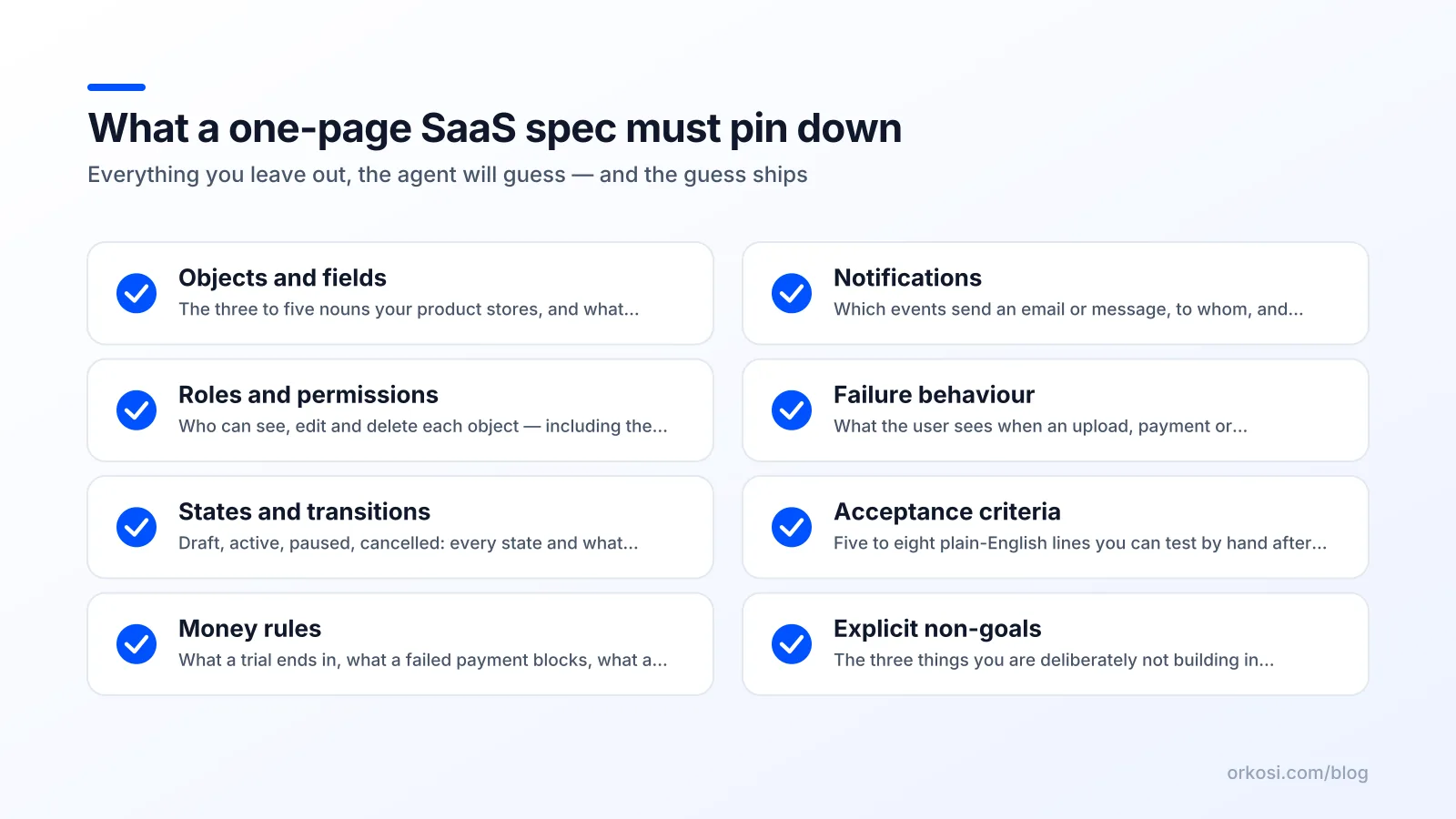
Six things on one page: the objects and their fields, who can do what to each object, the states each object can be in, how money and subscriptions behave, what happens when external services fail, and an explicit list of decisions you are delegating to the agent. Add acceptance criteria written in plain given/when/then sentences.
How long should it take to write the spec for a first version?
Two to four hours for a focused first version, not two weeks. If it takes longer, you are probably specifying version three. Write the page, build, test against your acceptance criteria, then expand the spec with what the first working build taught you.
Do I still need a developer if I write a good spec?
For a first version, a pilot, an internal tool or a product under a few thousand users, usually no. You will want a developer or a security review before handling regulated data, processing payments at volume, or signing enterprise contracts with audit requirements. Good specs make that later review cheaper, because the intended behavior is written down.
Write your one page this week, then let agents build against it and see what the first iteration teaches you. Start free, and check pricing when you're ready to keep iterating.