AI App Builder for Startups: Pass the Handoff Test
Orkosi Team · · 11 min read

The demo tells you almost nothing. The handoff tells you everything
Every AI app builder for startups looks the same in the first ten minutes. You type a prompt, a login page appears, a table of records appears, and you feel a small rush of relief that you will not have to raise a seed round just to validate an idea. That feeling is real, and it is also useless as an evaluation signal, because all of these tools produce it.
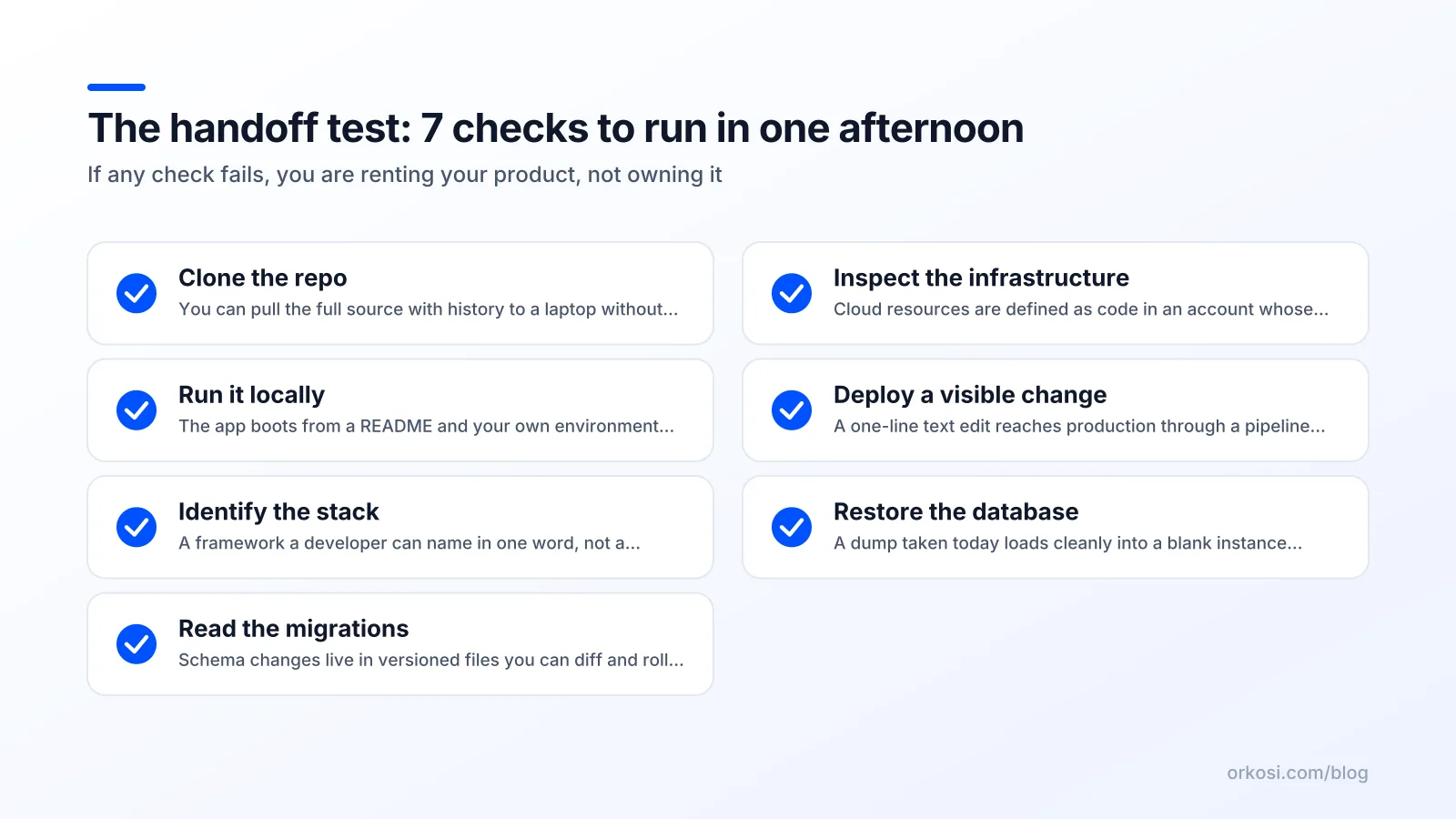
The only question that separates them is exit cost. Here is the test I would apply to any builder before giving it a credit card: if you hired a contract developer on Monday morning, could they clone your repository, run the app on their laptop, ship a visible change, and deploy it by Friday, without ever speaking to the vendor? That is the handoff test. If the answer is no, you do not own a product, you own a subscription to someone else's runtime.
This article gives you seven concrete checks, the three lock-in traps that catch founders after month six, and a five-step procedure you can run in a single afternoon during a free trial.

What 'handoff-ready' actually means: seven things a developer needs on day one
"You own your code" is a marketing sentence until you specify what ownership requires. Below is the specification. For each item: what good looks like, how it usually fails, and the one question to put to the vendor in writing.
A Git repository you control, with real history
Good looks like a repo in your GitHub or GitLab organisation, with commits that describe individual changes, branches, and the ability to revoke the vendor's access tomorrow without the app breaking. Transferring a repository with its history, issues and settings is a standard, documented operation, so asking for it is not an exotic demand.
The common failure is a single zip download labelled "export", with one commit called "initial commit" and no history at all. History is how a new developer learns why a decision was made. Ask: is the repository under my account from day one, or generated on request?
A mainstream framework, not a proprietary DSL
Good looks like Next.js, React, Node, Django, Rails, Flutter, something a developer can search Stack Overflow for. A domain-specific language (DSL) is a custom language or configuration format invented by the vendor; the failure mode is a codebase that is technically yours and practically unemployable.
Ask: name the exact framework and version, and show me a public GitHub project that uses the same stack.
Database schema and migrations you can read
Good looks like SQL migration files in the repo, versioned, applied in order, with a schema you can inspect in any Postgres client. Migrations are the record of how your data model got to its current shape, and without them a new developer cannot safely change a column.
The failure mode is a schema that only exists inside the vendor's admin UI. Ask: where in the repository are the migration files?
Environment config and secrets separated from code
Good looks like an .env.example listing every variable the app needs, with the real values held in your own secret store. This is the twelve-factor config principle: anything that varies between deploys belongs in the environment, not the codebase.
The failure fails in two directions: API keys hard-coded into source files, or, worse, keys that live only in the vendor's dashboard and are never exposed to you at all. Ask: can I see and rotate every credential my app uses?
Infrastructure defined as code, in your cloud account
Good looks like Terraform, Pulumi or AWS CDK definitions committed to the repo, describing the database, storage buckets, queues and networking, deployed into an AWS or GCP account with your name on the bill. Infrastructure as code means a developer can reproduce your production environment from scratch in a staging account.
The failure mode is infrastructure that exists only as clicks the vendor performed on your behalf. Ask: whose cloud account is this running in, and can I get an admin role in it?
A build and deploy path that runs without the vendor UI
Good looks like npm install && npm run build working on a clean laptop, plus a CI workflow file (GitHub Actions or similar) that builds and deploys on push. The failure mode is a deploy button that exists only inside the vendor's web app, which means your release process dies with your subscription.
Ask: show me the CI configuration file that performs a production deploy.
Enough tests and docs to change things safely
Good looks like a README that gets a new developer running locally in under thirty minutes, plus tests covering the paths that touch money and authentication. You do not need 90% coverage. You need enough that an inheriting developer can refactor without guessing.
Ask: what happens when I run the test suite on a fresh clone?
| Check | Pass signal | Fail signal |
|---|---|---|
| Repository | Yours, with granular commit history | Zip export, one commit |
| Framework | Named mainstream stack and version | Proprietary visual runtime or DSL |
| Database | SQL migrations in repo | Schema lives in vendor UI |
| Config | .env.example plus your own secret store |
Keys hidden in vendor dashboard |
| Infrastructure | IaC files, your cloud account | Vendor-managed, invisible |
| Deploy | CI file runs without vendor login | Deploy button only |
| Tests and docs | Fresh clone runs in under 30 min | No README, no tests |
Why a boring, mainstream stack beats a clever one
Framework choice is a hiring decision, not an aesthetic one. The Stack Overflow Developer Survey 2024 puts JavaScript at roughly 62% usage among professional developers, Python around 51%, TypeScript around 38%, React the most-used web framework at around 40%, and PostgreSQL the most-used database at around 49%. Those percentages are your contractor pool.
A React and Node app on Postgres can be handed to tens of thousands of freelancers in any time zone, at a rate the market sets rather than one vendor sets. A bespoke visual runtime can be handed to the few dozen people who happen to specialise in that one product, at whatever rate scarcity dictates. The code is the same either way; the liquidity of the labour market around it is not.
The honest counterargument: proprietary runtimes genuinely do ship faster on day one. When auth, data tables, file uploads and emails are all first-party primitives in one closed system, nothing needs wiring. You are trading week-one velocity against year-two optionality, and for a weekend prototype that trade is correct.
The three lock-in traps founders miss
AI app builder vendor lock-in rarely announces itself. It shows up as a sequence of small conveniences that each made sense at the time.

Trap 1: 'export' that gives you code you can't run
An export button proves nothing. Plenty of platforms will hand you a folder of real source files that import a package only resolvable from the vendor's private registry, or that call an internal SDK with no public documentation. The code compiles, starts, and does nothing.
Detection: clone the export onto a laptop that has never logged into the vendor and run the install and start commands. If it cannot boot without a vendor token, the export is theatre.
Trap 2: the invisible infrastructure (auth, storage, queues, cron)
This is the trap that catches serious products. The application code is clean and portable, but sign-in runs through the vendor's hosted auth service, images sit in their bucket, background jobs run on their queue, and the nightly billing job runs on their cron. Replacing those four things is a three-week project for a developer who did not build them.
Detection: grep the codebase for the vendor's domain name. Every hit is a dependency you would have to rebuild.
Trap 3: data you can download but can't restore
A CSV export of your users table is not a backup. It loses foreign keys, indexes, constraints, sequences, and anything stored in JSON columns, and it gives you no path back to a working database. A genuine backup is a pg_dump output or equivalent: a consistent, restorable snapshot that recreates the schema and the data as they were.
Detection: ask for a dump, create an empty database, and restore into it. If the restore fails, your data is hostage even though you have a copy of it.
Run the handoff test on an AI app builder for startups in one afternoon
You do not need a developer for this. Four of the five steps are copy-paste terminal commands, and the fifth is a question you send by email. Run it during a trial, before the second invoice.
- Build something small but real. Ask the agent for a feature with a database write, a login, and a file upload. Pass: it appears in the repo as readable source files. Fail: you cannot find where it lives.
- Clone the repo to a machine that is not the builder. Your laptop, a colleague's, anything. Pass:
git cloneworks from your own account and the history has more than one commit. Fail: you can only download a zip. - Run it locally with your own environment variables. Copy
.env.example, fill in your own keys, start the app. Pass: it boots and the login page loads. Fail: it demands a vendor session to start. - Change one visible thing and deploy it. Edit a heading, commit, push, let CI deploy. Pass: the change reaches production without you opening the vendor's UI. Fail: deploys only happen from inside the dashboard.
- Restore the database into a blank instance. Take a dump, create an empty Postgres database, restore, point the local app at it. Pass: the app runs against the restored copy. Fail: you have CSVs and no path home.
Five passes means you can hand off the AI-generated codebase to a developer whenever you choose. Three or four passes means you have a known, scoped migration cost. Fewer than three means your product is a feature of someone else's platform.
The honest trade-off: portability has a price
Portable architecture is more work. You will have a real AWS account with a real bill that varies month to month, IAM roles to manage, migrations that can fail in production, and a staging environment that someone has to maintain. Closed platforms absorb all of that, which is exactly why they feel faster in week one.
There is also a competence cost. Owning infrastructure means owning incidents, and a founder with no technical co-founder will eventually hit a 2am certificate expiry that a managed platform would have handled invisibly.
So the rule of thumb: if the thing you are building is a disposable prototype, a landing-page test, an internal tool with five users, or a pitch demo you expect to throw away in six weeks, use the closed tool and move on. The moment there is revenue, a customer contract, a compliance questionnaire, or an investor asking what happens if the vendor shuts down, portability stops being an architectural preference and becomes a business risk control. Due diligence will ask where the code lives. "In the builder" is not an answer that survives the question.
How Orkosi is built to pass its own handoff test
Orkosi is one option among several, and it is designed around the assumption that you will eventually want a developer in the loop. Agents write and iterate on a real codebase and deploy it on AWS; the product advances through tasks against that repository rather than through live edits inside a proprietary runtime, which is the structural difference that makes a handoff possible at all.
Templates cover SaaS and web apps, online stores, websites, image studios, mobile apps, desktop apps and video channels, and hosting, a brand kit, billing and SEO tooling come with the platform. You can see the range of outputs in the Orkosi showcase, and the documentation describes how tasks, deploys and environments fit together, which is itself a fair thing to read before signing up anywhere.
The honest trade-offs: agent-written code still needs human review on anything security-sensitive, and running on real AWS infrastructure means real cloud mechanics rather than a frictionless managed sandbox. Credits are consumed by agent work, so iteration has a marginal cost that a flat-fee closed platform does not have. Starter is $25 a month and Pro is $100 a month; the pricing page has the full breakdown, and the comparison page sets Orkosi against other builders feature by feature.
The point is not to take our word for it. The afternoon test above works on Orkosi too, and the free trial exists precisely so you can run it.
FAQ
Can I export the code from an AI app builder and run it myself?
Sometimes, but "export" means very different things. Some builders give you a Git repository on a mainstream stack that boots on any laptop; others give you source files that depend on private packages, hosted auth and managed storage you cannot replicate. The only reliable way to know is to clone the export onto a machine that has never logged into the vendor and try to start it.
How long should a developer handoff of an AI-generated app take?
For a genuinely portable codebase, a competent contractor should clone, run locally, ship a visible change and deploy it inside one working week. If the README gets them running in under thirty minutes and the test suite passes on a fresh clone, expect days rather than weeks. If any part of the stack lives only in a vendor UI, budget weeks of rebuild work instead.
What questions should I ask an AI app builder vendor before signing up?
Five, in writing: which exact framework and version does it generate, is the repository in my own GitHub organisation from day one, whose cloud account does production run in, can I see and rotate every credential, and can you provide a restorable database dump rather than CSVs. Vague answers to any of these are the answer.
Is AI-generated code good enough for a developer to inherit?
Increasingly yes for conventional CRUD applications, dashboards and storefronts, provided it uses a mainstream stack with migrations and tests. Inheriting developers complain less about AI authorship than about missing context: no README, no history, no infrastructure definitions. Structure and documentation matter more to handoff cost than who or what wrote the functions.
Run the five-step test on a real build rather than a demo: start free and see whether the output survives a clone to your own laptop. Plan details and credit allowances are on the pricing page.