AI App Builder for Startups: Launch Narrow, Win Later
Orkosi Team · · 12 min read

Generating software stopped being the hard part. An AI app builder for startups can produce a working sign-up flow, a dashboard, a Stripe checkout and a settings page in an afternoon, deployed and live. What it cannot do is explain your product to a stranger, answer the fourteenth support email about a feature you shipped on a whim, or decide which half of your roadmap should never exist. That decision is still yours, and it matters more now than it did when code was expensive.

Generation got cheap. Support didn't.
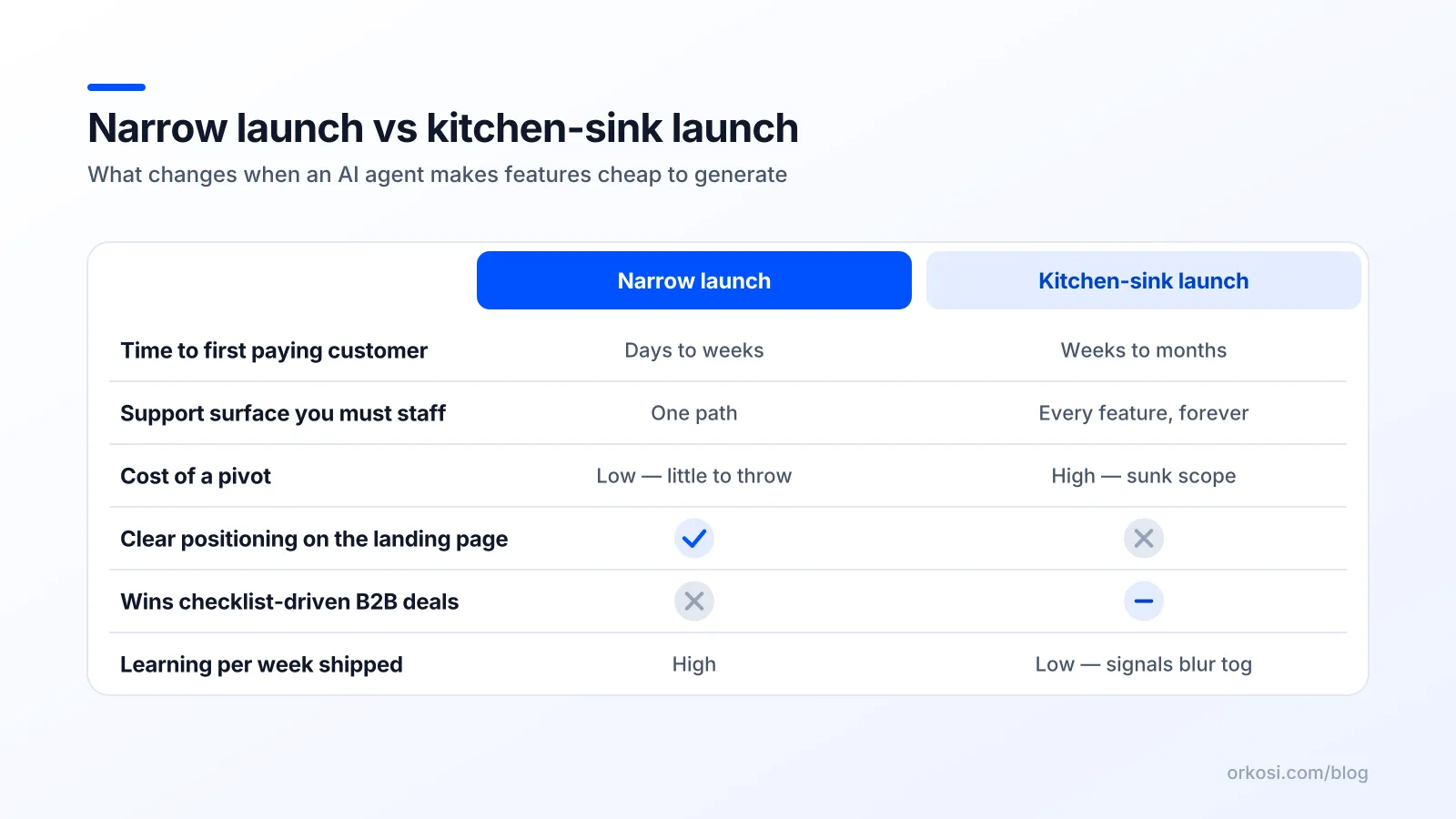
For twenty years, engineering cost acted as an accidental scope discipline. You cut features because you could not afford to build them. Remove that constraint and most founders do not get more disciplined; they ship a wide, shallow v1 with eleven half-explained features and no clear answer to "what does this do?"
The new bottleneck is attention, not engineering hours
Your real constraint at launch is the attention of three groups: your own (how many things you can hold in your head and debug), your customers' (how many concepts they will learn before giving up), and the market's (how many sentences it will read before scrolling past). None of those budgets grew because code generation got faster.
A visitor gives your landing page a few seconds. If the headline has to cover scheduling and invoicing and client portals, it covers nothing. Narrow products are easier to say out loud, and products that are easy to say out loud get retold by other people.
What a feature costs after it ships
Building a feature is now the cheapest thing you will ever do to it. The ongoing bill is unchanged by AI:
| Cost | What it looks like in practice |
|---|---|
| Support | Every feature generates questions. A feature used by 5% of users can produce 30% of your inbox. |
| Bug surface | Each feature multiplies the state combinations that can break, not adds to them. |
| Docs | Something has to explain it, and that something has to be updated when it changes. |
| Onboarding | Each extra concept is another screen, tooltip or decision between sign-up and value. |
| Regression risk | Future changes must not break it, which means it quietly taxes every later task. |
| Sales | A feature you cannot demo confidently is a feature that creates doubt on calls. |
An AI agent can regenerate code in minutes. It cannot answer a confused customer with context about their billing history, and it cannot un-ship the expectation that a half-working feature created. Feature creep at startup launch used to be a budget problem. Now it is an operations problem, which is worse, because it shows up after you have customers.
What 'launch narrow' actually means
A narrow launch delivers one complete job-to-be-done, for one named user segment, through one primary path, finished to production quality. Every word carries weight: complete rules out stubs, one segment rules out "freelancers and agencies and enterprises", one path rules out branching alternatives, and production quality rules out the excuse that it is "just an MVP".
One job, one user, one happy path
Y Combinator's guidance on how to plan an MVP lands in the same place: pick the single core use case, launch fast, and do unscalable things manually around the edges. The purpose of a first version is to start the learning loop with real users, not to be impressive.
"One happy path" is the part founders skip. If your app has three ways to create a project, you have three onboarding flows, three sets of bugs and three things to explain. Pick the one your target user would pick and delete the others from v1.
Narrow is not small, ugly or broken
The common misuse of "MVP" produces a wide product that is 40% finished everywhere. Nielsen Norman Group's analysis of minimum viable products and design draws the right line: viable means it genuinely solves the problem, not that it technically renders. An unfinished product teaches you that your execution was bad. A narrow, finished product teaches you whether the problem was real.
Narrow means fewer features at full quality. It does not mean broken auth, unstyled forms or a checkout that fails 10% of the time.
A worked example: three versions of the same invoicing app
Say you want to build invoicing for freelance designers.
| Version | Scope | Verdict |
|---|---|---|
| A. Kitchen sink | Invoices, estimates, time tracking, expenses, client portal, team seats, multi-currency, Xero sync, reporting | 9 features to explain, 9 support surfaces, no sentence describes it. Don't build. |
| B. Thin everywhere | All of the above, each at 40%: estimates that cannot be converted, a portal with no notifications, sync that drops line items | The worst outcome. Users hit the broken edge and churn blaming you, not the idea. |
| C. Narrow and finished | Create and send a branded invoice to a client, get paid by card, chase overdue invoices automatically. UK freelancers, GBP only. | One job, done fully. Demoable in 90 seconds. Build this. |
Version C can be described in one line, supported by one person, and sold without caveats. Multi-currency, estimates and Xero sync are not cancelled; they are queued behind evidence.
The four-question scope test
Run every candidate feature through these four questions. If it fails any of them, it goes in the backlog, not in v1.
Does the core job fail without it?
If a freelancer cannot get paid without card payments, payments are in. If they can get paid perfectly well without expense tracking, expenses are out. Be ruthless about distinguishing "the job breaks" from "the job would be nicer". Password reset passes: people forget passwords within a week and a locked-out user is a churned user. Dark mode fails.
Can a human do it manually for the first 20 customers?
This is the highest-leverage question on the list. Concierge the edges, automate the centre.
- Bulk CSV import: fail. Email you the file, you import it yourself. Twenty times, by hand, is maybe four hours total and teaches you exactly what the real importer needs to handle.
- Custom report builder: fail. Run the query, paste the numbers, send a PDF.
- Account deletion: pass, because it is a legal and trust obligation, and doing it manually invites mistakes with other people's data.
Will it generate support tickets I can't answer?
Any feature touching permissions, data migration or third-party sync produces questions whose answers require debugging. Team roles and permissions almost always fail at launch: they create invisible states ("why can't Sarah see this?") that are expensive to diagnose and rarely needed by your first twenty customers, who are mostly individuals or two-person teams. An audit log fails unless you sell to regulated buyers, in which case it passes and probably belongs in the top three.
Would I demo it on a sales call?
If you would skip past it in a live demo, it is not earning its place. This question is a useful proxy for conviction. Features you are slightly embarrassed by are features that will erode trust at exactly the moment you need it.
What you cannot cut, even in a narrow launch
Narrow does not mean unsafe. There is a floor, and it is mostly the unglamorous layer that an AI app builder for startups should generate for you, then you verify rather than assume.
Auth, billing and transactional email
Working sign-up, log-in, password reset and session handling are the floor, not features. So is billing that actually collects money. "Simple" paid launches are rarely simple: Stripe's own subscriptions overview covers trials, proration, failed payments, dunning and webhooks, and you will meet most of those in month one. Pick the smallest viable billing model (one plan, monthly, no trial) rather than skipping the rigour.
Transactional email needs to reach inboxes, not spam folders. Test a password reset to Gmail, Outlook and a corporate domain before you launch.
Backups, logging and a way to hear about breakage
Daily backups, a tested restore, centralised error logging and an alert path to your phone. The AWS Well-Architected Framework treats recovery and observability as baseline operational expectations for anything in production, and a narrow product is still production. An untested backup is a belief, not a backup. You also need one visible support channel: an email address in the footer is enough; silence is not.
The legal and trust surface
A privacy policy, terms, a cookie notice if you need one, and deliberate data minimisation. GDPR Article 5 requires personal data to be adequate, relevant and limited to what is necessary, which is also excellent product advice: every field you don't collect is a field you cannot leak, cannot migrate and don't have to explain. Narrow launches are easier to make compliant because they touch less data.
Where launching narrow is the wrong call
Three situations where a narrow v1 structurally cannot win.
RFP-driven B2B and feature-checklist buying
If your buyer sends a 60-row requirements spreadsheet, SSO, role-based access, data export and an audit log are not features, they are the price of entry. No amount of elegance in your core workflow gets you past a procurement checklist with gaps.
The adjustment: don't widen, change buyer. Sell to the 40-person company that buys on a credit card before you chase the 4,000-person one that buys on a checklist. Same product, different segment, and the checklist features get funded by revenue later.
Two-sided marketplaces and anything with a cold-start problem
A marketplace with supply and no demand is a broken product regardless of build quality. The same applies to anything whose value depends on other users being present.
The adjustment: don't launch both sides. Seed one side manually in a single city, category or niche, fake the other side with your own effort, and keep the geography absurdly small until liquidity is real.
Replacing a tool people already pay for
If you are asking someone to migrate off an incumbent, "narrow" reads as "fewer features than what I already have". Switching costs are real and parity matters more than polish.
The adjustment: pick the one workflow the incumbent does worst and be dramatically better at it, with an import path that makes switching a 10-minute job. Compete on the gap, not the overlap.
How to ship a narrow v1 with an AI app builder for startups
The mechanics matter, because the tooling either nudges you towards discipline or away from it.
Write the spec as one user story, not a feature list
Feature lists invite agents to build everything you listed, and they will. Describe the job instead: "A UK freelance designer signs up, connects their Stripe account, creates a branded invoice from a template, emails it to a client, and gets an automatic reminder sent at day 7 and day 14 if it's unpaid." That paragraph contains the entire product and implies the database, the emails and the screens. Anything that does not appear in the story does not get built this week.
Pick the template that matches the job
Starting from the wrong shape costs more than it looks. On Orkosi, the template you choose (SaaS / Web App, Online Store, Website, Image studio, Mobile app, Desktop app, Video Channel) determines the default auth, billing and deployment scaffolding you inherit on AWS. A storefront built as a generic web app means rebuilding cart and checkout logic that the Online Store template already assumes. The docs walk through what each template gives you by default.
The honest trade-off: templates constrain. If your product genuinely does not resemble any of them, a template will fight you, and a custom build or a different tool may suit you better. How Orkosi compares with other builders is the place to check that before you commit.

Treat the backlog as a queue, not a release
Once v1 is live, everything else becomes a task in a queue, worked one at a time, each deployed as it finishes. This is where credit-metered pricing quietly helps: at 1 credit = $0.01, with Starter at $25/month for 2,000 credits and Pro at $100/month for 6,000, small post-launch increments are cheap and a speculative kitchen-sink build burns real money. Paying per unit of work makes you ask whether the work is worth it, which is the question scope discipline is made of. Check current plans and credit allowances for the full picture.
Widen on evidence, not on vibes
Narrow is a starting position, not a religion. The discipline is in how you widen.
Instrument the one path before you add a second
Minimum viable analytics at launch: sign-ups, activation (the user completed the core job once), a weekly retention cohort, revenue, and error rate per key endpoint. Five numbers. Without them, every roadmap conversation is an argument between opinions. If you cannot see where users drop off in your single path, you have no business adding a second one.
The three signals that justify feature #2
A feature earns a slot when at least one of these is true, and you can name the specifics:
- Repeated support requests from paying users. Five or more paying customers asked for the same thing in their own words. Free-tier requests count for less.
- A lost deal you can name. Not "enterprises want SSO" but "Metrica Ltd, £340/month, walked because we had no SSO."
- A measured drop-off in the core funnel. Activation falls apart at a specific step and you have a hypothesis for why.
Founder intuition, competitor screenshots and "it would be cool if" are not signals. They are the mechanism by which feature creep enters a startup launch.
A 30-day widening cadence
Once a month, spend an hour: read every support thread from the period, list the requests, tag each against the three signals, and pick exactly one or two to queue. Everything else stays on the list, visible, unbuilt. Review the same list next month; most items decay and quietly disappear, which is the system working.
FAQ
How small is too small for a launch?
Too small is when the user cannot complete a valuable job end to end without your help. If a freelancer can create and send a real invoice and get paid, you are above the line even with no estimates, no reports and no team seats. If they can create an invoice but not send it, you have not launched a narrow product, you have launched a broken one.
Should I launch on Product Hunt with a narrow product?
Yes, narrow products launch better on aggregator sites, because they are easier to describe in one line and easier to remember. "Invoicing and chasing for UK freelancers" travels; "a complete business operating system" does not. The risk is not narrowness, it is quality: a launch day spike will find every rough edge in your single path, so make that path genuinely solid first.
If an AI agent can build features in hours, why not just ship them all?
Because building is the cheap part and owning is the expensive part. Every shipped feature carries permanent support, documentation, onboarding and regression costs that no AI app builder for startups reduces. Shipping ten features in a week means debugging ten features for the next two years, with a landing page that cannot explain any of them. Generate fast, ship narrow, queue the rest.
How do I tell investors my product is deliberately narrow?
Frame it as sequencing, not limitation. Say which job you own completely, which segment you own it for, what evidence will unlock the next slice of scope, and what the full surface looks like in two years. Investors are suspicious of unfocused v1s, not small ones; a founder who can name what they chose not to build reads as disciplined rather than underambitious.
Pick the one job your product must do perfectly, then start building it free and queue everything else behind real evidence. Check the plans and credit pricing to see what a month of narrow, iterative shipping actually costs.