No-Code vs AI-Generated Software: The Scaling Bill
Orkosi Team · · 11 min read

The argument in one paragraph
The real difference in no-code vs AI-generated software is no longer capability, it is what the meter counts. No-code platforms meter your success: seats, records, automation tasks, workload units. Code that agents write and deploy into a cloud account you own meters your machines: vCPU hours, gigabytes stored, requests served. Those are two different curves, and they cross. Below roughly a few hundred dollars of monthly activity, no-code is genuinely cheaper and you should use it. Above that, and especially once your product runs background work per record rather than per click, no-code starts charging you more for the exact months you were hoping to have.

What each model actually bills you for
No-code: seats, records, tasks, workload units
No-code vendors price against business activity because that is the metric that correlates with your willingness to pay. The mechanics differ by vendor, but the family resemblance is obvious once you line them up.
Bubble meters workload units, an internal unit of server-side consumption. A database search, a scheduled workflow, an API call, a file upload: each burns units. Your plan includes an allowance, and exceeding it means either overage charges or an upgrade. Crucially, workload units track what your app does, not how many people are logged in.
Airtable prices per seat with record limits per base. Twelve staff on a paid tier costs twelve times one, regardless of whether the twelfth person opens it weekly. Zapier bills tasks, where a task is one successful action inside an automation. A workflow with five steps firing on every new signup costs five tasks per signup.
Three vendors, three units, one shape: the bill rises when your business does something.
AI-generated code: compute, storage, egress, managed services
Infrastructure bills against resource consumption. AWS Fargate charges per vCPU-hour and per GB-hour of memory, so a container sized at half a vCPU and one gigabyte of memory costs roughly $18 per month to run continuously at current us-east-1 rates. Amazon RDS charges per instance-hour plus provisioned storage, so a small managed Postgres instance lands near $12 to $20 per month before backups.
Note what is absent from those sentences: users, records, seats, automations. A Fargate task serving 50 signups per day and the same task serving 5,000 cost the same, right up until you need a second container. That is the single most important asymmetry in AI-generated code hosting costs.
The hidden third line: your own time
Both models bill a third line that never appears on an invoice. No-code charges you in workarounds: the plugin that almost does it, the five-step hack around a missing join, the Saturday spent re-learning a visual workflow editor you touch twice a quarter. Self-hosted code charges you in operations: certificates, dependency bumps, an alarm at 2am.
Agent platforms shift the shape of that third line rather than removing it. You describe a change, an agent implements and deploys it, and you review the result. That is cheaper than hand-coding and more expensive than clicking a toggle, and anyone who tells you otherwise is selling something.
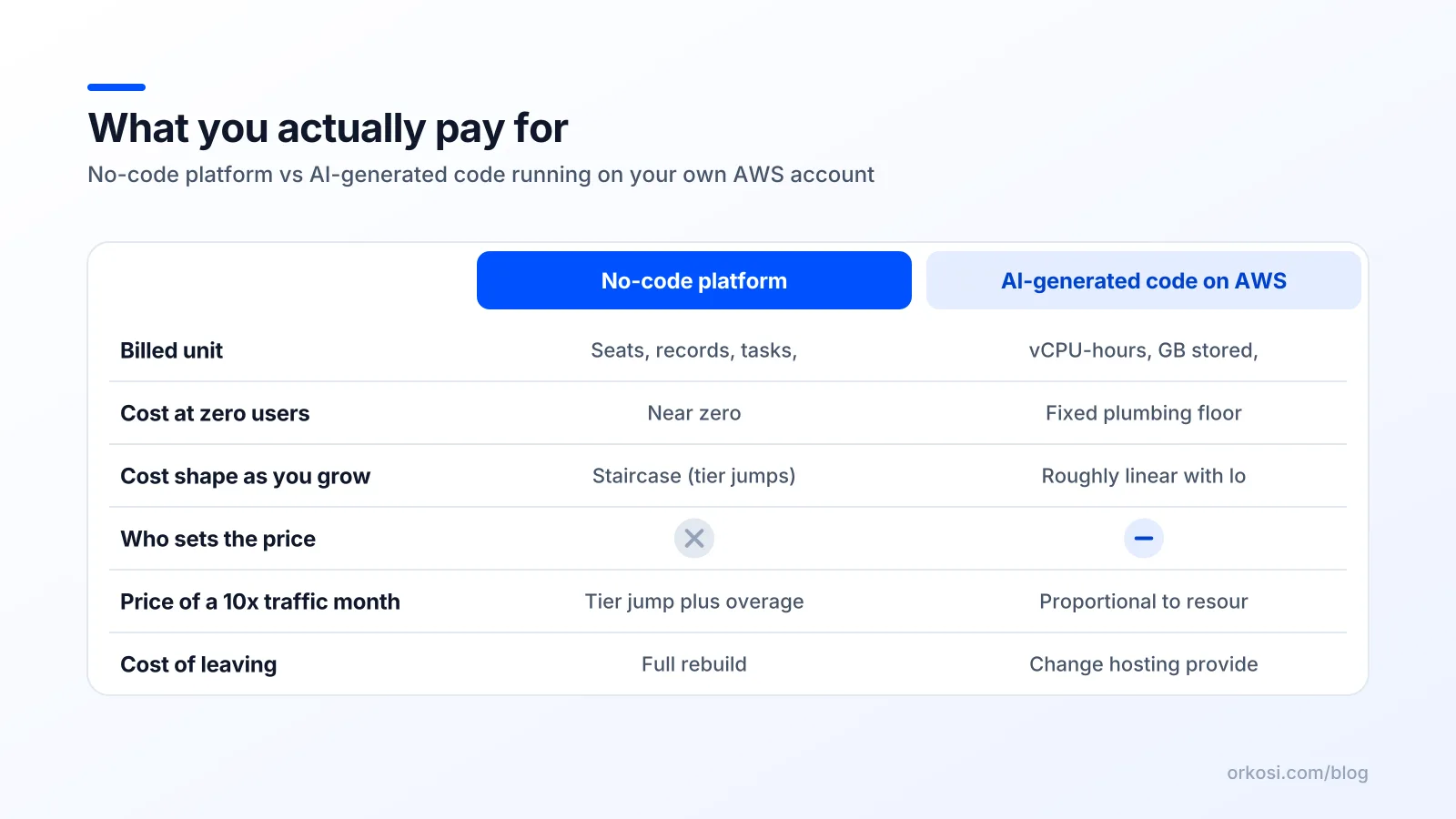
| No-code platform | AI-generated code on your cloud | |
|---|---|---|
| Primary meter | Seats, records, tasks, workload units | vCPU hours, GB stored, requests, egress |
| Cost at zero users | Near zero (free or entry tier) | A fixed floor: database, load balancer, logs, domain |
| Cost of a 10x traffic month | Tier jump, possibly two | Marginal, until you add capacity |
| Cost of background jobs | Direct and linear in the vendor's unit | Mostly absorbed by existing compute |
| Cost of adding a non-technical viewer | A full seat, usually | Zero |
| Cost of leaving | A rebuild | A redeploy |
Why the no-code curve is a staircase, not a ramp
Grow 4% and your no-code bill does not grow 4%. It stays flat for months, then jumps 2x the day you cross a boundary. No-code platform scaling costs are step functions, and steps are hostile to forecasting.
Here is the mechanism in practice. An app runs a nightly workflow that touches every record to recalculate a status. At 2,000 records that is cheap. A partner sends you a CSV with 40,000 rows, you import it on a Tuesday, and from Wednesday your nightly job is doing twenty times the work it did last week. Nobody signed up. Nobody clicked anything. The Bubble workload units cost line moved because your data grew, and the recalculation ran against all of it.
The price itself is not the scandal. The non-linearity is. You cannot forecast a staircase from your own unit economics, because the vendor's unit is not your unit. You know your cost per customer, your churn, your contribution margin. None of those map onto workload units, and no amount of spreadsheet discipline will make them map, because the translation depends on implementation details inside the platform that you did not choose and cannot see.
Per-seat pricing has the same defect in a friendlier costume. The staircase is just shorter: each new hire is a step. A ten-person ops team on a per-seat tool is predictable. A fifty-person one discovers that "give the warehouse team read access" is a budget conversation.
Why the AWS curve has a floor you can't dodge
Now the honest other side. Self-hosted, AI-generated code has a baseline that exists when nobody is using your product at all. You still need a managed database, a load balancer or equivalent ingress, logs with some retention, automated backups, a domain, certificates, and a transactional email provider.
Add those up with real numbers. A small managed Postgres instance at roughly $15, a container or two at roughly $20, an application load balancer at roughly $16 to $22, logs and backups and secrets at perhaps $5 to $15, plus email and DNS. You are at $60 to $90 per month before a single user signs up, and that number barely moves whether you have zero users or two thousand.
Compare that with an internal tool on a per-seat plan at $20 a seat for six people: $120, and it does everything you need with no deployment pipeline. Push the seat count down to three and no-code is a third of the infrastructure floor. Per-seat pricing vs infrastructure cost is not a trick question at small scale. No-code wins, clearly, and pretending otherwise is how founders end up paying cloud bills to run a glorified spreadsheet.
The Orkosi documentation is reasonably direct about this: agents can provision less, and smaller products get smaller footprints, but there is no configuration in which a production database costs nothing. If your product genuinely has eight users and no background processing, the floor is the whole argument against you.
Where the lines cross: no-code vs AI-generated software in three worked scenarios

Internal tool, 6 staff, low volume
Six people log shipments. Maybe 400 records a month, a handful of automations, two reports. On a per-seat platform this is $100 to $150 per month and roughly one weekend of build time. Hosted code costs $60 to $90 of plumbing plus build effort plus the operational attention, and it will not be meaningfully better.
Stay on no-code. The crossover is not close, and nothing about this workload is going to move it. This is the case no-code was built for, and migrating it is vanity.
Two-sided marketplace with background jobs
Now a marketplace with 800 active users, where each new listing triggers an image resize, a geocode lookup, a search index update, and three notification emails. Call it six server-side operations per listing, 3,000 listings a month: 18,000 metered operations, plus whatever recurring jobs run against the full listing table.
On a task-metered or workload-metered platform, that volume puts you in the upper-middle tiers, and your bill moves every time you add a step to a workflow. On your own infrastructure, those 18,000 operations are absorbed by a container that was already running and already paid for. You might add a worker process for $15.
The crossover has happened and it happened at modest user numbers. The driver was not headcount, it was operations per record.
B2C app with a traffic spike
A consumer app gets a feature in a newsletter and does 10x traffic for nine days. Hosted code responds by scaling containers: maybe $40 extra for the month, plus some egress. The product stays up, the invoice is boring, and the spike is unambiguously good news.
On a usage-metered no-code plan, the same spike consumes the monthly workload allowance in roughly four days. You then choose between overage charges, an emergency tier upgrade, or watching the app throttle during the only week that mattered. That is a structurally bad incentive: your platform has made you ambivalent about traffic.
The heuristic: cost crossover tracks automation volume and per-user activity far more than headcount. Ten heavy users with background processing cross sooner than two hundred passive viewers.
The bill nobody models: the cost of leaving
Every no-code total cost of ownership comparison I have seen omits the largest line item: exit cost. This is not a rounding error, it is often larger than three years of subscription fees.
Leaving a no-code platform is not an export, it is a rebuild. You can export records as CSV. You cannot export the logic, the workflows, the permissions model, the page structure, or the integrations, because those exist as proprietary configuration inside the vendor's runtime. The honest estimate for rebuilding a mature no-code app is whatever it would cost to build it from scratch, minus the value of knowing exactly what it should do.
Leaving a hosted codebase is a redeploy. The repository is yours, the schema is standard Postgres, the container runs anywhere that runs containers. You change hosting providers in a day or two and keep the product.
So the comparison is not "$80 of AWS versus $60 of SaaS." It is "$80 of AWS versus $60 of SaaS plus an option to avoid a four-month rebuild you will be forced into at the worst possible moment," which in practice is the month a large customer asks for something the platform cannot do. Price that option at even a conservative $30,000 and amortise it over three years and the monthly comparison inverts. Ownership of the code and the data model is the thing you are buying, and it is worth auditing before you commit, not after.
How the agent model changes the maths
Orkosi sits on the hosted-code side of this line with one structural difference: the build labour is also metered. Agents write the code, deploy it to AWS, and keep iterating through tasks you file, so you pay for build work in credits and for running the product in infrastructure. You do not pay for seats, records, or workload units.
The plans are public: Starter is $25 per month for 2,000 credits, Pro is $100 per month for 6,000 credits, and one credit equals $0.01. There is also an Enterprise tier and a custom free trial; current details live on the pricing page rather than in this article, because quoting numbers from memory is how blogs go stale.
The trade-offs are real and worth stating. Credits are a genuine variable cost during heavy iteration: a week of substantial feature work burns more than a week of small copy edits, and a vague task specification burns more than a precise one. Infrastructure still needs attention, because your database still needs backups and your alarms still need somewhere to ring. And agents are better at well-bounded tasks than at ambiguous architecture decisions, which means your written requirements are now a cost lever. The showcase is a reasonable sample of what the model handles well, and the comparison page covers how it differs from traditional builders.
A decision rule you can apply this week
Four questions, answered honestly, resolve most of this.
- Estimate background operations per user action. Count the server-side steps triggered by one signup, one order, one upload. One or two: no-code is fine. Five or more: you are buying a metered staircase.
- Count the seats that will never grow. If the user list is your staff and your staff is fixed, per-seat pricing is a predictable, flat, low cost. That is a feature.
- Ask whether a 10x month would be celebrated or feared. If a traffic spike creates a billing problem, your pricing model is fighting your growth model.
- Check whether the data model is yours. Can you point at a schema, in a repository, in an account with your name on it? If not, you are renting your product.
The position: pick no-code for bounded internal tools where the user count is known and the automation volume is low. Pick AI-generated code for anything you intend to sell, because the whole point of selling it is that usage goes up, and usage going up should not be an invoice event.
FAQ
Is no-code cheaper than AI-generated software?
Below roughly $100 to $150 of monthly activity, yes, almost always. No-code has no infrastructure floor, while a self-hosted app pays $60 to $90 a month for a database, ingress, logs and backups even with zero users. Above that level, and especially once you run multiple background operations per record, the metered no-code curve overtakes the flat infrastructure curve.
What are Bubble workload units and why do costs jump?
Workload units are Bubble's internal measure of server-side consumption: searches, workflows, API calls, scheduled jobs. Each plan includes an allowance, so the bill stays flat until you cross it, then rises through overage or a tier upgrade. Costs jump rather than drift because consumption is driven by data volume and automation depth, both of which grow in steps rather than smoothly.
At how many users should I move off a no-code platform?
User count is the wrong trigger. Move when background operations per user action reach roughly five, when a successful month produces a billing surprise, or when a customer requirement is blocked by the platform rather than by your time. Some products should migrate at 200 users; some internal tools should never migrate at all.
Can AI agents migrate my no-code app to real code?
Partly. Agents can read your exported data and rebuild the schema, pages and workflows as conventional code, which removes most of the manual rewriting. What they cannot do is recover logic that only exists as clicks inside a visual editor, so budget time for documenting what the app actually does before you start.
Start a free trial at /register and file one real task to see what a build actually costs in credits. The full plan details are on /pricing, including the free trial and Enterprise options.