AI App Builder for Startups: Who Fixes the 2am Bug?
Orkosi Team · · 12 min read
The question nobody asks during the demo
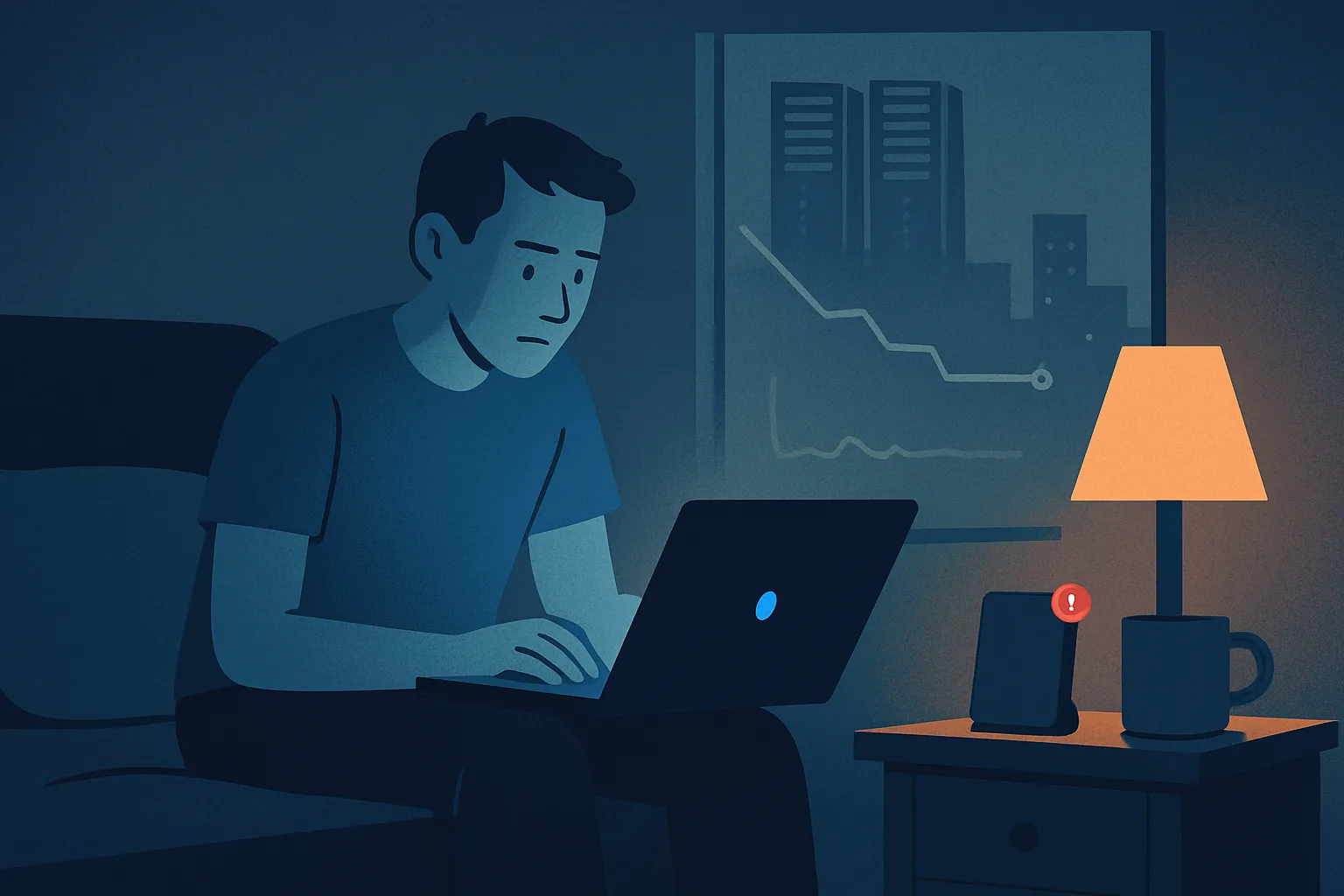
Every evaluation of an AI app builder for startups happens in the same forty-five seconds: you type a prompt, a UI appears, and something that looks like a product is running in a browser tab. Nobody asks what happens eleven months later, at 2:14am, when Stripe starts returning 400s on your webhook endpoint and your signup flow silently stops provisioning accounts. That question, not the demo, is the one that decides whether you still have a business.

Build time is the cheapest hour of your product's life
The initial build is the smallest cost your software will ever incur. A product that lives for three years spends maybe 2% of its calendar life being built and 98% being run, patched, migrated, re-credentialed and explained to confused customers. Shaving a week off the build saves a week. Getting production support wrong costs you churn, refunds and the thing you cannot buy back: a customer's belief that your app works.
This is why "it built my MVP in an hour" is a weak selling point on its own. The interesting claim is "it was still running correctly on a Tuesday in March, and when it wasn't, something woke me up and then helped me fix it."
Why the 2am bug is the real evaluation criterion
Pick your builder by imagining the worst hour, not the best one. Can you see the logs? Can you reach the infrastructure? Can you roll back? Is there anything on the other end of the alert besides you and a cold laptop?
A good test: if the vendor disappeared tomorrow, could you still operate your app? If the answer is no, you did not buy a product, you bought a dependency with a demo attached.
What actually breaks after launch (and what doesn't)
Here is the uncomfortable finding from running small apps in production: almost nothing that breaks is "the AI wrote bad code." Generated code fails loudly and early, usually before you ship. What fails later is the environment around the code.
The usual suspects: third-party APIs, auth, email, payments, migrations
The recurring failure classes for a small SaaS or store are boringly consistent:
| Failure | What it looks like | Typical cause |
|---|---|---|
| Expired credential | 401s from one integration, rest of app fine | API key, OAuth refresh token or certificate hit its expiry date |
| Payment webhook drift | Payments succeed, accounts never provision | Provider changed payload or your endpoint started timing out and retries exhausted |
| Transactional email bounce wall | Password resets stop arriving | Domain reputation, DMARC change, or sending limits hit after a spike |
| Half-applied migration | Some rows have a column, some don't | Migration ran, failed mid-way, no transaction wrapper |
| Runaway query | App gets slow, then unresponsive | One table grew past the point where a missing index mattered |
| Dependency upgrade | Build breaks or a subtle behaviour change ships | Transitive dependency bumped a major version |
| Cloud event | Everything down in one region | Provider incident you cannot fix, only route around |
Six of those seven are operational, not generative. They are about time, scale, third parties and state, which is to say they are about the part of software that no builder, AI or human, finishes once and walks away from.
What rarely breaks: your beautiful landing page
Static pages basically do not fail. Neither does your brand kit, your pricing table, or the marketing copy you agonised over. The parts you spent the demo admiring carry the lowest operational risk, and the parts you never looked at (webhook handlers, cron jobs, the queue that retries failed emails) are where your revenue actually leaks. Spend less time on the hero section and more on what happens when the third party behind your most important integration has a bad night.
Three bad answers founders give themselves
'I'll just ask the agent to fix it'
The grain of truth: an agent with repo access and logs genuinely is the fastest way to turn a stack trace into a deployed patch. The flaw is that an agent cannot fix what nobody detected. Who fixes AI-generated code is the wrong question; the first question is who notices it broke.
The most expensive outages for small products are not loud. They are a signup form that has been 500ing for nine days while your ad spend kept running. No agent, however capable, triages an incident it was never told about.
'It's a small app, nothing will happen'
Small apps absolutely fail, they just fail quietly and asymmetrically. Fifty users and one broken checkout is a 100% revenue outage. Low traffic also means low signal: with three signups a day, a dead signup endpoint looks exactly like a slow week. Paradoxically, small products need more explicit monitoring than big ones, because they lack the ambient noise of users complaining within minutes.
'I'll hire a developer when we grow'
You probably should, eventually. The flaw is timing. A contractor hired during an incident is the most expensive engineer you will ever buy and the least useful, because they arrive with zero context on your schema, your deploy process and your integrations. Emergency hiring also takes days, and incidents take hours. Build the operational kit now; hire later from a position where the new person inherits runbooks instead of mysteries.
The minimum operational kit for a one-person product
Four things, all of which you can set up in an afternoon. The AWS Well-Architected Reliability Pillar frames reliability as monitoring, recovery procedures and validated backups rather than heroics, and that framing scales down to a one-person product perfectly well.
Alerting you will actually see on a phone
You need at most two alerts that make noise at night: "the app is not responding to requests" and "the money path is broken." Everything else goes to email and waits for morning.
Cost is not a defence here. Basic CloudWatch alarms and modest log retention for a small app land in the range of a few dollars a month; check CloudWatch pricing for current figures, but the order of magnitude is "less than your domain registration." Monitoring a SaaS without a team is a configuration problem, not a budget problem.
Logs and error tracking you can hand to an agent
Structured logs plus an error tracker (Sentry, Rollbar, CloudWatch Logs Insights, whatever you will actually open) turn an incident from a guessing game into a reading task, and one an agent can do. Make sure errors carry a request ID, a user ID and the release version. Those three fields are the difference between "something broke" and "this deploy broke this endpoint for these accounts."
A rollback you have practised at least once
Rollback is a capability, not a button you assume exists. Deploy a trivial change, roll it back, and time yourself. If the answer is "I don't know how," you do not have a rollback.
DORA's four key metrics put failed-deployment recovery time and change failure rate alongside speed for exactly this reason: how fast you recover from a bad change matters more for survival than how fast you ship good ones.
Backups with a tested restore
Automated backups are table stakes and are also not the point. The point is a restore you have performed, into a scratch database, with a note of how long it took and what broke. Untested backups fail in predictable ways: missing extensions, encrypted snapshots with a lost key, a schema that no longer matches the app. Do the drill once, write down the steps, and put the file somewhere you can find at 2am.
Where AI agents genuinely shine at 2am
Having criticised the "the agent will fix it" reflex, let me argue the other side, because AI agent production support is real leverage and a different capability from scaffolding a UI.
Reading the stack trace faster than you can
An agent with log access reads 40,000 lines in the time it takes you to find your glasses. It correlates the error spike with the deploy timestamp, notices that only requests carrying a particular header fail, and surfaces the three candidate commits. That triage step is where a sleepy human loses the most time. Agents also have no context-switch cost and no fatigue penalty: at 2am your error rate goes up by orders of magnitude, theirs does not.
Writing the fix, the test and the deploy in one pass
Once the cause is identified, the mechanical work (patch, regression test, changelog, deploy to staging, verify, promote) is exactly what an agent pipeline is good at. Maintaining an AI-built app is far more tractable when the same system that wrote the code can also read its production logs and ship against the same deploy path. The question for any AI app builder for startups is not "can it generate an app" but "can it operate one."
Writing the post-incident note you'd otherwise skip
Solo founders never write postmortems, because at 7am the incident is over and there are customers to answer. An agent will produce the timeline, the contributing factors and the follow-up tasks while the logs are still warm, and that document is what prevents the same outage in April.
Where they don't: the judgement calls stay yours
Rollback vs forward-fix vs maintenance page
The Google SRE book's incident management chapter separates incident command from operational work for a reason: the person executing changes should not also be weighing business risk. That split applies even when the "operations" role is an agent.
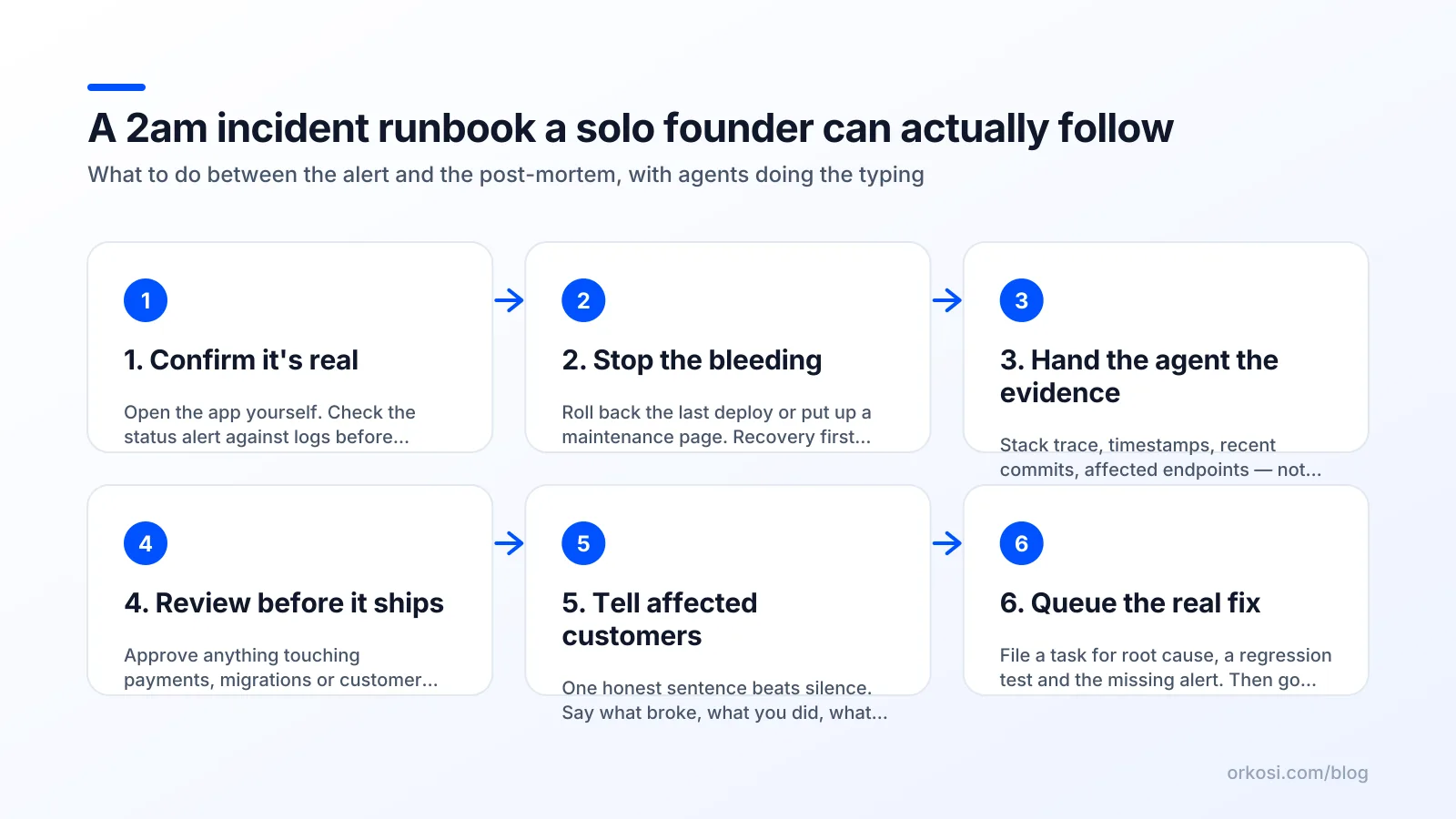
Choosing to roll back (losing the last four hours of a feature), forward-fix (risking a second bad deploy), or put up a maintenance page (visible to customers, buys clean time) is a business decision about reputation and revenue. Give the agent a decision, not a dilemma.
Anything involving customer data or money
Destructive migrations, bulk updates, refunds, retroactive charges and data deletions should require explicit human approval, every time. The guardrails that make the agent-as-hands model safe are narrow and boring: staging first, migrations reviewed before they run, backups verified before destructive operations, production write access scoped and logged.
An agent proposing DELETE FROM subscriptions WHERE status = 'stale' is being helpful. You are the one who knows that 'stale' means something different for your three enterprise accounts.
Telling customers the truth
Status updates, apology emails and the decision to credit affected accounts are yours. Customers forgive outages and remember evasions. No automation should ever decide how honest you are being about an incident.
How to evaluate a builder on support, not speed
Seven questions to ask before you commit a product to it
- Can I reach the running infrastructure directly, with my own credentials?
- Do the agents see production logs and errors, or only the repo?
- Is there a rollback, and can I trigger it myself?
- Do I own the repository and the cloud account?
- Is iteration priced per task or per seat, and does fixing a bug cost the same as building a feature?
- What happens to the live app if I stop paying?
- Can I export everything and hand it to a human developer next year?
A builder that answers "no" to questions one, three and four is fine for prototypes and dangerous for a business. A solo founder on-call needs an escape hatch at every layer.
What Orkosi does with production issues
Orkosi's model is that agents build the product, deploy it on AWS, and keep iterating through tasks after launch, so the same system that wrote the feature also ships the fix. Hosting is included, and work is priced in credits rather than seats: Starter is $20/month for 2,000 credits and Pro is $100/month for 6,000 credits, with 1 credit equal to $0.01; see pricing for the full set of plans and the free trial.
The honest trade-off: credit-based pricing means a bad month of debugging consumes credits, and no agent removes your obligation to configure alerting and decide what counts as an emergency. What it does remove is the gap between noticing a problem and having someone competent working on it. The features and docs pages cover the task and deployment model in detail, and the app templates tell you which kinds of products this applies to.
A realistic on-call plan for a solo founder
Define what 'down' means and what it costs
Write one sentence: "My app is down when X." For most products X is "the signup or checkout endpoint returns errors" or "the main page does not load." Attach a number to it, even a rough one: if checkout is broken for six hours, what does that cost in lost trials?
That number is your alerting budget. If six hours of downtime costs $40, you do not need a pager at 2am. If it costs $4,000, you do.
Set an error budget instead of chasing perfection
Embracing Risk, the opening chapter of the SRE book, makes the case that 100% availability is the wrong target because the marginal cost of each extra nine is enormous and users cannot perceive the difference. Pick 99.5% for a young product, which is roughly 3.6 hours of downtime a month, and spend the remaining attention on shipping.
The practical routine looks like this:
- Two phone-waking alerts, no more.
- Everything else into a morning queue.
- One recurring monthly task with the agent: review errors, patch dependencies, run a restore drill, prune logs.
- One rollback rehearsal per quarter.

An AI-built product does not need less operational discipline than a hand-built one; it needs the same discipline, applied by someone who now has hands available at 2am. Judge any AI app builder for startups on that hour, and the rest of the comparison sorts itself out.
FAQ
Who fixes bugs in an app built by an AI app builder?
You do, with the agent as the implementer. In practice the agent reads the logs, identifies the cause, writes the patch and test, and deploys it, while you decide whether to roll back, forward-fix or wait until morning. On platforms like Orkosi this happens as a task against the live deployment; on tools that only generate code, you or a developer own the fix end to end.
Do I need monitoring for a startup app with 50 users?
Yes, more than a large app does, because 50 users will not reliably tell you when something breaks. A single uptime check on your main page plus an alarm on error rate for your signup and payment endpoints is enough to start, and basic CloudWatch alarms cost a few dollars a month. The failure mode you are preventing is a broken checkout that nobody notices for a week.
Can an AI agent deploy a fix to production without me?
Technically yes, and for low-risk changes (dependency patches, copy fixes, reverting a bad deploy) that is reasonable. Anything touching schema, customer data, payments or deletions should require your explicit approval, which mirrors the SRE practice of separating operational work from incident command. Set that boundary before launch, not during your first outage.
How much ongoing time does an AI-built SaaS really need per month?
For a small product with the operational kit in place, budget two to four hours a month: one session reviewing errors and patching dependencies, plus occasional interruptions. Expect spikes when a payment provider changes an API, a certificate expires, or you ship a significant feature. The time goes up sharply, to days rather than hours, if you skipped alerting and backups and have to diagnose problems from customer complaints.
Pick the worst hour, then pick your tooling: start a free trial and see how the task and deployment flow handles a real fix, not a demo. Plan details and credit allowances are on the pricing page.