Build a SaaS Product Without Code: Launch Is the Hard Part
Orkosi Team · · 12 min read
Yes, you can build a SaaS product without code. In 2026 a non-technical founder can have authentication, a database, a handful of screens, Stripe checkout and a custom domain live inside a week, using templates, visual builders or AI agents that write and deploy real code. No, that is not the part that will kill you. The part that kills you is a pricing page you cannot defend, an onboarding flow nobody finishes, a support inbox with no owner, and no honest answer to "where do the next five users come from?" Building was always the visible bottleneck. It was rarely the real one.

The thesis: code was never the bottleneck, it was just the visible one
Why 'I can't build it' was always a convenient excuse
Look at why companies actually die. CB Insights' analysis of startup post-mortems puts no market need, running out of cash, getting outcompeted, flawed pricing and poor marketing at the top of the list. "We could not write the software" does not appear.
"I can't build it" was comfortable because it was falsifiable only by building. It postponed the harder, more exposing work of charging money and being told no.
What changed in 2025 to 2026
Two things collapsed at once. Visual builders matured past toy status, and AI coding agents started producing deployable applications instead of snippets. The cost of a working MVP fell from roughly three months of contractor time to roughly a weekend of prompting and reviewing.
That is a genuine shift. It is also a shift in the wrong direction for anyone whose advantage was the ability to produce software.
The uncomfortable consequence of cheap software
When the supply of working software goes up, its price goes down. Your competitors can now also ship in a weekend. Your differentiator moved entirely to three places: what you charge and why, where your users come from, and whether the thing keeps running and improving after launch day.
That is not a reason to avoid building without code. It is a reason to spend your saved months on the parts that still cost something.
What 'build a SaaS product without code' actually gets you by Friday
To build a SaaS product without code means producing a deployed, multi-user, paid web application without typing application logic yourself. It does not mean no code exists. It means you did not author it.
The three honest routes: templates, visual builders, agent-built code
| Route | What you get | Main constraint |
|---|---|---|
| Templates and clones | A working product in a known category, configured by you | You inherit someone else's data model and feature set |
| Visual builders | Drag-and-drop UI, hosted database, built-in auth | Logic that cannot be expressed in the builder cannot exist |
| Agent-built code | A real repository, real framework, real deployment | You must review and direct; the agent is fast, not wise |
The third route has the lowest ceiling problem, because the output is ordinary source code. Orkosi sits here: you describe the product, agents write it and deploy it on AWS, and you keep iterating through tasks. Its app templates cover SaaS / Web App, Online Store, Website, Image studio, Mobile app, Desktop app and Video Channel, which is a starting shape, not a finished product.
The realistic weekend scope
A non-developer can realistically have live by Friday: email and OAuth signup, a data model with three to five entities, four to eight screens, role separation between owner and member, Stripe checkout with one or two plans, a marketing page, a custom domain with TLS, and transactional email. That is a real artefact.
What you will not have: edge cases, empty states, abuse handling, invoicing disputes, or any evidence that a stranger understands the first screen. For a longer walkthrough of the build step itself, see our piece on how to build a web app without coding.
What a working app is worth on its own: roughly nothing
Before anyone uses it, a working app has a resale value close to zero and an option value that depends entirely on distribution. The schema is the exception. Get the data model wrong and every later pricing or reporting decision fights you, which is the argument in own the data model. Everything else at this stage is replaceable in a weekend, including by your competitors.
The launch work no agent does for you
None of these artefacts is produced by a code generator, a template or an agent, because each one encodes a decision only you can make. Do them in order.
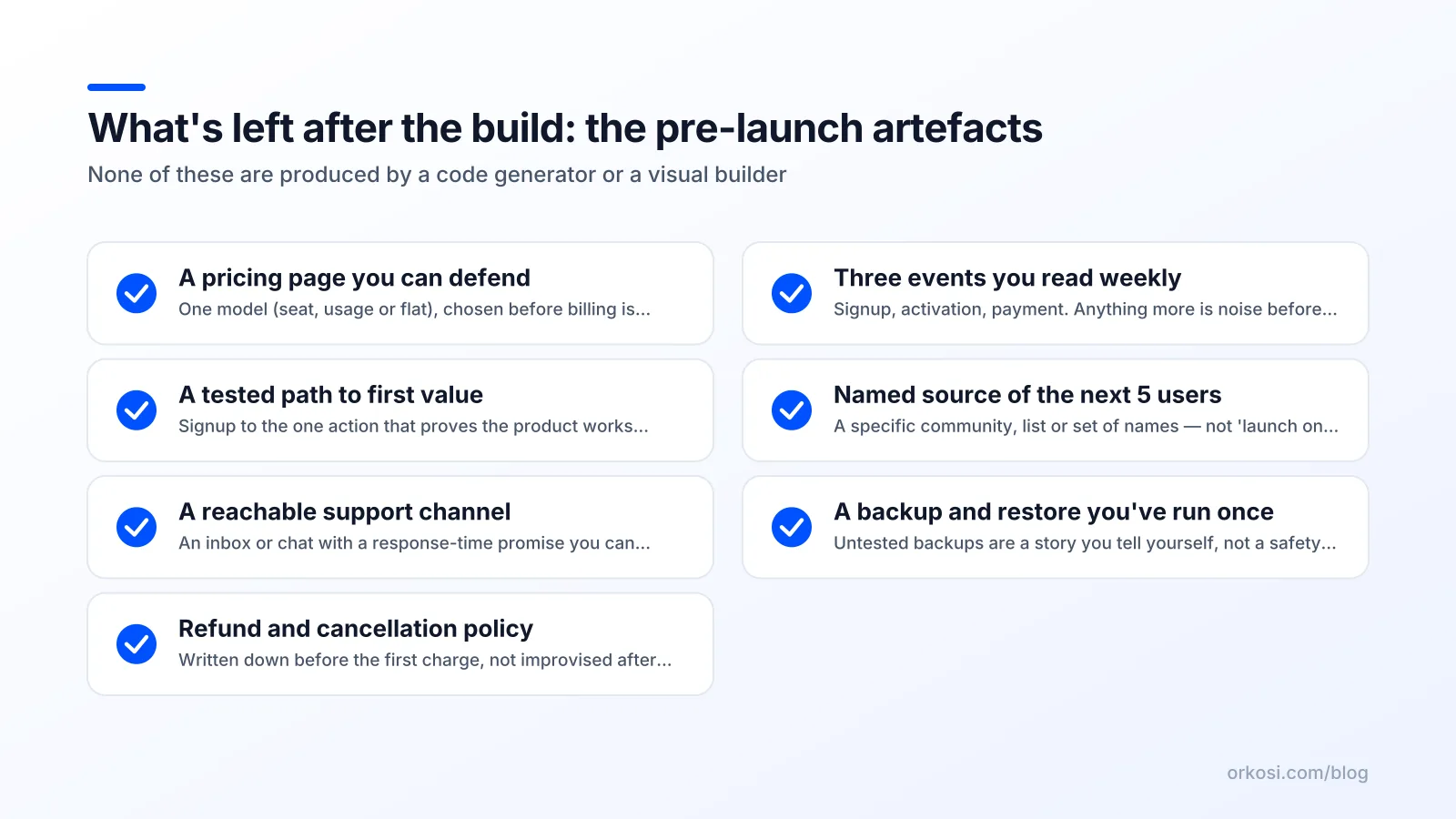
A pricing page you can defend
Done looks like: two or three plans, a one-line statement of who each is for, the limit that separates them, and an answer you can say out loud to "why is the middle plan four times the cheap one?" A no-code SaaS pricing page that lists features without naming the buyer is not finished.
A path from signup to first value
Done looks like: a written sequence of the five steps between account creation and the moment the product does something useful, with the step count measured, not guessed. If first value requires importing data, the import must work on a messy real file, not your sample CSV.
Somewhere for a confused customer to reach you
Done looks like: a visible support address or chat widget, with a response-time promise you will actually keep. "Within one business day" kept is better than "within an hour" broken twice.
Events you can actually read
Done looks like: three events instrumented and verified in a dashboard you will open weekly. Signup, activation (your definition of first value), and payment. Not forty events. Three you trust.
Refund, cancellation and data deletion policies
Done looks like: a page stating what happens when someone cancels mid-period, whether you refund, and how long you keep their data afterwards. Write it before your first angry email, not during.
An onboarding test on one real stranger
Done looks like: you watched someone who is not a friend try to sign up, in silence, and wrote down every place they hesitated. One stranger exposes more than ten surveys.
A backup you have restored at least once
Done looks like: a restore performed into a scratch environment. An untested backup is a belief, not a control.
A single owner for the inbox and the on-call pager
Done looks like: a name. Usually yours. Shared ownership at launch means nobody answers on Saturday.
Pricing is a product decision, not a launch chore
Founders who build without code almost universally defer pricing until the end, then discover the billing model contradicts the schema. You cannot bolt per-seat billing onto a product with no concept of a seat, or metered usage onto a product that never recorded usage events.
Why $9 a month is usually a mistake
At $9 a month you need roughly 550 customers for $5,000 in monthly revenue, each with the same support burden as a $200 customer. Low prices do not reduce the amount of hand-holding; they reduce how much hand-holding you can afford.
The trade-off runs the other way too. Higher prices mean fewer early customers, slower signal and conversations that can sting, because people who paid $150 expect it to work and say so. That feedback is more useful than silence from a hundred free users.
Per-seat, per-usage or flat: pick before you build the billing
Stripe's subscriptions documentation covers recurring prices, trials, proration on upgrades and metered usage. The mechanics are solved. The choice is not.
| Model | Fits when | What it demands of your schema |
|---|---|---|
| Flat per account | Value does not scale with team size or volume | Almost nothing; simplest to launch |
| Per seat | Value grows with collaborators | Real user and membership entities, invite flow, seat counting |
| Metered usage | Value tracks a countable action | Durable usage records, aggregation, overage handling |
| Hybrid base plus usage | Predictable floor with variable upside | Both of the above, plus clear invoicing copy |
What your billing model does to your data model
Changing from flat to per-seat after launch is a customer migration, not a config edit. You must backfill memberships, decide who grandfathers in, reissue invoices and explain the change to everyone who already paid. Pick the model while the schema is still soft.
For reference on how a credit-based model reads to a buyer, Orkosi's own plans are on its pricing page; study the structure, not the numbers.
Distribution: get ten customers by hand before you automate anything
If you cannot name the source of your next five users, you do not have a product, you have a hobby with a Stripe account.
Manual onboarding is research, not inefficiency
Paul Graham's Do Things That Don't Scale remains the correct instruction manual for the first ten customers: recruit them individually, set them up yourself, and treat the unscalable work as the research phase it is. When you configure an account by hand you learn which field names confuse people and which step they would have abandoned.
Automate that flow only after you have watched ten people through it. Automating a broken path just makes the breakage silent.
Why SEO is a 90-day instrument, not a launch tactic
Organic search is a real channel and a slow one. Google Search Essentials describes crawling, indexing and quality expectations that take weeks to months to resolve for a new domain with no history. Publish on day one, expect results in the second quarter. Which means launch traffic has to come from somewhere that is not search.
The one channel test: can you name where the next five users come from?
Three manual plays a non-technical founder can run in week one:
- Twenty direct messages to people who complained in public. Search forums, subreddits or review sites for the exact problem. Offer to set it up for them, free, while you watch.
- One niche community, used honestly for a month. Answer questions without linking. Link when someone asks what you built.
- Five founder-to-founder calls per week. Not pitches. Ask what they currently do instead. Three of the five will not need you, which is also data.
Day-2 operations: the part that decides whether you still have a product in March
A launched SaaS is a standing commitment. Uptime, dependency updates, expiring certificates, a provider deprecating an API, a customer who cannot log in on a Sunday.
Incidents, backups and the 3am question
If the database is corrupted at 3am, what happens? Acceptable answers include "it restores from a snapshot I tested in January and I lose at most an hour of data". Unacceptable answers include "I think the platform handles that".
Change requests arrive weekly, forever
Once you have twenty paying customers, you will get two to five change requests a week, most small and some load-bearing. The product that stops changing stops renewing. This is why "launch a SaaS without developers" is the wrong framing: the development work never ends, so the question is who or what absorbs it.
The cost of keeping it running vs. the cost of building it
Infrastructure is rarely the expensive part. AWS pricing is usage-based, and a small SaaS with a few hundred users typically costs tens of dollars a month, not thousands. The expensive part is attention: the hours spent triaging, patching and deciding.
This is where agent-run iteration earns its keep. Tasks executed against code you own, with hosting and deploys included, absorb a meaningful share of day-2 work without a payroll, which is the model Orkosi runs and which we cover in our writing on AWS deployment without a DevOps team. Be clear about the limit: an agent can ship the change, but someone still has to decide which change is worth shipping, and that someone is you.
Where 'without code' genuinely blocks the launch, and what to do about it
Three launches that need real code: compliance, integrations, migration
There are cases where you will stall, and pretending otherwise is how founders lose a quarter.
- Compliance and custom auth. SAML single sign-on, audit logs with tamper evidence, or data residency in a specific region. Enterprise buyers ask for these in the first call and visual builders usually cannot express them.
- Third-party APIs with no connector. If your value depends on an obscure ERP, a bank feed or a hospital system, "no connector available" means no product until code is written.
- Bulk migration from a legacy system. Moving 400,000 records out of a 12-year-old database, with validation and a rollback plan, is engineering work regardless of how the new app was built.
If any of these sit on your critical path, choose a route that produces editable source code from the start.
The exit-cost test before you commit to a platform
One question separates platforms: can you export the code and run it yourself? If the answer is no, every future constraint is permanent and your pricing power is capped by someone else's roadmap. Ask it before you have customers, because asking it after is an acquisition-blocking conversation.
Where Orkosi sits on this spectrum
Orkosi's agents write the code, deploy it on AWS and keep iterating through tasks, with hosting, a brand kit, billing and SEO and marketing tooling in the same place. That suits founders who want a real codebase and a running deployment rather than a closed builder, and it still leaves you the product decisions: what to charge, who to sell to, and which task to queue next. Details and credit-based plans are on the pricing page, and the feature list and docs describe scope more precisely than any blog post can.
FAQ
Can you really build a SaaS product without code in 2026?
Yes. Templates, visual builders and AI coding agents can produce a deployed application with authentication, a database, several screens and Stripe checkout in days rather than months. The genuine blockers are specific: SAML, data residency, obscure third-party APIs and bulk legacy migration. If none of those sit on your critical path, you can build a SaaS product without code and charge for it. Whether anyone buys depends on pricing and distribution, not on who wrote the code.
How long does it take to go from no-code build to first paying customer?
Plan for two to eight weeks, where the build is the short part. A working app takes days; a defensible pricing page, a tested onboarding path, a support channel and twenty direct conversations take the remaining weeks. Founders who already have an audience often convert within a fortnight. Founders starting from zero distribution should expect the launch itself to take a weekend and the first payment to take a month or more.
Do I need a technical co-founder to launch a no-code SaaS?
Not to launch. You do need someone, human or agent, accountable for deploys, backups, dependency updates and incident response after launch. A technical co-founder is one way to cover that; an agent platform with hosting and iteration included is another, cheaper for a pre-revenue product. What you cannot outsource is judgment about what to build next, which stays with whoever talks to customers.
What should I do first: build the product or find customers?
Find five people who describe the problem in their own words, then build. The sequencing matters less now that building costs a weekend, but talking to people first stops you shipping a confident answer to a question nobody asked. A practical compromise: spend two days on a landing page and twenty conversations, then build only what those conversations justified.
Start free and have something deployed this week at orkosi.com/register. Then spend the months you just saved on pricing and distribution, and check the plans when you are ready to put it in front of real customers.