Build a SaaS Product Without Code: Model Data First
Orkosi Team · · 12 min read

You can now describe a dashboard, a pricing page and a customer portal in a sentence and have working screens an hour later. That is the part of software that got cheap. So when you set out to build a SaaS product without code, the question that decides whether your product survives its first hundred customers is not what the screens look like. It is how the data underneath them is shaped, because that is the one layer that gets more expensive to change every day you operate.

The screens are the cheap part
Why UI feels like the product
Founders over-index on the interface because it is the only part they can see. You can show a mockup to a friend and get a reaction. You cannot show someone a table relationship and get a reaction, so it never feels urgent.
It is also the part that generates the most opinions. Three people will argue about button placement for an hour and nobody will ask whether an invoice belongs to a customer or to a project. The second question is worth a hundred times more.
What an AI agent can redo in an afternoon vs. a month
The practical test is reversibility. Ask what a competent agent can regenerate from scratch without touching stored data, and what requires a coordinated migration across live customer records.
| Change | Typical effort with an AI agent | Why |
|---|---|---|
| Redesign the dashboard layout | Hours | Pure presentation, no stored data affected |
| Add a new page or report view | Hours | Reads existing data differently |
| Rename a field shown to users | Hours | Label change, not a structure change |
| Split one table into two (orders into orders and line items) | Days, plus a migration | Existing rows must be rewritten without loss |
| Add tenancy to a single-tenant app | Weeks | Every table, every query and every permission check changes |
| Change what "account" means after billing is live | Weeks, plus billing reconciliation | Subscription records point at the old shape |
Everything above the line is near-free. Everything below it is the real cost of software now. That asymmetry is the whole argument of this article.
What a data model actually is (in founder language)
A data model is the list of things your product stores and how those things connect. The schema is that model written down in a form a database enforces: tables, columns, and rules about which rows can point at which other rows.
Entities, relationships, and the one-to-many question
Entities are the nouns: client, booking, invoice, staff member, location. Relationships answer a question you can ask out loud: can one of these have many of those?
A client belongs to one studio. A studio has many clients. That is a one-to-many relationship, and getting the direction wrong is the most common foundational error in a first product.
A worked example: bookings, clients and staff
Imagine a booking app for a three-person massage studio. You model it the obvious way: a client belongs to a therapist, because when you started, each client saw one person.
Six months in, a client books with whoever is free. Now "which therapist does this client belong to" has no answer, and every feature built on that assumption breaks: the therapist's client list, commission reporting, the reminder email that signs off with a name. The fix is a join table recording that a booking links one client to one therapist at one time, with the client belonging to the studio, not the person.
That change takes ten minutes with ten rows of test data. With eight thousand bookings, two years of revenue reports and a Stripe history attached, it takes a planned migration and a weekend. Same decision, two orders of magnitude apart in cost.
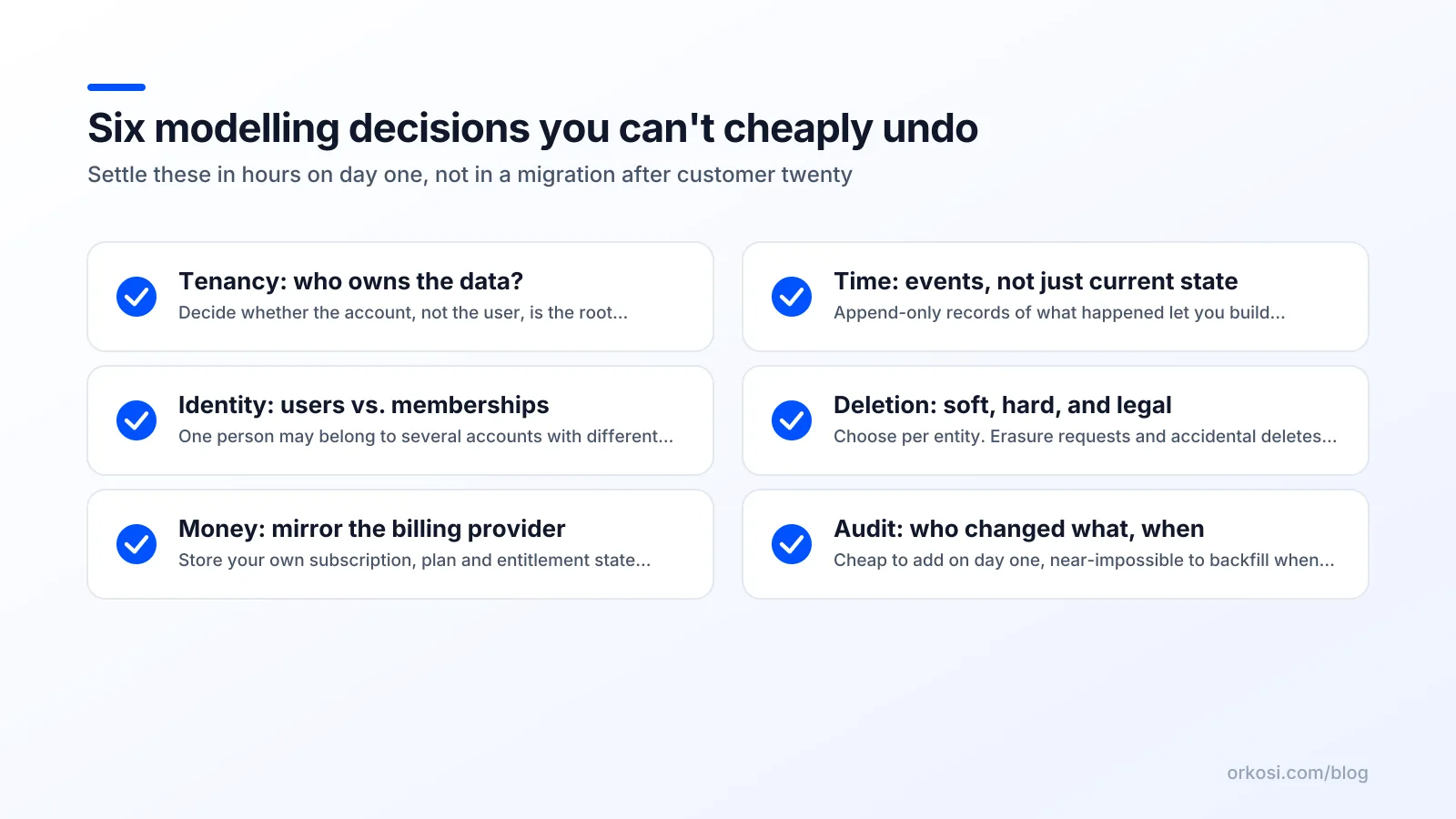
Six modelling decisions you can't cheaply undo
These are the six places where a wrong answer compounds. Settle all six before the first screen is built, even if you settle some with "not yet, but here is where it will go."
Tenancy: who is the account?
Tenancy is how your database separates one customer's data from another's. If you sell to businesses, the account is almost never the individual user, it is the company, and every row needs to know which company it belongs to.
AWS treats this as an architectural choice with real consequences, not a setting: the SaaS Lens of the Well-Architected Framework walks through silo, pool and bridge partitioning models precisely because retrofitting isolation is painful. Recommendation: put a tenant identifier on every table from row one, even in your MVP, even with one customer.
Identity: users, members and invitations
A person is not the same thing as their membership of an account. The same email may eventually belong to two agencies, and a user you invited last week may not have signed up yet.
Model three things separately: the user (an identity with a login), the membership (that user's role inside one account), and the invitation (a pending membership with no user attached yet). Recommendation: separate user from membership before you add your second customer, not after.
Money: plans, subscriptions and the Stripe mirror
Your billing provider holds the truth about payments, but your app still needs its own copy of what a customer is entitled to. Stripe's model of customers, subscriptions and prices has to be mirrored into your schema, because your app must answer "can this account use this feature right now" without calling an API on every page load.
That mirror is a modelling decision: what fields, updated by which webhook, and what happens during the gap when payment fails but access has not yet been revoked. Recommendation: store subscription status and current period end on the account, update them from webhooks, and never compute entitlement from a hard-coded plan name in your UI code.
Time: events vs. states
A state says "this booking is cancelled." An event says "this booking was cancelled by Maya at 14:03 on 3 March." States are smaller and simpler. Events are the only way to answer questions about history.
Most SaaS products need both, and the failure mode is storing only the state and then being asked for a trend. Recommendation: for anything money, status or compliance touches, store the event log and derive the state from it.
Deletion: soft, hard and legally required
Soft deletion marks a row as hidden. Hard deletion removes it. Under GDPR Article 17, an individual can require actual erasure of their personal data, so "we just hide it" is not always a defensible answer. You also cannot blindly hard-delete a client who appears on three paid invoices.
Recommendation: soft-delete operational records to protect referential integrity, and build one real erasure path that anonymises personal fields while preserving financial rows.
Audit: who changed what, when
The first time a customer says "someone changed this price and it wasn't me," you will discover whether you can answer. Audit trails are almost impossible to backfill, because the information was never captured.
Recommendation: add a minimal audit table on day one recording actor, action, target and timestamp. It costs one table and pays for itself the first time it is needed.
Where no-code tools quietly decide for you
Visual builders do not avoid these decisions. They answer them on your behalf, through the storage layer they ship with, and you inherit the answer whether or not it matches your product.
Spreadsheet-shaped databases and the single-table trap
Many no-code platforms store data in something closer to a spreadsheet than a relational database. That shape rewards wide, flat tables and punishes the normalised structures a multi-tenant SaaS actually needs.
The result is predictable: a single "Bookings" table with columns for client name, client email, therapist name and price, duplicated on every row. It works beautifully for forty rows and becomes unmaintainable at four thousand, because changing one client's email means touching every booking they ever made.
When relation depth, not row count, is the constraint
The harder version of no-code database limitations is not row caps. It is that per-tenant isolation, custom indexing and row-level permissions are either absent or approximated with filters in the UI layer, which means a bug in a view becomes a data leak.
Once you own real code on a real database, you can enforce separation where it belongs. PostgreSQL's row security policies let the database itself refuse to return another tenant's rows, regardless of what the application query asks for. That is a guarantee a filtered view cannot make.
None of this means no-code is wrong. For an internal tool, a single-tenant tracker, a waitlist, a client portal for one agency, or a prototype you intend to throw away, a visual builder is faster and perfectly adequate. The ceiling only matters if you plan to sell the thing to many separate organisations. For a longer breakdown of where that line falls, see Orkosi compared with other builders.
Why AI agents make this better and worse at the same time
Agents that write real code against a real Postgres database remove the tool's ceiling entirely. They also introduce a failure mode visual builders never had.
Agents will happily generate a plausible, wrong schema
Ask an agent for "a booking app" and you will get a schema. It will be syntactically valid, reasonably named, and wrong in at least one of the six ways above, usually tenancy, because nothing in your prompt said you were selling to multiple studios.
This is the core risk when an AI agent builds SaaS schema without direction: confidence is not correctness, and a generated model nobody reviewed is still an unreviewed model. The agent is fast, not clairvoyant.
Prompting for the model, not the feature
Change what you ask for. Instead of "build me a booking page," ask for the data model first and read it back.
A useful prompt shape: "List the entities, their relationships, and which table carries the tenant identifier. Assume I will sell this to 200 independent studios, each with 2 to 20 staff. Do not write any UI yet." Then check the output against the six decisions. That review takes twenty minutes and saves weeks.
Platforms built around this kind of iteration make the review cheap. On Orkosi, each change is a task against a running codebase deployed on AWS, so "revise the schema, then regenerate the screens" is a normal request rather than a rebuild. The Orkosi docs cover how tasks and deployments relate.
Migrations: the thing to ask for before you need it
A database migration without code is not magic, it is a versioned script the agent writes and runs. Martin Fowler's Evolutionary Database Design makes the case that schemas can change safely over years, but only with discipline: every change scripted, versioned alongside the application, and reversible.
Ask your agent, before launch, to confirm that migrations are versioned and that a rollback exists. If the answer is "I edited the database directly," you have no history and no safe path backwards.
A data-first sequence to build a SaaS product without code in two weeks
The modelling pass is hours, not weeks. Here is a sequence that front-loads it without turning your launch into an architecture project.
Day 1: write the nouns and the counts
List every noun your product stores. Next to each, write the expected count at 100 customers: accounts (100), users per account (2 to 20), bookings per account per month (200), invoices per account per month (30).
Counts expose structure. Anything that grows quickly needs its own table and an index. Anything that stays at one per account can live on the account itself.
Day 2: one review pass against the six decisions
Walk the six decisions in order and write a one-line answer for each. Tenancy: account is the studio. Identity: user, membership and invitation are separate. Money: Stripe mirror on the account. Time: event log for bookings and payments. Deletion: soft delete plus an erasure path. Audit: one table, four columns.
Hand that document to the agent as the specification. This is the highest-leverage page you will write all month.
Days 3-14: let the agent build screens on top
Now the fast part is actually fast. Screens, flows, emails, admin views and the marketing site all sit on a structure that will not need rewriting, so iteration is additive rather than corrective.
This is the stage where hosting, billing and deployment should be somebody else's problem. Orkosi bundles the AWS deployment, brand kit and SEO tooling with the agent work so the build does not stall on infrastructure, and the credit-based plans are listed on the pricing page. Other paths exist, including hiring a developer for the schema and using a builder for the rest. Examples of finished products are on the showcase page.
How to tell your model is wrong before customers do

The copy-paste smell
If users are retyping the same information into two places, something that should be one record is two. A client whose phone number lives on both the client profile and every booking means the booking should reference the client, not copy it. Fix: replace the duplicated fields with a relationship now, while you have dozens of rows instead of thousands.
The 'we handle that in a spreadsheet' smell
When you or your first customers keep a side spreadsheet, that spreadsheet is a missing entity. It is usually commissions, capacity, or anything with a date range attached. Fix: ask what the spreadsheet's columns are. That is the table your schema is missing, and adding it is a small task today.
The report you can't build
If a customer asks "how much revenue did Maya generate in March" and the honest answer is "I can't get that out," the data is there but not structured to be queried. Usually it means you stored a state where you needed an event. Fix: add the event log and backfill what you can before the history gets long. In three weeks you lose almost nothing. In three years you lose the only record of how the business behaved.
FAQ
Can you really build a SaaS product without code in 2026?
Yes, for a large and growing class of products. AI agents can write, deploy and iterate on real application code against a real database, which removes the ceilings visual builders imposed. The constraint has shifted from what the tool allows to whether anyone reviewed the data model the agent generated. Products with heavy regulatory, real-time or hardware requirements still need specialist engineering.
Do I need to understand SQL to design a data model?
No. You need to name your entities and answer "can one of these have many of those" for each pair. SQL is the language used to implement and query the model; the modelling itself is a thinking exercise you can do on paper in an afternoon. The agent handles the translation into tables, keys and indexes.
What happens to my data if I outgrow a no-code tool?
You can usually export the raw records, often as CSV, but you rarely export the structure, permissions, automations or integrations. The migration cost is the rebuild, not the data transfer, and it grows with the number of relationships encoded in the tool's conventions. Products built as real code on a standard database like PostgreSQL stay portable because the schema travels with the data.
Can an AI agent change my database schema after launch without losing data?
Yes, if it works through versioned migrations rather than editing the live database directly. A migration describes the change as a script, applies it in order, and can be rolled back. Ask explicitly for migration files and a backup before any structural change, and test on a copy first. Adding tables and columns is low risk; splitting, merging or renaming needs a plan.
Start by writing your nouns and your counts, then hand that one page to an agent and watch how much faster the screens come together. You can start free and check what the credit-based plans cover on pricing.