AI App Builder for Startups: Judge It on Day 90
Orkosi Team · · 11 min read

Every credible AI app builder for startups now produces a working-looking app from a single prompt. Auth, a dashboard, a table, a payment button, deployed on a URL you can send to a friend. That is genuinely useful, and it is also almost zero signal about whether you should commit. The question that decides your next six months is not how good the first build looks. It is what happens to change number forty, on day ninety, with real customers in the database.

The day-one demo is a terrible predictor
Why first-prompt output converges across tools
First-prompt output has converged because it is the easiest part of the problem. A CRUD app (create, read, update, delete) with a login screen is the most heavily represented pattern in every model's training data. Ask five tools for "a job board with employer accounts and Stripe checkout" and you will get five variations on the same scaffold, because there is a dominant right answer and the models all know it.
So demo quality mostly tells you about the tool's prompt engineering and its template library. Neither survives contact with your actual roadmap. That said, fast demos are not worthless: they de-risk the idea stage cheaply. If you need to know whether a concept is coherent enough to show a design partner, a one-hour build is a bargain.
What you're actually buying: change velocity
What you are buying with a monthly subscription is change velocity: how quickly and safely the system absorbs a modification you did not plan for. DORA, the research programme behind the industry's standard delivery metrics, measures this with two numbers worth borrowing: lead time for changes (how long from request to running in production) and change failure rate (the share of changes that cause a degradation needing a fix or rollback). Both are defined in DORA's four key metrics guide.
Those two numbers, measured at day 90 rather than day 1, are the only evaluation that matters. A tool that ships your first build in an hour and then needs three attempts per change has a worse lead time than a tool that took a day and absorbs changes cleanly.
What changes between day 1 and day 90
The change inventory nobody plans for
Here is what actually lands in the first three months. Not a hypothetical list, the recurring one:
| Change | Why it arrives | What it touches |
|---|---|---|
| A second user type (admin, agency, team member) | Your first customer has a colleague | Auth, permissions, every query |
| Stripe edge cases: refunds, proration, failed payments | Someone cancels mid-month | Billing logic, webhooks, email |
| A spreadsheet import | Customers arrive with existing data | Parsing, validation, schema |
| Auth complaints: magic links, password reset, SSO request | Real users forget passwords | Session handling, email delivery |
| A data deletion request | GDPR Article 17, or just a cautious user | Every table with a foreign key |
| Dependency security updates | A CVE lands in a library you did not choose | Build, deploy, possibly API changes |
| A schema change you did not foresee | The product was slightly wrong | Live rows, migrations, backups |
Six of those seven are invisible on day one. None of them is an interesting product decision. All of them are mandatory.
Who the app serves at day 90 vs day 1
On day one your app serves you. It needs to look plausible in a browser. Nothing has to survive a refresh, and there is no data you would be upset to lose.
On day ninety your app serves people who are paying and people who are operating it. That means the AWS Well-Architected operational excellence pillar requirements stop being theoretical: you need to observe what the system is doing, know what changed, and roll back safely. Those are not enterprise luxuries. They are what separates "we had a bug" from "we lost Tuesday's signups".
The day-90 test: six questions to ask before you commit
Ask these six questions of any AI app builder for startups, and verify each one during the trial rather than taking the marketing page's word for it.
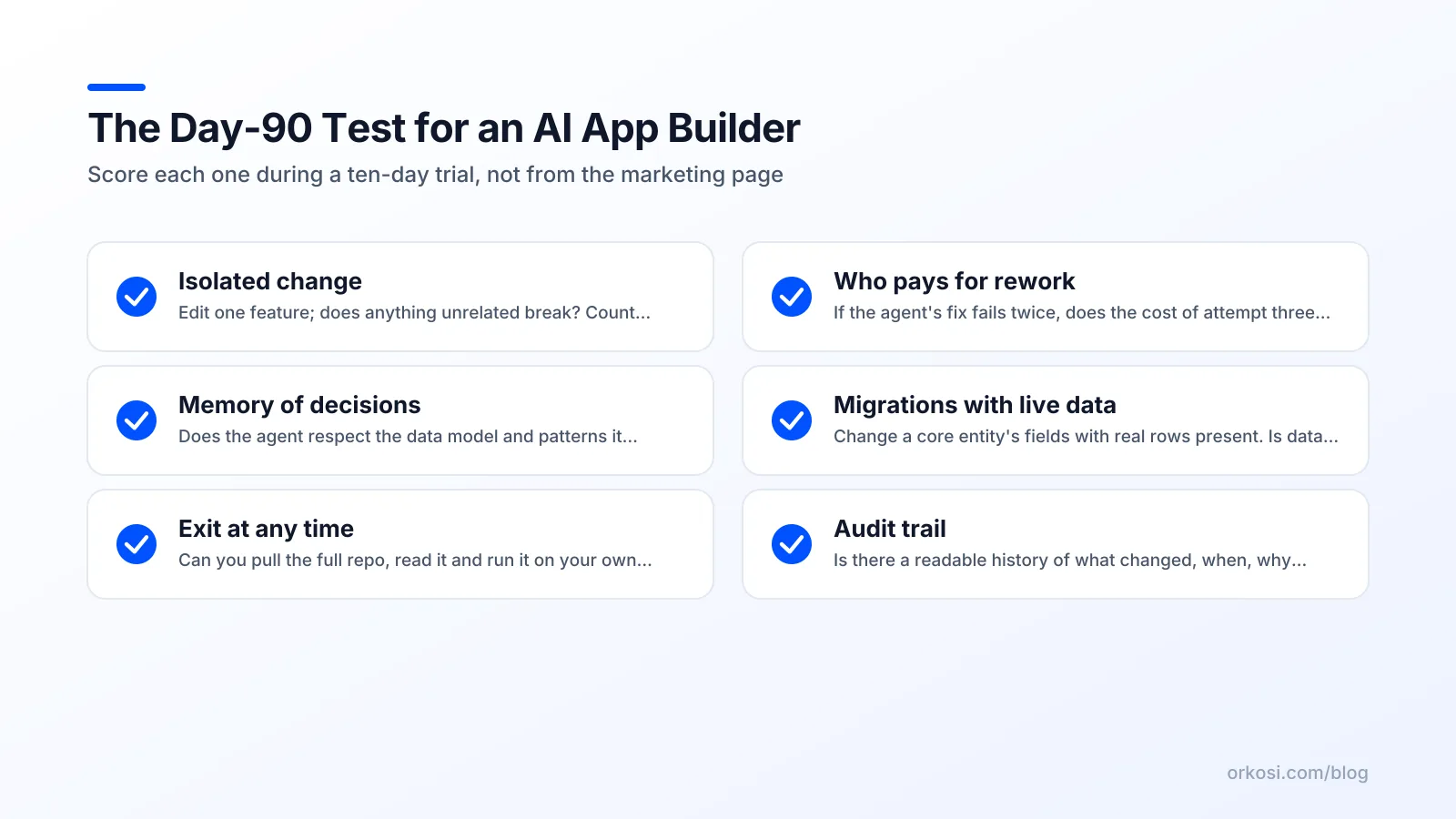
Can it change one thing without breaking two?
The answer you want: a change to one feature leaves the rest untouched. How to verify: build three features, then modify the second one and manually test the first and third. Repeat with a change to a shared concept, such as renaming "project" to "workspace". Count the collateral breakage. This is your informal change failure rate for AI code, and anything above one in four is a warning.
Does it remember the decisions it already made?
The answer you want: the agent respects the architecture it built last week without being re-told. How to verify: on day five, ask for a feature that depends on a convention established on day one (your permission model, your naming, your date handling). If it invents a second, parallel way of doing the same thing, context is not persisting, and your codebase will fork into dialects.
Can you get the code and run it elsewhere?
The answer you want: a full repository export that builds and runs outside the platform. How to verify: export it, clone it on a clean machine, and follow the instructions. If it will not start without the vendor's runtime, you do not own a product, you own a tenancy. Test this in week one, not month six, when the answer costs more.
Who pays for rework when the agent breaks something?
The answer you want: clarity, and ideally a model where failed attempts are cheap. How to verify: read the billing rules, then break something deliberately and watch the meter. Metered and credit-based tools charge for the fix attempts too, so the real question is attempts-per-successful-change. Check the specifics on the vendor's own pricing page rather than guessing.
What happens to data on a schema change?
The answer you want: a reversible migration that preserves existing rows, with a backup taken first. How to verify: seed 50 realistic records, then change a core entity: split a name field, make an optional field required, add a relationship. Check all 50 rows afterwards. "It regenerated the database" is a failing answer once a single customer exists.
Is there an audit trail of what changed and why?
The answer you want: a per-change record (task, diff, deploy, rollback) you can read in six weeks when something is subtly wrong. How to verify: make five changes, then try to answer "when did the pricing logic change and what else shipped with it?" If the history is a chat log, debugging at day 90 becomes archaeology.
Four ways change velocity dies
Generation speed and change safety are different properties. The 2024 DORA Accelerate State of DevOps Report found that increased AI adoption correlated with reduced delivery throughput and reduced delivery stability, even as individual productivity perceptions improved. Code arrives faster; the system gets shakier. Here is the mechanism, in four patterns.
Context loss: the agent forgets your architecture
Symptom: two authentication helpers, three date formats, a second API client that duplicates the first. Cause: the agent's working context does not span the whole project, so it re-derives decisions instead of recalling them. Mitigation to demand: persistent project context (documented conventions, a spec the agent reads before each task) rather than a per-session chat window.
Entanglement: features wired through the UI, not the data model
Symptom: adding a second user role requires edits in nineteen files. Cause: generated apps often encode business rules in page components because that is where the prompt pointed. There is no single source of truth for "who can do what". Mitigation: ask the agent to implement permissions once, at the data layer, and test it by adding a role. If a new role is a one-place change, the model is sound.
Migrations by hope: schema edits with live rows
Symptom: a field change that empties a column, or an export that silently drops records. Cause: regenerating a schema is easy; migrating data is a careful, ordered operation with a rollback plan. Mitigation: require migrations as explicit, reviewable steps, with a backup before each one. Insist on seeing the migration, not just the result.
Silent dependency rot: the CVE you never see
Symptom: nothing, for weeks. Then a scanner or a customer's security questionnaire finds a known-vulnerable library. Cause: your app was generated against a snapshot of package versions and nobody is watching them. OWASP A06:2021, Vulnerable and Outdated Components exists precisely because this is the easiest way for a competent codebase to become a liability. Mitigation: ask who patches dependencies, how often, and whether you get told.
Underneath all four is the rework problem that developers report directly. In the Stack Overflow Developer Survey 2025, the leading frustration with AI tooling was output that is "almost right, but not quite", and trust in AI accuracy was notably low even among frequent users. Almost-right code is more expensive than obviously-wrong code, because you ship it.
The cost curve nobody models
Rework is the hidden line item
Founders model AI app builder cost over time as first-build cost plus a subscription. The real curve is dominated by rework. Every failed change costs you twice: once for the attempt, once for the fix, plus the re-testing you now do not trust yourself to skip.

So the metric to track during a trial is attempts per successful change. A builder at half the price that needs three attempts per change is not cheaper; it is 50% more expensive and three times slower. This is the single most common evaluation error I see.
Credits, infra and the month-three bill
Agent work is metered somewhere, under some name. On Orkosi it is credits, where 1 credit = $0.01: Starter is $25/month including 2,000 credits, Pro is $100/month including 6,000, and Enterprise is $245/month. I am deliberately not converting those into "changes per month", because consumption depends on how large and well-specified your tasks are. Current details are on the Orkosi pricing page.
The second line item is infrastructure, which grows with real usage rather than with your roadmap. An app with 40 customers and three months of records costs more to run than an empty demo. Model both, and treat any tool that cannot tell you where your spend is going as a risk.
How to run a 90-day stress test in ten days
You do not have to wait ninety days to evaluate AI coding agents. Compress the change inventory into ten.
Days 1 to 2: build the ugly version
Build the real MVP, not a toy. Three or four entities, one payment path, one email. Skip polish entirely; you are not evaluating aesthetics. Then seed 50 realistic records and, if possible, invite one actual user.
Days 3 to 6: six deliberate changes
Request these, one at a time, in this order:
- Add a second user role with different permissions.
- Change a core entity's fields with the 50 live rows in place (split one field, make one required).
- Add a Stripe refund path with a webhook.
- Rename a central concept everywhere it appears, including emails and URLs.
- Add a CSV export of one entity.
- Revert change 4 completely.
Log attempts and collateral breakage for each. Change 6 is the sleeper: reverting cleanly is the clearest proof that the system tracks what it did.
Days 7 to 10: break it, export it, price it
Delete a required field in production data and see whether the app degrades or dies. Export the repository and run it on a clean machine. Then total your credit or token spend and divide by five successful changes to get a real unit cost.
Scoring rule: count how many of the six changes needed more than two attempts. Zero or one, commit. Two or three, proceed with a plan to review the code yourself. Four or more, walk away, however good the day-one demo was.
Where Orkosi sits, and what it doesn't fix
Orkosi is built around the change loop rather than the first build: you describe the product, agents write it, deploy it on AWS, and then keep iterating through discrete tasks, each of which is a reviewable unit of change. You own the code. Hosting, brand kit, billing, SEO and marketing tooling are included, and templates cover SaaS and web apps, an online store, websites, mobile and desktop apps, image studio and video channel. Examples are in the showcase, and the task model is documented in the docs. It should be judged on the same six questions as everything else, which is why we publish a direct comparison with other builders.
What no tool fixes, including this one: a vague spec produces vague software, and a muddled data model stays muddled no matter who writes the migrations. If you cannot say in two sentences who the user is and what object they manipulate, the agent will guess, and you will pay for the guess at day 90. Someone still has to decide what the product is, and that someone is you.
FAQ
What is the best AI app builder for startups in 2026?
There is no single winner, because the deciding factor is how a tool handles your specific change pattern, not its feature list. Judge candidates on the day-90 test: isolated changes, persistent context, code export, data-safe migrations, an audit trail, and transparent rework costs. Run the ten-day protocol above on your two shortlisted tools with your real MVP. For tool-by-tool detail, see the comparison.
How do I test an AI app builder before committing?
Build your actual MVP in two days, seed 50 realistic records, then force six deliberate changes: a second role, a schema change with live rows, a Stripe refund path, a global rename, an export, and a full revert. Count how many needed more than two attempts. Finish by exporting the repository and running it on a clean machine. Ten days gives you a reliable read.
Does AI-generated code get harder to change over time?
It can, and the mechanism is specific: duplicated conventions from context loss, business rules scattered through UI components, and migrations applied without a rollback path. The 2024 DORA report found AI adoption correlating with reduced delivery stability, which matches that pattern. AI-generated code maintenance stays manageable when the agent reads a persistent spec, permissions live in the data layer, and every change is a reviewable, revertible task.
Should I rebuild if my AI-built app stalls at month three?
Usually no. Rebuilding resets your data, your integrations and your calendar, and often reproduces the same entanglement with a different tool. Diagnose first: if the data model is sound and only the UI is tangled, refactor the tangled layer. Rebuild only when the schema itself is wrong for the product you have discovered, and budget for the migration either way.
Run the ten-day stress test on your own idea rather than on a demo: start free and put six real changes through it. Check pricing before you commit to anything beyond the trial.