No-Code vs AI-Generated Software: Passing the Audit
Orkosi Team · · 11 min read
The question nobody asks until a deal is on the line
Six months after launch, a mid-market buyer replies to your proposal with a spreadsheet. Forty questions, three tabs, a column for "evidence/attachment". This is the moment where the choice between no-code vs AI-generated software stops being a debate about speed and starts being a question about paperwork. Most comparisons argue about what each approach can build and how fast. The decision that actually costs money is simpler: when someone asks you to prove how your product handles their data, who is able to answer?

"Evidence" is not a vibe. In a security review it means six specific artefacts: a description of your architecture, a data flow showing what personal data enters the system and where it lands, a list of subprocessors (every third party that touches customer data), a description of who has production access and how that access is granted and revoked, a documented backup and restore procedure with evidence you have tested it, and a vulnerability handling process with timelines. Some of those you can write in an afternoon. Some you cannot write at all if your application logic runs inside someone else's runtime.
My position: for consumer products and internal tools, no-code is usually the better bet. The moment your buyer has a procurement process, owned source code is worth more than the weeks it saves you, because evidence you can produce yourself is the only evidence that survives a follow-up question.
No-code vs AI-generated software: two different things are being compared
No-code: you rent an application you configure
A no-code platform executes your app. You define tables, logic, forms and permissions in a visual editor, and the vendor's servers interpret that configuration at runtime. There is no repository you can clone, no container you can inspect, no database you can connect to with your own credentials unless the platform exposes one. You are a tenant. Your product is a configuration inside a product that someone else owns and operates.
AI-generated: you own source code that runs in your accounts
AI-generated software means agents write conventional code: a framework, a repository, migrations, a database schema, infrastructure definitions. The output is the same kind of artefact a contract development shop would hand you, deployed to cloud infrastructure you control. Orkosi works this way, as do several coding-agent tools; the agents build and deploy, and the repo and the AWS account stay yours. You are the operator, with everything that implies in both directions.
Both routes can get a working product in front of users in days. The difference is not capability at launch. It is what you can inspect, move and prove in month seven.
What a security questionnaire actually asks for
The nine questions that recur
Almost every security questionnaire for startups is a reshuffling of the same nine items:
- In which country or region is customer data stored?
- Is data encrypted at rest and in transit, and with what?
- Who has production access, and how is it granted, reviewed and revoked?
- Do you maintain audit logs of administrative and user actions, and for how long?
- How do you identify and patch vulnerabilities, and within what timeframe?
- May we or a third party perform a penetration test?
- Do you have a Data Processing Agreement and a current subprocessor list?
- What are your RTO and RPO (recovery time and recovery point objectives), and when did you last test a restore?
- Do you hold SOC 2 Type II or ISO 27001, and may we see the report?
Who can answer each one
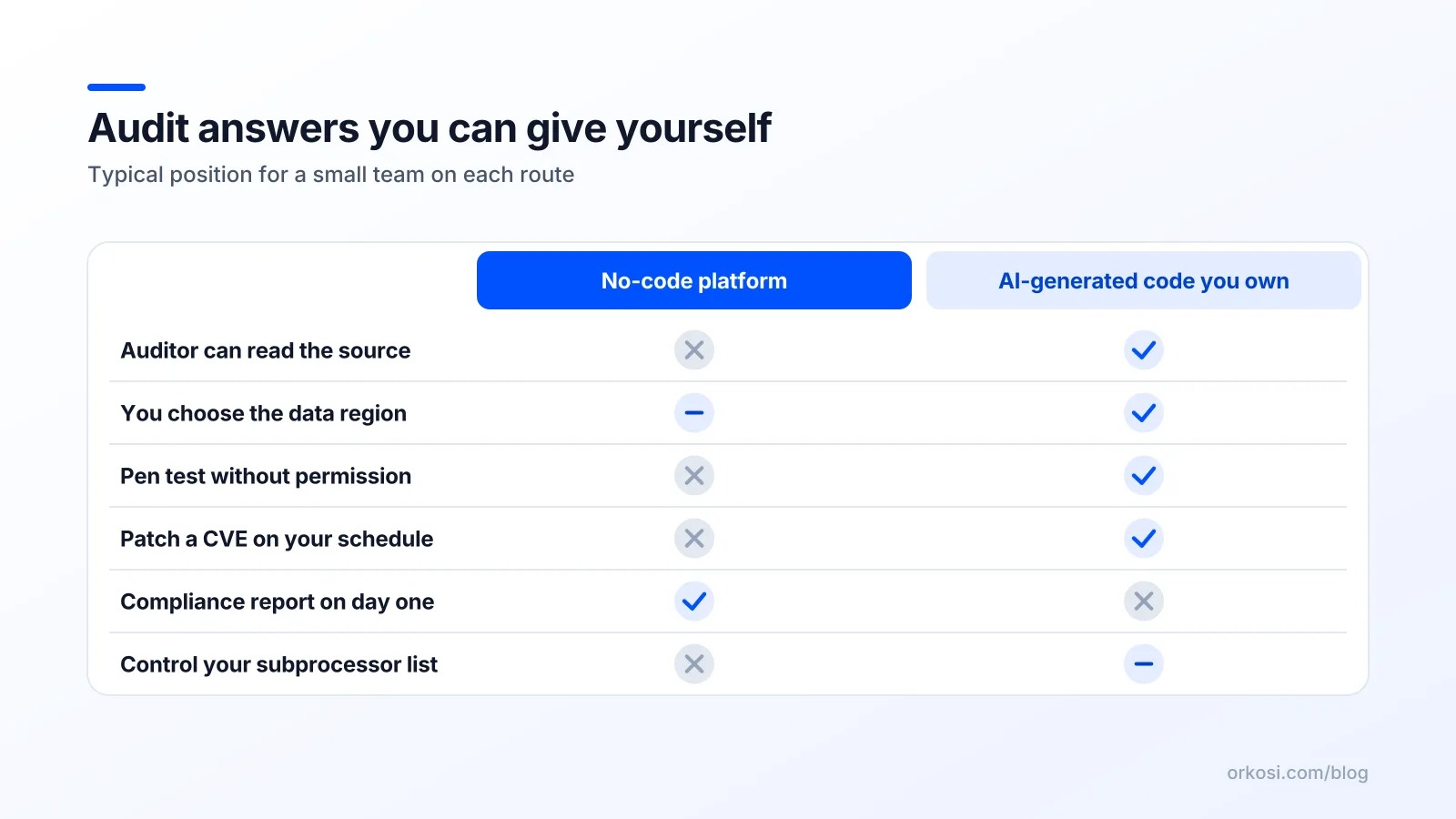
| Question | No-code tenant | Owner of generated code |
|---|---|---|
| Data region | Vendor's answer, limited to regions sold on your plan | Yours: you pick the AWS region at deploy time |
| Encryption | Vendor's answer, usually strong and documented | Yours, and you must configure it correctly |
| Production access | Vendor controls their staff access; you control your editor seats | Yours end to end, including IAM and key rotation |
| Audit logs | Often a higher plan tier | Yours to build, and nobody builds them by default |
| Patching | Vendor's schedule, not yours | Yours: dependency bumps on your timeline |
| Pen test | Requires vendor permission; frequently refused | Yours to authorise against your own account |
| Subprocessors | Inherited, and changes are announced to you | Yours, and you chose each one |
| RTO/RPO | Vendor's SLA, if published | Yours, which means untested unless you test it |
| SOC 2 / ISO | Vendor has one; you do not | Neither of you has one yet |
That last row is where most founders get confused. Running on AWS or on a certified no-code vendor does not make you certified. The AWS Shared Responsibility Model draws the line explicitly: the provider secures the infrastructure of the cloud, you secure what you build in the cloud. Inheriting a provider's compliance covers the data centre, the hypervisor and the physical controls. It says nothing about whether your endpoint checks authorization.
Where no-code wins the audit
Here is the honest counter-position, and it is stronger than code-owners like to admit. A mature no-code vendor hands you, on day one, a trust centre with a SOC 2 Type II report, penetration test summaries, encryption specifications, an uptime history and a signed DPA template. A two-person startup cannot produce any of that alone. Getting your own SOC 2 Type II takes a readiness project, an observation window and an auditor, and the whole thing typically lands somewhere between five and six figures.
There is a second real advantage: less code you authored means less code-level attack surface you authored. You cannot ship a SQL injection in a visual table builder. The platform's permission model, declared in a UI, is often easier to reason about and review than hand-rolled middleware, because it is enumerable. You can screenshot it. Reviewers like screenshots.
So if your buyer accepts "our application is built on Platform X, here is their SOC 2 report and here is our configuration," no-code genuinely reaches a passing grade faster. Plenty of six-figure deals close exactly that way, especially where the data is low sensitivity and the reviewer is a generalist rather than a security engineer.
Where no-code fails the audit
Answers you can't give without the vendor
The failure mode is specific: every structural answer becomes a support ticket. You cannot choose a data region unless the vendor sells that region. You cannot authorise a penetration test against infrastructure you do not own, and most platforms' terms forbid it outright. You cannot patch a dependency on your schedule, because you do not know what the dependencies are.
Subprocessors are the sharpest edge. Under Article 28 of the GDPR, a processor may not engage another processor without the controller's authorisation, and must flow equivalent data protection obligations down the chain. When your app runs inside a platform, that platform's subprocessors are now in your chain, and when they add one, your disclosure changes without you touching anything. GDPR data residency questions for no-code apps have the same shape: "where is the data" is answerable only to the precision your vendor offers.
Requirements the plan doesn't cover
Then there is the pricing trap. SSO, SAML, granular audit logs, custom data retention and region selection are, on most platforms, enterprise-tier features. A compliance requirement therefore becomes a pricing negotiation at the worst possible moment: after you have promised a buyer you can meet it. Founders who budgeted for a $50/month plan discover the compliant configuration starts an order of magnitude higher, with annual commitment.
Finally, be precise about export. Most platforms let you export your data. Almost none let you export your behaviour. The tables come out as CSV; the workflows, validation rules, permission logic and integrations do not. Vendor lock-in compliance risk is not about hostage data, it is about the fact that leaving means re-implementing the application.
Where AI-generated code fails the audit
Generated code is only as secure as what was asked for, and the default ask is "make the feature work." The recurring findings are depressingly consistent: an endpoint that checks authentication but not authorization, so any logged-in user can read any record by changing an ID; secrets committed to the repository; no rate limiting on login or password reset; dependencies carrying known CVEs; personally identifiable information written into application logs. These are not exotic. They are the OWASP Top 10, and broken access control sits at number one for a reason.
AI-generated code security also has a human problem. The arXiv study Do Users Write More Insecure Code with AI Assistants? found participants with an AI assistant produced less secure solutions across several tasks and were more confident their code was secure. Confidence without verification is the exact condition a questionnaire is designed to expose.
The operational gaps hurt more than the code ones. Nobody set up automated backups. Nobody has ever run a restore, so the RPO in your answer is a guess. Nobody rotated the database credentials after the contractor left. Owning the code means owning the gaps, including the ones you cannot see because no dashboard is telling you about them.
Where AI-generated code wins the audit
Evidence you can produce yourself
Ownership converts unanswerable questions into tedious ones. A buyer's engineer can read your repository under NDA. Your commit history, pull requests and deploy logs are a change management record, which is one of the controls auditors ask about most. You pick the AWS region, so data residency is a deployment parameter rather than a sales conversation. You can authorise a penetration test against your own account tomorrow. Your subprocessor list contains exactly the vendors you chose, and it changes only when you change it.
A repo-and-pipeline setup also maps cleanly onto the NIST Secure Software Development Framework (SP 800-218), which is increasingly the vocabulary buyers use: protect the software, produce well-secured software, respond to vulnerabilities. You can point at branch protection, dependency scanning and a documented release process and say which practice each one satisfies.
Fixes you can ship the same day
When a CVE lands in a dependency, you bump the version and deploy. When a buyer requires 400-day audit log retention, you add a table and a retention job. When they require SSO, you implement it, because SSO is a feature of your product rather than a line item on your plan. The deals that die slowly are the ones where the answer is "we have asked our vendor."
This is the case for agent-built, owned code generally, and it is how Orkosi's platform is structured: agents write the code, deploy it to AWS and keep iterating through tasks, while the repository and the infrastructure stay in your name. The trade-off is unglamorous and real: you are now the operator, so backups, patching and access reviews are your jobs. Orkosi gives you deployment and hosting, not a SOC 2 report; see the pricing page for what plans include and the docs for how deployments are structured.
How to decide: three questions, not a feature matrix
1. Who is your buyer? Consumers and solo operators almost never send a questionnaire. Anyone handling employee data, patient data, student data or money always does, and so does any company whose own customers send them questionnaires. If your first ten customers are HR, health, fintech or education, assume the spreadsheet arrives before your first renewal.
2. Is any requirement structural or cosmetic? Cosmetic requirements are satisfiable with configuration and documentation: a password policy, a privacy page, MFA on admin accounts. Structural requirements touch architecture: a specific data region, a named subprocessor set, the right to pen test, custom retention windows, bring-your-own encryption key. One structural requirement points at owned code, because no amount of negotiation will add it to a plan tier.
3. Could you survive the vendor changing? Write down what happens if your platform adds a subprocessor you cannot disclose, deprecates a feature your product depends on, or triples the price of the tier that holds your audit logs. If the honest answer is "we would rebuild," you have a vendor lock-in compliance problem already; you are just paying for it later.
Whichever route you are already on, the same 90-day list applies. Run a standard questionnaire against yourself and mark every answer you cannot evidence. Perform one real restore from backup into a clean environment and time it, then use that number as your RTO. Inventory your dependencies or your platform's published subprocessors. Draw the data flow on one page: where personal data enters, which services touch it, where it rests, how long it stays. Those four exercises cost a week and answer roughly thirty of the forty questions.
If you are starting from scratch and expect procurement in your future, starting from owned code is cheaper than migrating to it. Browse the app templates to see what the starting point looks like.
FAQ
Can a no-code app be SOC 2 compliant?
Your organisation can be, your app cannot. SOC 2 audits the controls of a service organisation against the Trust Services Criteria, and the scope is your company's system, not the tool you used. You can achieve SOC 2 for no-code apps, but you will need evidence of your own access reviews, incident response and change management, plus vendor due diligence on the platform.
Does AI-generated code pass a penetration test?
It passes or fails on exactly the same findings as handwritten code: broken access control, injection, weak authentication, exposed secrets. The research suggests AI-assisted code ships with more of those flaws, not fewer, and that authors overestimate its safety. The practical difference is remediation speed, because you can fix your own repository the same day a tester reports the issue.
Do I need SOC 2 before my first enterprise customer?
Usually not. A large share of deals close on a completed questionnaire, a signed DPA, a subprocessor list and a short policy pack, often with a contractual commitment to obtain a report within twelve months. Ask the buyer whether a report is a hard gate or a preference before spending the budget; security teams will tell you.
Can I migrate a no-code app to owned code later?
Yes, but treat it as a rebuild rather than an export. Data migrates reasonably well as CSV or via API; workflows, permission rules, validation logic and integrations have to be re-implemented from scratch because they only existed as platform configuration. Budget a real project with real weeks, and do it before the migration is forced on you by a contract deadline.
Pick the route that matches your buyer, then produce the evidence before anyone asks for it. Start a free trial if you want agents building on infrastructure you own, and check the plans to see what fits.