AI App Builder for Startups: Run a 2-Week Bakeoff
Orkosi Team · · 12 min read

Most founders choose their AI app builder the way they choose a restaurant: whichever demo looked best on a Tuesday. That is a bad way to make a decision you will be living inside for a year. Picking an AI app builder for startups is closer to hiring a contractor than buying software, and the only honest way to compare contractors is to give them the same job, the same clock and the same spec. This article gives you a two-week protocol that does exactly that, plus a scorecard that weights the things that still matter in month six.

Every AI app builder demo is a rigged race
Public demos are optimised for one moment: the first prompt landing something that looks like a product. That moment is real, it is genuinely impressive, and it predicts almost nothing about what happens on day nine when you need to change the pricing logic without breaking signup.
Why the todo-app demo tells you nothing
A todo app has one entity, no roles, no money, no third-party integration and no migration path. Every serious tool in this category can produce one in under five minutes, which means the todo demo discriminates between nothing. It is a test every candidate passes.
Worse, greenfield generation is the part of software work that AI agents are currently best at. Judging a builder on generation alone is like judging a chef on how fast they can boil water.
The three things demos always hide
Iteration cost. The first build is one prompt. Real products are 200 change requests. Demos never show request number three, where the agent has to understand the code it wrote on Monday.
Deploy reality. A shareable preview URL is not a deployment. The AWS Well-Architected Framework describes the baseline: backups, monitoring, least-privilege access, a path to recovery. "It loads in my browser" clears none of that.
Ownership. Can you export the code, read it, hand it to a contractor, and run it somewhere else? Some platforms give you a repository. Some give you a hostage. You find out in month four, when leaving is expensive.
The protocol below surfaces all three inside 14 days.
The rule: test an AI app builder for startups on your ugliest real feature, not a greenfield toy
Pick the feature you have been avoiding. That is the test. If you evaluate on something easy, every tool scores well and you learn nothing worth $25,000 of engineering time.
How to pick the feature
A good bakeoff feature meets four criteria:
- It touches real data. Existing records, a schema you care about, or a CSV you can import. Not seeded fakes.
- It has at least one integration. Stripe, an email provider, a CRM, an internal API. Integrations are where generated code most often goes quietly wrong.
- It has permissions or money in it. Roles, tenancy, refunds, quotas. Anything with an "only this person may do this" rule.
- Somebody will actually use it. A teammate or a friendly customer must be willing to touch it in week two.
Examples that work well: a client portal where each account sees only their own invoices; a refund flow with partial refunds and an audit log; a bulk importer that validates rows and reports failures; a subscription upgrade that prorates correctly.
Writing one spec, not two
Write the spec once, in a document, before you open any tool. Include: entities and their fields, roles and what each role may do, 5 to 8 acceptance criteria written as checkable statements, and at least three unhappy paths (duplicate email, expired card, user deletes a record another record depends on).
Then paste the identical text into every tool you are testing. Any prompt-tuning you do for one, you do for both. This is the whole discipline of how to evaluate AI app builders: if the inputs differ, you are measuring your own prompting, not the product. Keep the spec to two pages; longer specs slow the first build everywhere and compress the differences you are trying to see.
The two-week bakeoff protocol
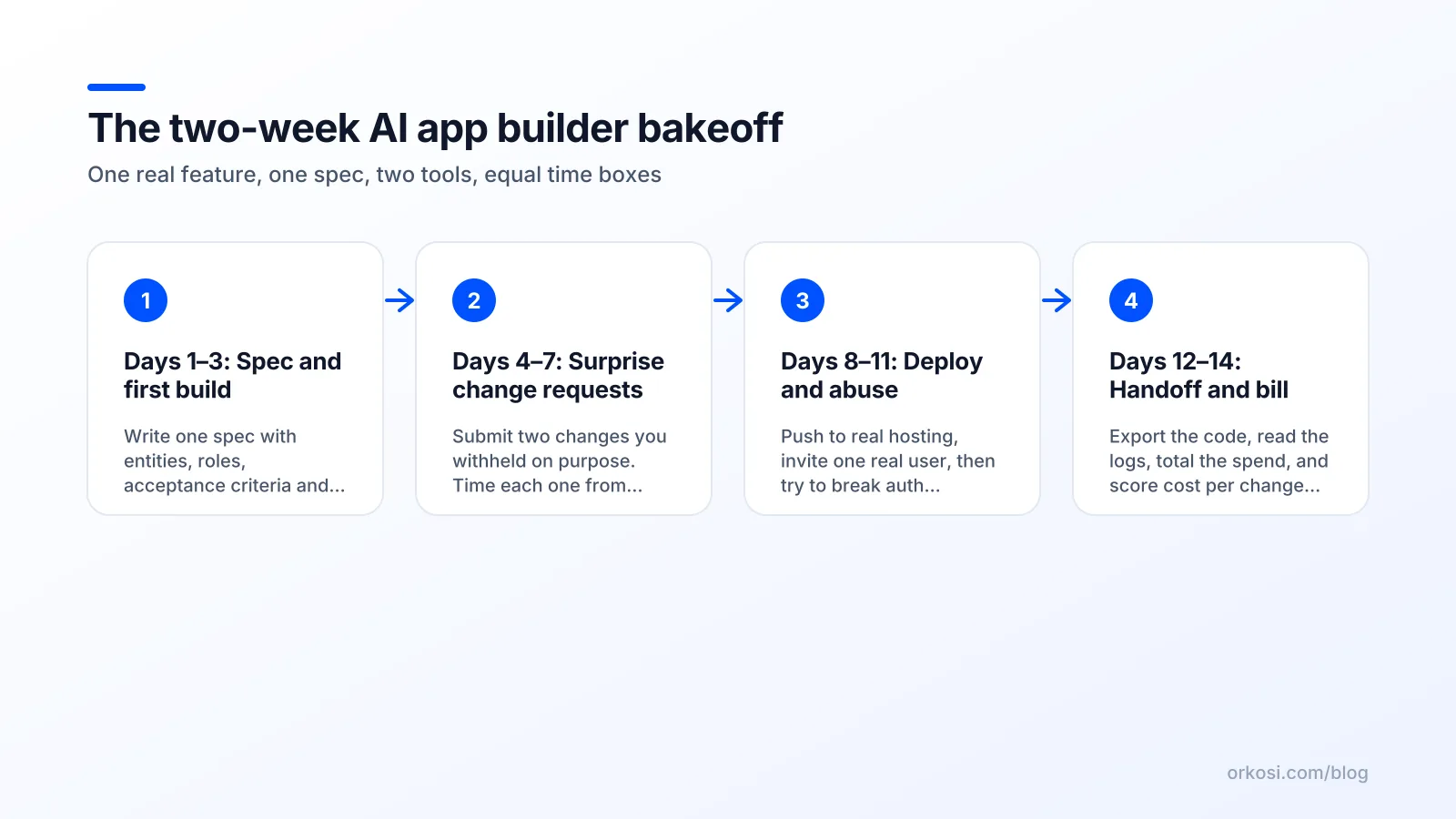
Two tools, ten working days, equal timeboxes. The headline rule: you hold back two change requests until after the first build ships. Generation is the commodity; iteration is the product.
Days 1–3: spec and first build
Day 1 is spec only. No tools. On days 2 and 3, give each tool a hard timebox of four hours of your attention, tracked with a timer, and submit the same spec to each.
Log every interaction: timestamp, what you asked, what came back, whether it worked. Do not trust your memory of speed. METR's study of experienced open-source developers found participants believed AI tooling made them roughly 20% faster while measurement showed them around 19% slower. Your perception of "this one feels fast" is unreliable by a margin wide enough to flip the decision.
At the end of day 3, record for each tool: acceptance criteria passing out of total, and minutes of your attention consumed.
Days 4–7: change requests you didn't tell them about
Now file the two held-back changes, plus one schema change. Good held-back changes look like this:
- A rule inversion. "Admins can now also see archived records, but only for their own organisation."
- A surface change with data implications. "Add a CSV export of this list, including a computed field that doesn't exist yet."
- A schema change. Add a required field to an existing entity with live rows in it.
Timebox each change to 90 minutes per tool. Record: did it ship, did anything previously passing break, and how many back-and-forth turns it took. Regressions matter more than speed. A tool that fixes your request and silently breaks login has negative velocity. This phase is the real AI coding agent comparison. Everything before it is marketing.
Days 8–11: deploy, invite a real user, break it
Deploy both builds to something a stranger can reach over the public internet. Then run three checks.
The user check. Give one real person a task and say nothing. Watch. Count the number of times they get stuck.
The security check. Run the basics from the OWASP Top 10: try to read another account's data by changing an ID in the URL, submit a form field with SQL and script payloads, hit an admin endpoint while logged out, and check whether secrets appear in client-side code.
The operations check. Where are the logs? Does an unhandled error reach you, or vanish? Is there a backup, and can you restore it? Can you roll back the last change?
Days 12–14: the handoff and the bill
Export the code from each platform. Clone it to a clean machine. Try to run it locally, or at minimum open the three most important files and read them. If you cannot read code, pay a contractor for two hours to do this and write you four sentences.
Then pull the money. Total spend per tool, divided by number of shipped changes, gives you cost per change. That number predicts your year-two bill far better than the monthly plan price does. Score on day 14 using the table below, before you discuss it with anyone.
The scorecard: seven criteria that actually predict month six
Use this as your AI builder evaluation checklist. Score 1 to 5, then apply weights.
| # | Criterion | Pass/fail test | Weight |
|---|---|---|---|
| 1 | Change velocity | All three held-back changes shipped inside 90 minutes each, with zero regressions | ×2 |
| 2 | Real deployment | Public URL on infrastructure you control, with logs and a rollback | ×1 |
| 3 | Code ownership | You can export and run the code outside the platform | ×2 |
| 4 | Verification | Tests or error reporting exist without you asking | ×1 |
| 5 | Cost per change | Total spend ÷ shipped changes is a number you can afford ×200 | ×1 |
| 6 | Security basics | Survives the OWASP spot checks in days 8–11 | ×1 |
| 7 | Support reality | A human or useful docs answer a blocking question within one working day | ×1 |
Maximum weighted score is 45. Below 30, do not commit a product to it.
Change velocity, not first-build speed
Score 5 if all three changes shipped cleanly, 3 if two shipped, 1 if any change required you to rebuild from scratch. DORA's research on lead time for changes has consistently identified the time from committed change to running in production as a core predictor of delivery performance. Initial build speed is not on the list, because it happens once.
Does it deploy or just preview?
Score 5 for a real deployment with monitoring and backups, 3 for a managed URL with no observability, 1 for preview-only. Ask directly: if the platform disappeared tomorrow, is my app still serving traffic?
Code ownership and export
Score 5 for a Git repository you own with a readable framework, 3 for export-on-request, 1 for no export. Weighted double because this is the only criterion that determines whether a bad decision is reversible.
Verification: tests, logs, error reporting
Score 5 if the tool wrote tests you did not ask for and errors reach you. The Stack Overflow 2024 survey found roughly three-quarters of developers using or planning to use AI tools, while only about 43% expressed trust in their accuracy. That gap is exactly why verification has to come from the platform rather than your optimism.
Cost per change, not cost per month
Score 5 if cost per shipped change is under roughly 1% of what the same change would cost from a contractor. Multiply by 200 changes and see whether the number still works.
Security basics
Any failure of the ID-swapping test is an automatic 1. Access control failures are the most common serious flaw in generated code and the easiest to miss in a demo.
Who answers at 2am
Score 5 if a human answered within hours and the docs resolved your next two questions without a ticket. Score 1 if your blocking question is still open on day 14.
What the results usually look like (and how to read them)
The fast starter that stalls
Prototype-first tools usually win days 1 to 3 outright: more acceptance criteria passing, fewer minutes spent. Then the schema change arrives and they regenerate half the app, losing work. In my experience this is the single most common outcome, and it is why choosing an AI development platform on a 20-minute trial is unreliable.
The slow starter that compounds
Tools that deploy to real infrastructure look worse early. There is actual setup: environments, a database, access policies. By day 10 they are ahead, because the second and third changes cost roughly the same as the first and nothing silently regressed.
Orkosi sits in this second camp, deploying to AWS rather than serving a preview, which means your day-2 impression will be slower than a preview-only competitor's. That is a genuine trade-off, not a hidden virtue, and the bakeoff is designed to tell you whether it pays back by day 14.
When both fail
A tie usually means your spec was vague. Check whether your acceptance criteria were actually checkable; "the dashboard should feel fast" is not. Rewrite and rerun days 4 to 7 only. If both tools fail the security checks on a feature handling money or medical data, the correct answer is to hire a human for that specific slice and keep the agents on everything around it.
Trade-offs I won't pretend away
Two weeks of founder time is expensive. This protocol costs roughly ten working days of founder attention plus two trial subscriptions. For a decision that shapes 12 months of product work, that is cheap. For a weekend project, it is absurd.
Bakeoffs favour the measurable. Change velocity, cost and export are easy to score. Design taste, architectural judgment and whether the vendor still exists in 2028 are not. Read the scorecard as 80% of the decision, not 100%.
Switching costs are real. A bakeoff winner can still be the wrong long-term bet, which is why criterion 3 carries double weight: keep the exit cheap. For a smaller decision, run a compressed four-day version: day 1 spec, day 2 first build, day 3 two held-back changes, day 4 deploy and security spot checks. You lose the real-user signal and the cost-per-change sample size, but you keep the part that matters most.
How to run the bakeoff on Orkosi
If Orkosi is one of your two candidates, here is the concrete mapping. Start with the free trial so your AI app builder trial costs nothing but time: create an account and check the plans page before you compare running costs.
Pick the template that matches the product
Choose the template that matches what you are actually building: SaaS / Web App, Online Store, Website, Image studio, Mobile app, Desktop app, or Video Channel. Running a storefront bakeoff on a generic web app template adds work that has nothing to do with the tool's quality. The showcase shows what each template produces.
Spec, task, iterate, deploy
Paste your two-page spec as the product description, exactly as you gave it to the other tool. On day 4, file your held-back change requests as individual tasks so each one has a clean start and end you can time. Deploy to AWS during days 8 to 11 so the operations checks run against real infrastructure rather than a preview.
Watching credits as a cost signal
Credits make cost per change visible: note the credit burn for each of the three held-back changes and divide. With 1 credit equal to $0.01, that converts straight into dollars per change for your scorecard.
The honest downside is that iteration has a visible marginal cost, which some founders find uncomfortable compared with a flat subscription. The upside is that you learn your true unit economics in week one instead of month six. For a feature-level view alongside the bakeoff, the comparison page lays out where Orkosi differs from other builders.
FAQ
How many AI app builders should I test at once?
Two. Three doubles your logging burden and halves your attention per tool, which corrupts the timeboxes that make the comparison valid. Shortlist three or four on paper using the scorecard criteria, eliminate on deal-breakers like no code export, then run the full two weeks on the final two.
Can I run a bakeoff without any coding ability?
Mostly yes. Spec writing, change requests, user testing, cost per change and the URL-based security checks all work without code. Budget two hours of a freelance developer's time at the end of week two to read the exported code and answer one question: would you be willing to maintain this?
What if both tools produce code I can't read?
That is a finding, not a failure. Unreadable output means every future change must go through the platform, which turns criterion 3 into a 1 for both and raises your switching cost sharply. Either accept that lock-in consciously, or rerun the test with a tool that targets a mainstream framework your future hires will recognise.
Should I throw away the bakeoff build afterwards?
Keep the winner's build and throw away the loser's. Because you chose a real feature with real data, the winning build is usually production-viable after a security pass and a design cleanup. Throwing it away also throws away the only version of your product that has been tested by a real user.
Run the protocol, score it honestly, and let the day-10 numbers decide rather than the day-2 feeling. Start a free trial to put Orkosi on one side of the chalk line, and check pricing when you are ready to compare the real cost per change.