Why Every Small Business Needs a Custom App (Not Just a Website)
Orkosi Team · · 9 min read
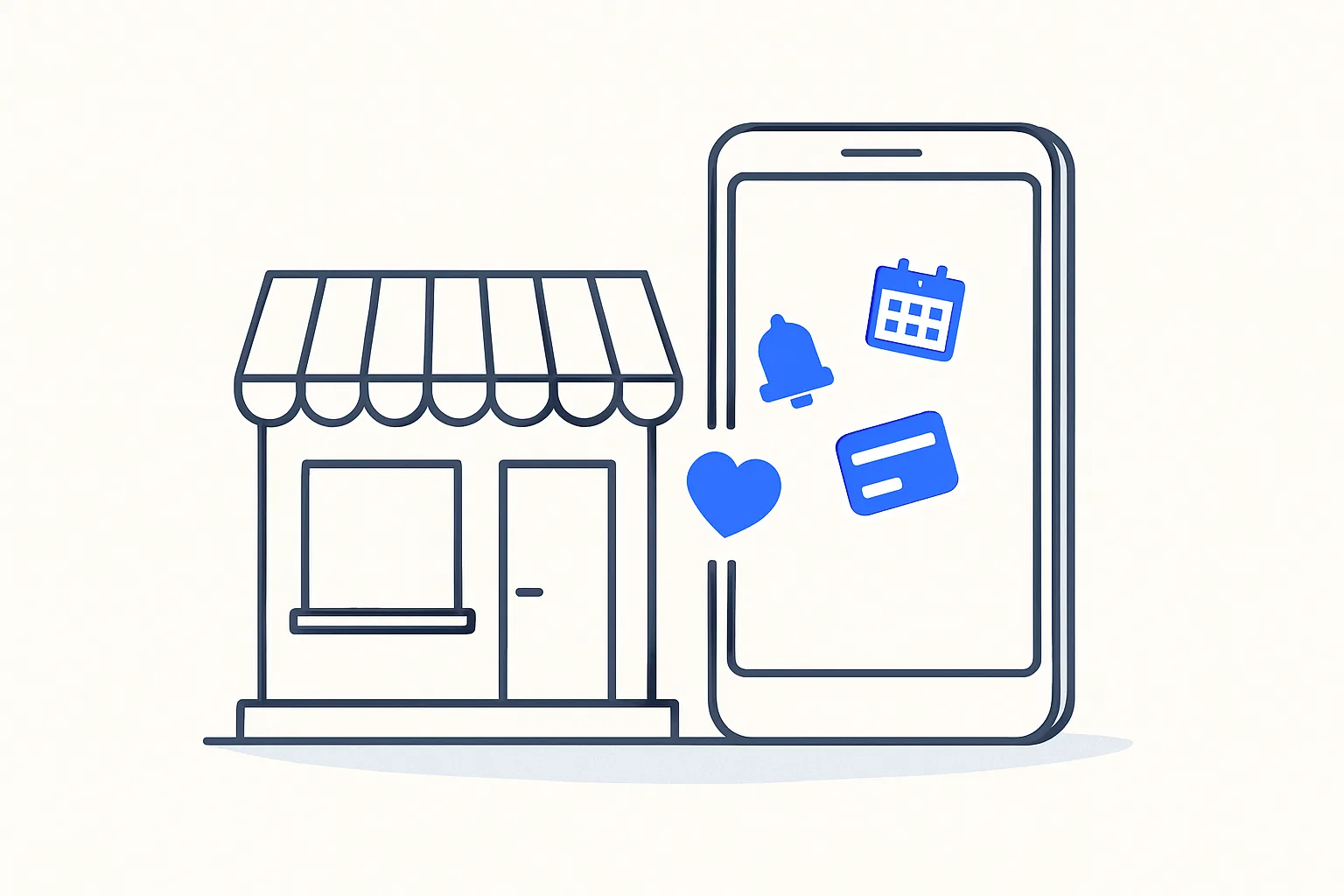
A custom app for small business used to mean a six-figure agency quote and a nine-month timeline, so most owners settled for a website and a phone number. That maths has changed. In 2026 a clinic, gym or contractor can have a working app with bookings, payments and customer accounts for less than the cost of a part-time receptionist, and the gap between businesses that run on software and businesses that run on voicemail is widening every quarter. This article explains what an app does that a website cannot, shows what it looks like for five common business types, and puts real numbers on the cost of getting one built.

A website tells; an app does
A website is a brochure. It answers "who are you, what do you offer, how do I contact you." That is still necessary, and Google's Core Web Vitals guidance still matters for being found. But a brochure does not take a booking at 11pm, charge a deposit, remind the customer the morning of, or tell your staff what the day looks like.
An app, in the sense used here, is software that does work for your business: it holds customer records, moves money, sends notifications, and gives your team a screen to run the day from. It can be a web app that customers open in a browser, a mobile app, or both. The distinction that matters is not "website versus app" as technologies; it is content versus operations.
Most small businesses already run operations across four or five disconnected tools: a booking widget from one vendor, a card terminal from another, a WhatsApp group for staff, a spreadsheet for loyalty stamps, and an email marketing account nobody has logged into since March. Each costs $15 to $80 a month. None of them talk to each other. The customer experiences the seams.
Website vs custom app: what each actually handles
| Capability | Standard website | Custom app |
|---|---|---|
| Bookings | Embedded third-party widget, generic, no deposit logic | Native booking flow with your rules: buffers, deposits, staff availability, waitlists |
| Payments | Link out to a processor, or none | Stripe checkout, deposits, packages, memberships, invoices, refunds in one place |
| Customer accounts | None; every visit is anonymous | Login, history, saved preferences, documents, family or team members |
| Notifications | Contact form emails you | Automated SMS and email reminders, confirmations, follow-ups, review requests |
| Loyalty | Paper stamps or a separate app | Points, visit counts, referral credit tied to the customer record |
| Staff tooling | None | Daily schedule, customer notes, checklists, job status, payroll-ready hours |
| Reporting | Page views in Google Analytics | Revenue by service, no-show rate, repeat rate, staff utilisation |
| Data ownership | Scattered across vendors | One database you own and can export |
The right-hand column is not a wishlist. Every item is standard, well-understood software that has been built thousands of times. That is precisely why it has become cheap to build again.
Five businesses, five apps
The physiotherapy clinic
A three-practitioner clinic loses roughly one in six appointments to no-shows. Its app takes bookings with a mandatory $20 deposit, sends an SMS 24 hours before, and lets patients reschedule themselves. Practitioners see the day's list with intake notes. Deposits alone recover more than the app costs; the reduction in front-desk phone time is the bonus.
The gym or studio
A boutique gym with 180 members runs class bookings, membership billing and a waitlist. Its app handles recurring Stripe billing, class capacity, a waitlist that auto-promotes, and a check-in screen on a tablet at the door. Trainers see attendance trends. Members who have not visited in 14 days get a nudge. Retention, not acquisition, is where a gym makes money, and retention is a software problem.
The restaurant
A 40-cover restaurant pays a reservation platform $250 a month and a commission on delivery orders. Its own app takes reservations with a card hold for parties over six, runs a simple pre-order for collection, and stores a customer's allergy notes and birthday. The kitchen sees pre-orders in a queue. The owner gets a report on covers by hour. The platform fee goes away in month one.
The salon
A salon with five stylists needs bookings by stylist and service duration, deposit enforcement for colour appointments, product retail, and a loyalty scheme. Its app does all of that with a stylist-facing schedule that shows the client's last three visits and colour formulas. Rebooking at checkout becomes a button. The salon's repeat rate is its entire business model.
The contractor
A plumbing or electrical firm with four vans needs quotes, job scheduling, photo documentation and invoicing. Its app lets a customer request a visit, lets the office assign and route jobs, lets the technician upload photos and mark the job complete, and sends the invoice with a pay link before the van leaves the driveway. Days-to-payment drops from 30 to 3.
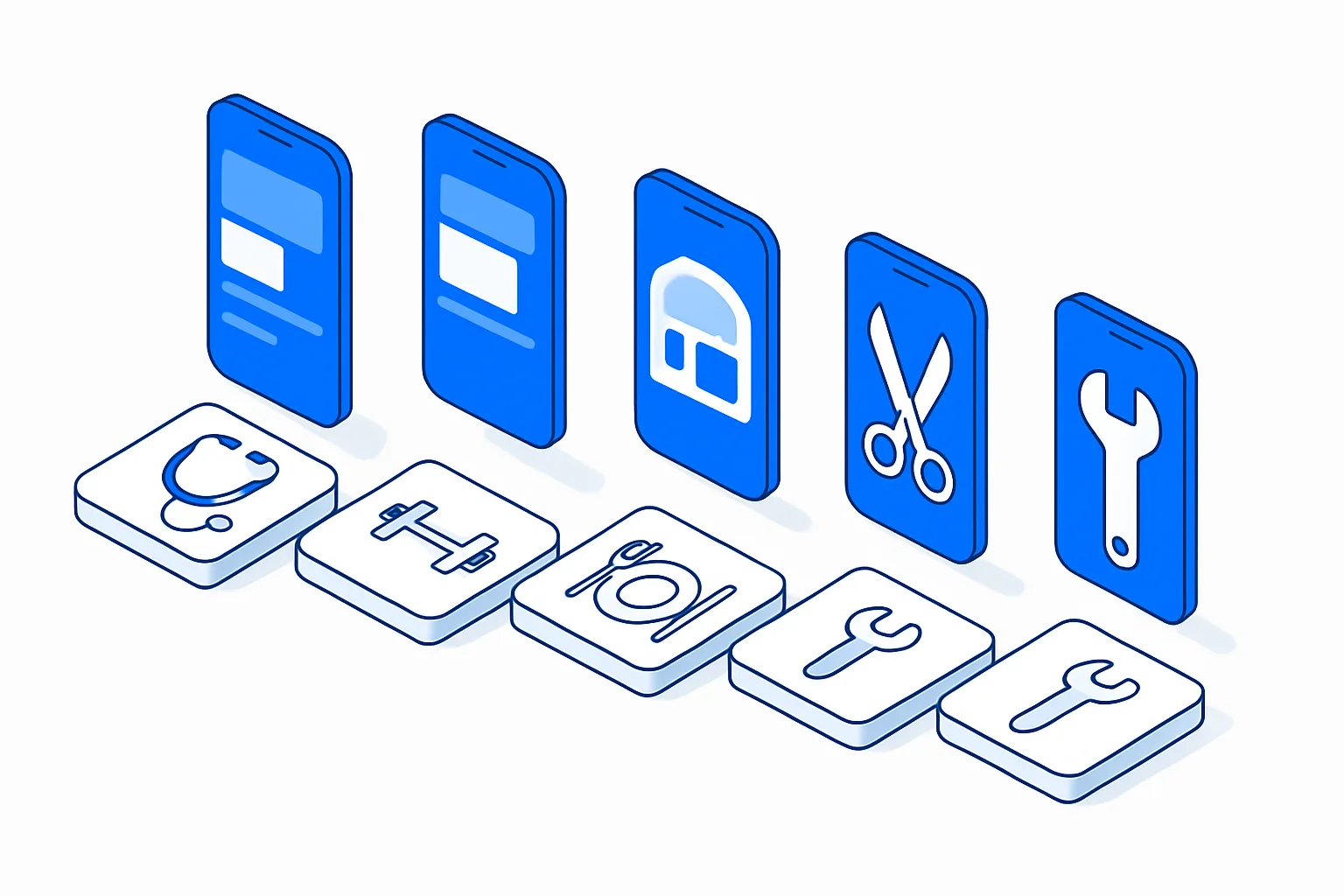
None of these five apps requires invention. They require the boring parts (accounts, bookings, payments, notifications, an admin panel) assembled with the business's specific rules. Templates cover the first part; the rules are where the value is.
The cost of not having one
The U.S. Small Business Administration has documented for years that the leading operational problems for small firms are cash flow and time. Both are directly affected by the tooling gap.
Put numbers on it for the clinic above: 3 practitioners, 25 appointments a day each at $90, 16 percent no-show rate. That is 12 lost appointments a day, or roughly $1,080 of unbilled capacity. If deposits and reminders cut no-shows to 6 percent, which is typical, the clinic recovers about $675 a day. Over a 22-day month that is $14,850. Even if the true figure is a third of that, it dwarfs any plausible software cost.
For the contractor, the maths is cash flow. $60,000 of monthly invoicing collected in 3 days instead of 30 frees roughly $54,000 of working capital. That is the difference between financing a fifth van and not.
McKinsey research on small and medium business digitisation has repeatedly found that SMBs adopting integrated digital tools grow revenue faster than peers, with the gap concentrated in customer retention and operational efficiency rather than in marketing. Statista tracks mobile commerce and app usage shares that show where customers now expect to transact: increasingly on their phone, inside an account they already have.
Agency build vs AI-built app: cost and time
This is where 2026 differs from 2019. Here are realistic figures for a small business app with bookings, payments, accounts, notifications and a staff view.
| Traditional agency | Freelance developer | AI agent platform | |
|---|---|---|---|
| Discovery and design | 3 to 6 weeks, $5,000 to $15,000 | 1 to 3 weeks, $2,000 to $5,000 | Days; you write the brief |
| Build | 3 to 6 months, $40,000 to $120,000 | 2 to 4 months, $15,000 to $40,000 | 1 to 3 weeks, $29 to $149 per month in platform fees |
| Hosting (monthly) | $100 to $500, often marked up | $50 to $150 | $40 to $100 on standard AWS |
| Changes after launch | Change requests at agency rates | $80 to $150 per hour | Described as tasks; credits per task |
| Code and data ownership | Sometimes; read the contract | Usually yes | Yes, on platforms that deploy to standard cloud |
| Biggest risk | Budget, timeline, over-engineering | Availability, handover | Imprecise brief; needs owner review |
Orkosi is one example of the third column: you describe the business and its rules, agents build the app and deploy it on AWS, and you request changes as tasks. The Launch plan is $29 a month for 290 credits (one credit is $0.10), and there are templates for a SaaS product, an online shop and an informational site to start from; the full breakdown is on the pricing page. The honest trade-off is that the owner has to be specific about rules and has to test the result the way a customer would. An agency does that thinking for you and charges accordingly.
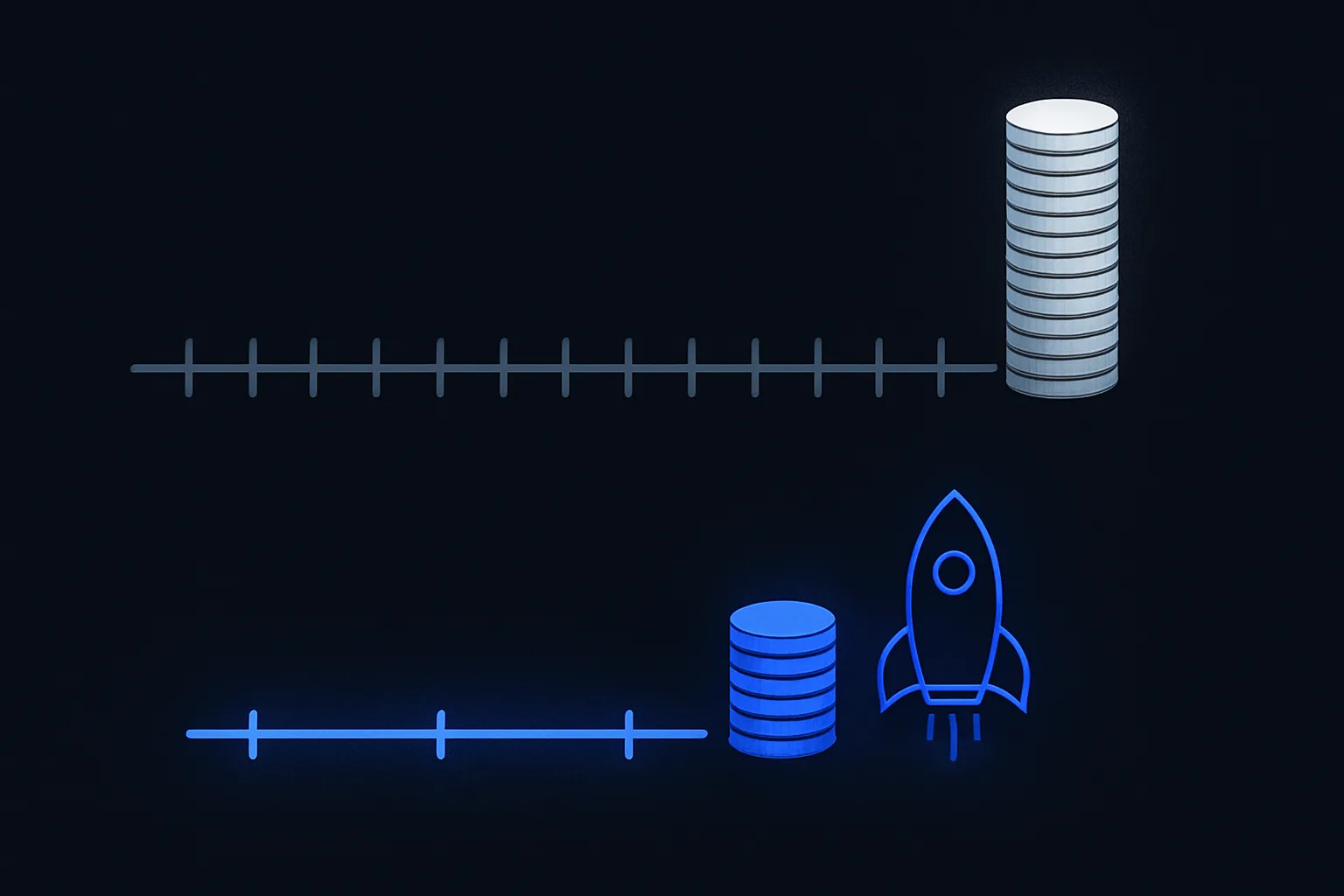
The numbers are not close. A $60,000 agency build for a salon is a decision that takes a year to pay back. A $1,500 first year on an AI platform plus hosting pays back in the first month if it prevents a handful of no-shows. The practical question is no longer "can we afford an app" but "which of our operational problems do we fix first."
What to put in version one
Resist the urge to replicate every tool you use today. Version one should do the one thing that costs you the most money or time, done well.
- Clinic, salon, gym: bookings with deposits and reminders, customer accounts, a staff schedule. Loyalty and retail later.
- Restaurant: reservations with card hold and allergy notes. Pre-orders in month two.
- Contractor: job request, scheduling, photo capture, invoice with pay link. Quoting later.
Keep the public website. The app sits behind a "Book" or "Log in" button on it. Search engines still need the content pages, and the feature checklist of any platform you consider should include a decent public site alongside the app itself.
Plan the rollout: staff first for a week, then existing customers by email, then the public. Existing customers are forgiving and will find the gaps for you.
Trade-offs, and when a website really is enough
Custom software is not free of downsides.
It needs an owner. Someone at the business has to care about it: review the booking rules, watch the no-show report, request changes when a process shifts. If nobody will, an off-the-shelf tool with a support line is the better choice.
Off-the-shelf can be right. A single-person bookkeeping practice with ten clients does not need a custom app. A general booking tool at $30 a month is fine. The case for custom grows with staff count, transaction volume and the number of rules specific to your business.
AI-built means owner-reviewed. Agents produce working software quickly, and they also produce confident mistakes when the brief is vague. Budget an evening a week for the first month to test and send corrections. On Orkosi and similar platforms that is the normal workflow, not a failure; it is still your time.
Vendor risk exists everywhere. Agencies close. Platforms change pricing. Mitigate by owning your domain, your Stripe account, your customer data export and, where possible, the code.
How to get started this month
- Write one page: who your customers are, the three rules that make your business different (deposit policy, staff availability, package types), and the one problem you want fixed first.
- Pick the path from the comparison table that matches your budget and appetite for involvement.
- Start from a template rather than a blank page. Bookings, payments and accounts are the same across most service businesses.
- Launch to staff, then existing customers, then everyone.
- Review the numbers that matter (no-shows, repeat rate, days to payment) after 30 days and pick the next problem.
FAQ
Does a small business need both a website and an app?
Usually yes, but not as separate projects. The website handles discovery and content; the app handles bookings, payments and accounts. Most platforms, including Orkosi through its informational and SaaS templates, produce both from one brief so they share branding and a domain.
How much does a custom app for a small business cost in 2026?
An agency build typically runs $40,000 to $120,000 plus hosting and change fees. A freelance developer is $15,000 to $40,000. An AI agent platform is $29 to $149 a month in platform fees plus $40 to $100 a month of AWS hosting, with the trade-off that you write the brief and review the result yourself.
Can I keep my existing booking or payment tools?
Often, at least initially. Stripe in particular is the standard payment layer that a custom app will use directly, so existing Stripe customers and saved cards carry over. Third-party booking widgets are usually replaced, since the whole point is to apply your own rules and own the customer record.
What if my business changes its processes?
That is the argument for custom software over off-the-shelf. When you add a service, change a deposit rule or hire a fifth stylist, you describe the change and it ships, rather than waiting for a vendor to add a setting. On agent platforms this is a task; with an agency it is a change request; either way the app follows the business rather than the reverse.
If one of the five examples above sounded like your Tuesday, start with a free Trial account and describe your business, then compare the plans on the pricing page once you know how often you will want changes.